3 Futuristic Eldercare Inventions That Feel Like Science Fiction
1. Vayyar Home: The Wall Sensor That Can See Without Cameras
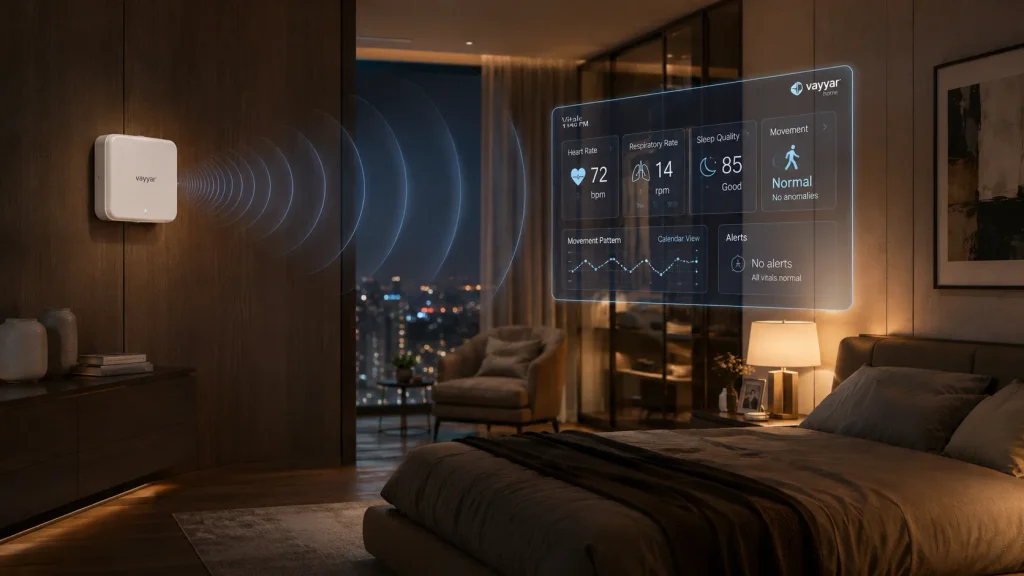
A minimalist white Vayyar Home radar sensor mounted on a modern bedroom wall, emitting subtle glowing 3D radar waves with a transparent health-monitoring interface displaying movement and vital-sign data.
[CTA BUTTON: Explore Vayyar Radar / View Amazon Alternatives]
Imagine a senior living alone at home, sleeping peacefully in the bedroom. There is no camera pointed toward the bed, no bracelet strapped around the wrist, and no emergency button hanging around the neck. Yet, somewhere on the wall, a small radar sensor is quietly analyzing what is happening in the room. That is the idea behind Vayyar’s senior-care radar technology: turn invisible radio-frequency sensing into a layer of protection that can operate without constantly filming the person being protected. Vayyar describes its technology as capable of detecting people and tracking movement while also monitoring respiration, heart rate, sleep, and gait patterns. Its care systems are designed to provide touchless fall detection and activity information while preserving privacy because they use RF sensing rather than optical cameras. For families, that difference is enormous. A camera can make an older adult feel as though someone is always watching, while a discreet radar sensor can work quietly in the background. It is a powerful example of how futuristic eldercare inventions are moving away from intrusive surveillance and toward invisible assistance that protects dignity as much as physical safety.
How Vayyar’s Radar Turns a Room Into a Safety Zone
At the heart of this concept is 4D imaging radar, a technology capable of interpreting radio-frequency reflections to understand what is happening inside a space. Instead of producing the familiar photographic image associated with a security camera, radar systems analyze signals bouncing around the environment and use sophisticated processing to identify people, positions, movement, and other patterns. Vayyar says its imaging technology can monitor respiration, heart rate, sleep, and gait patterns, while its senior-care applications can detect whether a person is moving, standing, sitting, or lying on the floor. That creates an entirely different model of home monitoring. The system does not need an elderly person to remember to charge a wearable or press a button after an accident. Instead, the environment itself becomes intelligent. Think of it as giving the room a nervous system: the walls remain ordinary, the furniture remains ordinary, but an invisible digital layer is constantly interpreting what is happening around them. For an older adult who wants to remain independent, that can be emotionally significant. Independence does not necessarily mean having no help; sometimes it means having help that is subtle enough that you barely notice it is there.
What the Radar Can Monitor
The potential becomes even more interesting when you look beyond simple fall detection. Vayyar’s technology can collect information about movement, breathing, activity patterns, gait, bathroom usage, and other behavioral signals, depending on the specific deployment and software integration. Changes in those patterns may give caregivers useful clues that something has changed before an obvious emergency occurs. For example, Vayyar has discussed how unusual bathroom activity can be relevant to identifying possible UTI-related concerns, because infections and changes in bathroom habits can contribute to instability and fall risk. This should not be confused with a sensor independently diagnosing a disease; the important idea is that behavioral changes can become visible earlier. A caregiver might notice that someone is getting up repeatedly during the night, walking differently, spending more time in bed, or changing their normal routine. Those signals can then prompt a human to investigate. That is where AI and sensing become genuinely useful: not as replacements for doctors or caregivers, but as an additional set of eyes that never gets tired. In a traditional home, subtle changes can disappear into everyday life. In an intelligent home, those changes can become data that helps people ask better questions sooner.
Predictive Care Instead of Simply Reacting to Falls
The most exciting idea here is the shift from reactive eldercare to proactive eldercare. Traditional safety technology often waits for something dramatic to happen: a person presses an emergency button, a smartwatch detects a fall, or a family member discovers that something has gone wrong. Radar-based monitoring creates the possibility of identifying unusual patterns before they become emergencies. Vayyar has described applications in which activity trends, bathroom frequency, mobility, and other behavioral indicators can help caregivers identify potential risks and intervene earlier. Some descriptions of Vayyar Home have also emphasized monitoring health deterioration and unusual activity. It is important, however, to separate the technology’s genuine capabilities from exaggerated marketing claims. A radar sensor should not be treated as a crystal ball that can guarantee a specific medical prediction three days before symptoms appear. Instead, the compelling future is continuous observation of patterns that humans might otherwise miss. Imagine a daughter living hundreds of miles away receiving an alert that her father’s nighttime movement has changed significantly, followed by a simple phone call: “Dad, how are you feeling?” That tiny conversation could be the difference between noticing a problem early and discovering it after an emergency.
Why Camera-Free Privacy Changes Aging at Home
Privacy may be the most human reason to care about this technology. Aging at home should not mean surrendering the feeling of having a private home. Bathrooms, bedrooms, and living rooms are deeply personal spaces, and placing cameras throughout them can create understandable discomfort even when the intention is protection. Vayyar specifically promotes RF-based sensing without optics for its care systems, describing the approach as privacy-preserving and touchless. That matters because the best eldercare technology should not force a person to choose between independence and safety. Ideally, technology should disappear into the background and intervene only when necessary. A camera may record what someone looks like; radar can instead focus on spatial and movement information. The result is a different relationship between a person and their smart home. Rather than feeling monitored like a patient in a hospital, an older adult can feel as though the home itself has quietly become more responsive. That emotional distinction is huge. When technology protects dignity instead of compromising it, people may be more willing to accept assistance and continue living in the environment they love.
2. ElliQ: The AI Companion That Makes a Home Feel Less Empty
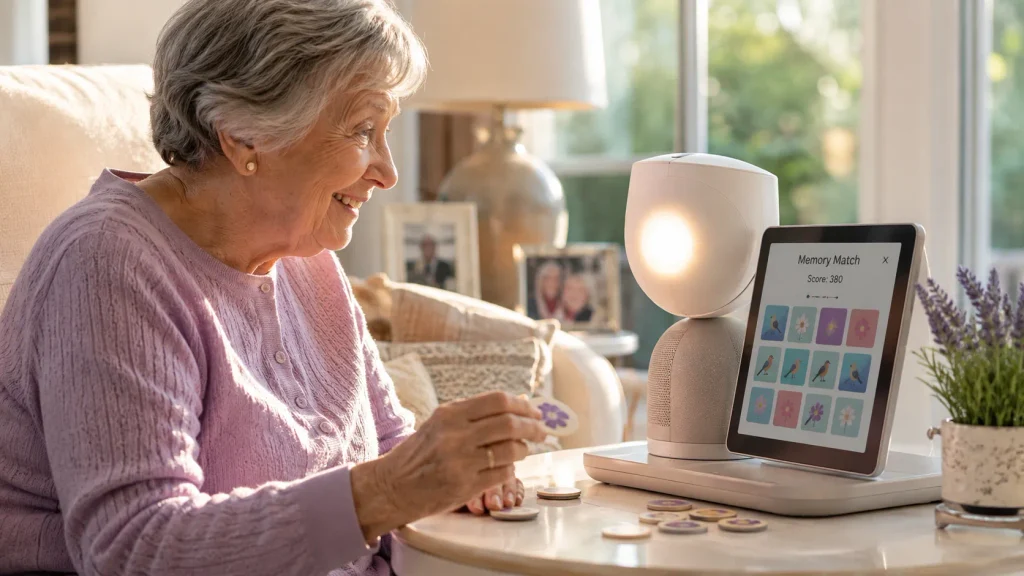
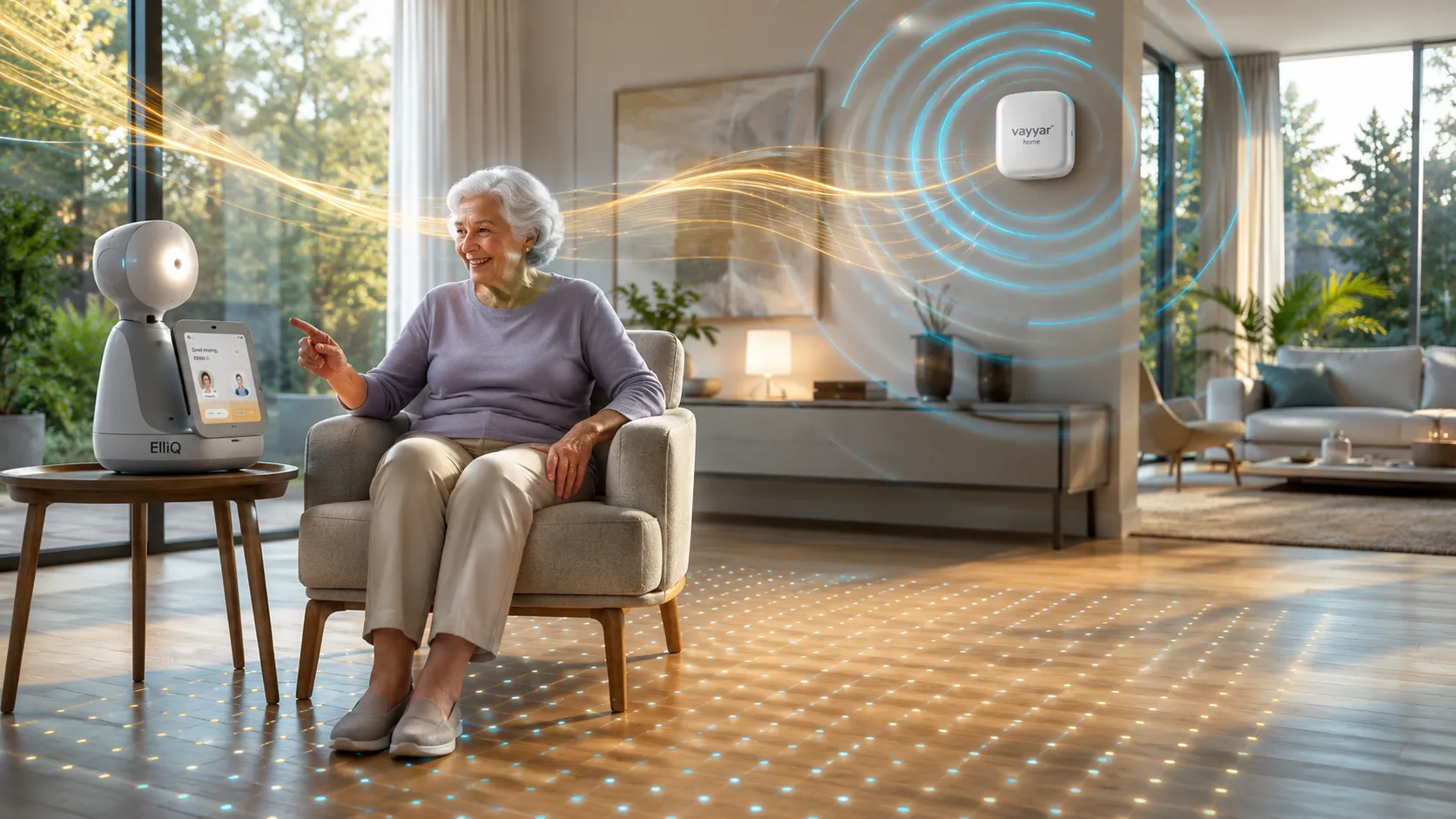
A happy elderly person interacting with a sleek ElliQ companion robot on a modern living-room side table, with the robot’s expressive head illuminated and its attached interactive screen displaying a friendly wellness interface.
[CTA BUTTON: Discover ElliQ Robotic Companion]
Now imagine a completely different problem. There is no emergency. Nobody has fallen. The house is perfectly safe, but the person living inside it has spent most of the day without speaking to anyone. This is where ElliQ by Intuition Robotics takes a surprisingly emotional approach to eldercare. ElliQ is designed not simply as a voice assistant that waits for commands but as an AI companion that proactively starts conversations, suggests activities, provides reminders, supports wellness routines, and helps older adults stay connected with family and friends. The company describes ElliQ as a companion designed specifically to support independent aging, with features spanning companionship, communication, health and wellness, entertainment, and daily assistance. That distinction is important. Alexa-style assistants generally wait until you ask something. ElliQ is designed around the idea that sometimes the person needs the technology to reach out first. It can ask how the day is going, suggest a game, encourage movement, remind someone about medication, or facilitate a video call. It does not replace a son, daughter, friend, or caregiver, but it can help bridge the quiet moments between human interactions.
A Robot Designed Around Conversation, Not Commands
ElliQ’s physical design is part of what makes the concept so different. Rather than looking like a conventional smart speaker, the system combines an interactive display with a distinctive expressive robotic head capable of movement and light-based feedback. That gives the interaction a sense of presence that a stationary speaker simply cannot create. The official ElliQ platform emphasizes proactive conversations, games, music, trivia, personalized content, reminders, wellness activities, and communication with loved ones. The robot can also support video calls, photo sharing, messages, and other ways of maintaining social contact. Why does that matter? Because humans naturally respond to social cues. A moving head, a light, a voice, and a screen can make an interaction feel more like an encounter than a command-and-response transaction. For someone spending many hours alone, that small psychological difference may matter enormously. The machine is still a machine, but the interaction is intentionally designed to feel warm, familiar, and engaging rather than cold and technical. In that sense, ElliQ represents another direction for futuristic eldercare inventions: technology that protects not only the body but also the emotional experience of growing older.
The Features That Keep the Mind Engaged
One of the most fascinating parts of ElliQ is the sheer variety of activities it can bring into a person’s routine. Instead of treating cognitive engagement as a clinical exercise, the system can turn it into everyday entertainment through trivia, games, stories, conversations, creative activities, music, and other interactions. ElliQ also supports wellness routines, medication reminders, exercise suggestions, hydration reminders, and personal goals. That does not mean the robot can prevent or cure dementia, and it would be misleading to promise that conversational AI can replace professional cognitive care. The more realistic benefit is regular stimulation and routine reinforcement. Memory, attention, curiosity, and social interaction are encouraged through repeated everyday engagement. Imagine waking up and having the system ask about your plans, later suggesting a trivia challenge, then reminding you about an appointment, and finally helping you call your daughter. None of those actions individually looks revolutionary. Together, however, they create a digital rhythm around the person’s day. That rhythm can be particularly valuable when routines become difficult to maintain. Instead of technology becoming another complicated device to operate, the technology becomes a familiar presence that gently encourages the person to keep participating in life.
From Reminders to Family Connections
For families, ElliQ becomes particularly interesting because the experience extends beyond the robot itself. The company’s caregiver platform allows family members and caregivers to communicate, send photos, make video calls, establish reminders, set wellness goals, and receive certain updates from their loved one’s ElliQ experience. This creates a kind of digital bridge between generations. A daughter who cannot visit every day can still send a photograph. A son working in another city can initiate a video call. A caregiver can help structure reminders without physically being inside the home. The emotional value is easy to understand: technology can shrink the distance between people without pretending that distance does not exist. ElliQ’s own user stories describe members experiencing companionship, connection, entertainment, and support in their daily routines. At the same time, responsible use requires understanding its boundaries. ElliQ states that it is not a medical device, and its emergency role is to encourage users to contact caregivers or trusted contacts rather than replace emergency services or clinical professionals. That distinction makes the concept more credible. The goal is not to create an artificial nurse. It is to create an always-available layer of companionship and routine support.
Can an AI Companion Really Fight Loneliness?
This is where the technology becomes surprisingly emotional. Loneliness is not solved simply because a device can answer questions. What matters is whether the interaction gives someone a reason to speak, laugh, remember, participate, or reach out to another human being. ElliQ is explicitly designed to be proactive, with the company describing it as a companion that helps older adults stay engaged, connected, and independent. The platform also reports user-reported improvements in health and wellness, connection, and quality of life, although those figures should be understood as company-reported outcomes rather than universal guarantees. The deeper idea is beautiful: technology does not always need to imitate a human perfectly to provide human value. A robot cannot replace the feeling of a real family member walking through the door. But it can make a quiet morning less quiet. It can remind someone to call their granddaughter. It can turn an ordinary afternoon into a trivia game. It can encourage someone to move, reflect, or share a story. In a future where more people want to age independently, that kind of companionship could become as important as physical safety.
3. SensFloor: The Floor That Knows When Someone Falls
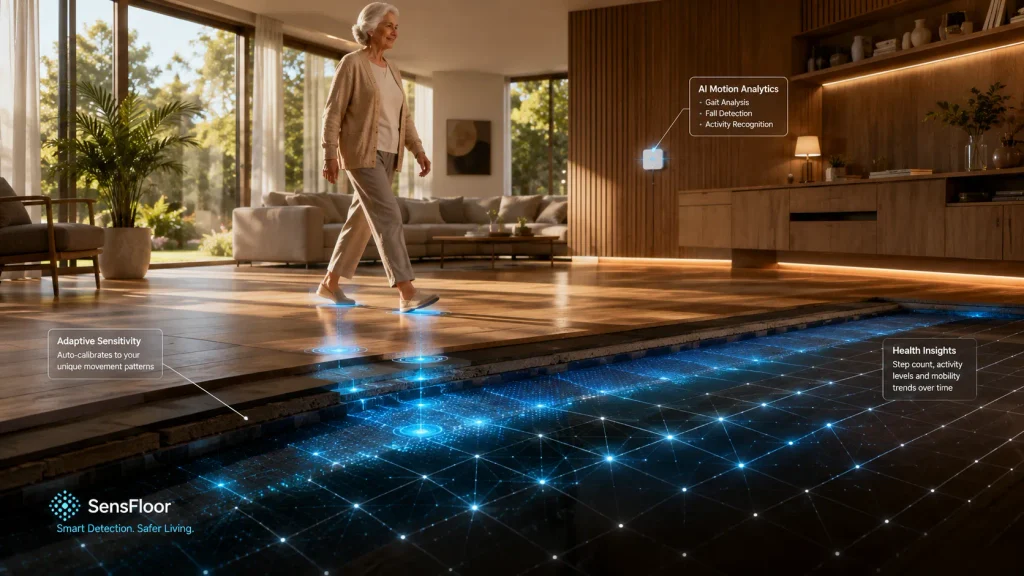
A luxurious modern wooden floor shown in an architectural cutaway, revealing an invisible glowing geometric sensor grid beneath the surface while an elderly person walks naturally above it.
[CTA BUTTON: See How SensFloor Smart Sensor Flooring Works]
What if the most important safety device in an elderly person’s home were not worn on the body or mounted on the wall? What if it were simply the floor itself? That is the futuristic idea behind smart sensor flooring such as SensFloor: hidden sensing technology can transform ordinary surfaces into intelligent environments capable of detecting movement and responding to activity. Instead of asking an older adult to remember a wearable, press a button, or carry a phone, the environment can potentially recognize what is happening beneath their feet. This concept fits perfectly into the broader movement toward invisible eldercare. The technology disappears beneath familiar materials, allowing a person to live normally while the home quietly monitors movement patterns. For someone who dislikes gadgets, that could be transformative. There is no device to charge before bed and no pendant to remember when leaving the room. The floor remains a floor to the person walking across it, but behind the scenes it becomes a sophisticated sensing surface. That is the magic of futuristic eldercare inventions: the best technology may eventually become the technology you barely notice.
How Invisible Smart Flooring Detects Movement
Smart flooring systems use sensor elements installed beneath or integrated into floor coverings to detect changes caused by movement and pressure. The important concept is not that the floor literally “sees” a person like a camera; rather, a network of sensors captures patterns associated with movement across the surface. Depending on the system architecture and installation, those signals can then be analyzed by software to determine where activity is occurring and whether an event looks ordinary or potentially dangerous. This creates a fascinating possibility for eldercare because the same surface that supports everyday walking can also become part of the home’s safety infrastructure. A person can walk from the bedroom to the bathroom, sit down, stand up, or move around the living room without interacting with a dedicated device. The system can potentially interpret those patterns in the background. That is especially useful for people who are reluctant to wear medical-alert devices. Instead of changing the person’s behavior, the environment adapts to the person. It is a little like turning a passive road into a smart highway: the road still looks normal, but sensors underneath can detect traffic and identify unusual events. In aging-in-place design, that philosophy could help make safety technology more natural, less intrusive, and easier to live with.
Turning Ordinary Flooring Into a Safety Sensor
The real potential becomes clear when you imagine a home where different rooms become intelligent zones. A bedroom could recognize movement after bedtime. A hallway could detect unusual activity. A bathroom could become a particularly important safety area because falls frequently occur where wet surfaces and nighttime movement create additional hazards. A smart floor could theoretically contribute to a broader system in which location, timing, movement speed, and other signals are combined to understand what is happening. The most powerful version of this technology would not simply react to a single pressure event. Instead, algorithms could learn the difference between normal household activity and potentially dangerous events. Someone dropping a book is fundamentally different from a person collapsing onto the floor. A pet moving across the room is different from a human being suddenly lying motionless. A person walking normally is different from someone whose movement pattern has changed dramatically. The challenge is therefore not just sensing pressure; it is interpreting context. That is where machine learning and sensor fusion become important. When environmental intelligence becomes sophisticated enough, the home can stop being a collection of disconnected gadgets and start behaving more like one coordinated safety system.
Why Wearable-Free Fall Detection Matters
Wearables are useful, but they are not perfect. An older adult may forget to wear a smartwatch, remove it while sleeping, forget to charge it, or simply decide that they do not want to wear something that constantly reminds them of their age. That is why wearable-free fall detection is such an attractive idea. Wall-mounted radar systems already demonstrate the value of touchless monitoring; Vayyar, for example, describes its care technology as passive and not dependent on pendants or bracelets. Smart flooring takes that philosophy one step further by putting the sensing infrastructure under the person rather than on the person. The benefit is psychological as much as technical. The home does not say, “You are a patient, so you need this device.” Instead, it quietly says, “This is your home, and your home is looking out for you.” That can make a major difference in acceptance. Independence is partly about physical capability, but it is also about identity. People want to continue feeling like themselves, not like someone being constantly managed. Invisible technology can support safety without turning every room into a reminder of vulnerability.
The Future of Intelligent Homes May Be Under Your Feet
SensFloor-style technology points toward a fascinating future in which the architecture itself becomes part of healthcare. Today, we usually think of smart homes as collections of devices: smart lights, smart thermostats, cameras, speakers, watches, and sensors. Tomorrow’s smart home could be fundamentally different. Sensors could be embedded in walls, ceilings, furniture, floors, and appliances, creating a continuous layer of environmental awareness. That could allow different systems to cooperate: a radar sensor might identify a fall, smart flooring might help locate the event, a companion robot might ask whether the person needs assistance, and a caregiver platform might notify a family member. None of these technologies has to work alone. Together, they could form a digital safety net around an older adult while preserving as much normality and privacy as possible. The important caveat is that smart flooring should not be presented as a guaranteed replacement for emergency services or human supervision. Sensor accuracy, installation, software integration, false alarms, and the specific capabilities of a given product all matter. But the direction is unmistakable: the physical home is becoming computational. The floor beneath your feet may one day be as intelligent as the smartphone in your hand.
How These 3 Inventions Could Transform Aging in Place
The most exciting thing about these three technologies is not any individual gadget. It is what happens when their ideas are combined. Vayyar Home represents invisible sensing. ElliQ represents proactive companionship. Smart flooring represents intelligent infrastructure. Together, they suggest a future where an older person’s home can quietly understand movement, encourage healthy routines, recognize unusual situations, and connect the person with family when human help is needed. Vayyar’s current senior-care technology already demonstrates how camera-free radar can provide fall detection and behavioral information while respecting privacy. ElliQ demonstrates another side of the equation by using proactive AI to support companionship, wellness, reminders, and communication. Smart flooring adds the possibility of embedding sensing directly into the architecture. The result could be an aging-in-place ecosystem rather than a collection of unrelated products. That matters because aging is not one problem. It involves safety, mobility, loneliness, memory, medication routines, communication, and the desire to remain independent. The home of the future may respond to all of these simultaneously.
From Emergency Response to Predictive Eldercare
The biggest shift may be the movement from waiting for emergencies to identifying risk earlier. A traditional emergency button is valuable because it lets someone ask for help after something happens. A smart environment can potentially provide another layer by recognizing unusual behavior before or during an event. Vayyar’s research and care materials, for example, describe how bathroom activity, gait, time in bed, and other behavioral patterns can provide information relevant to fall risk and changing health conditions. ElliQ can reinforce routines and encourage communication, while a smart floor could provide another source of movement information. None of this eliminates human judgment. In fact, the opposite may be true: the more useful the technology becomes, the more it should direct important information toward the people capable of making decisions. The future is not an elderly person being surrounded by robots while human caregivers disappear. The more realistic and humane vision is a human-centered care network enhanced by intelligent technology. Family members get better information. Caregivers can respond faster. Older adults get more freedom. And the home becomes a quiet partner rather than a surveillance system.
Conclusion: The Future of Eldercare Is Becoming Invisible
The most powerful eldercare technology may not look futuristic at all. It may look like a small white sensor on a wall, a friendly robot sitting beside an armchair, or an ordinary wooden floor that secretly contains an intelligent sensor network. That is what makes these inventions so compelling. They are not trying to turn aging into a science-fiction movie; they are trying to solve very human problems: fear of falling, isolation, loss of independence, missed warning signs, and the constant worry felt by families who cannot be physically present every day. Vayyar’s camera-free radar approach shows how homes can monitor movement and other signals without relying on conventional optical surveillance. ElliQ shows how AI can become proactive and emotionally engaging, helping older adults maintain routines and connections. Smart flooring points toward a future where the architecture itself participates in safety. The real breakthrough is not replacing people with machines. It is creating homes where technology quietly handles some of the invisible work of care, allowing families to spend less time worrying and more time actually being family.
FAQs About Futuristic Eldercare Inventions
Are these technologies a replacement for human caregivers?
No. These technologies are better understood as support systems, not replacements for human care. Radar sensing can identify falls or changes in activity, AI companions can encourage routines and communication, and smart flooring can potentially provide another source of movement information. But none of those capabilities eliminates the need for human judgment, emotional connection, medical professionals, or emergency services. ElliQ itself explicitly states that it is not a medical device, while Vayyar’s technology is designed to provide information and alerts that can support caregivers. The strongest future model is therefore human-centered: technology handles repetitive monitoring and delivers useful signals, while people make the important decisions. That approach can reduce caregiver stress without pretending that a machine can replace a loving family member.
Are camera-free eldercare systems more private?
They can be significantly less visually intrusive because they do not depend on conventional video surveillance. Vayyar describes its care technology as RF-based and specifically highlights the absence of optics as a privacy advantage. However, “camera-free” does not automatically mean that every privacy concern disappears. Any connected technology can involve data collection, cloud services, software integrations, and security considerations. Families should therefore examine exactly what a product detects, what information is stored, where it is processed, who can access it, and how alerts are shared. ElliQ, for example, provides privacy information explaining how its system uses microphones and sensors and how caregiver sharing is controlled. Privacy should be treated as a core feature, not an afterthought.
Can AI companions prevent dementia?
There is no responsible basis for promising that an AI companion can prevent or cure dementia. What these systems can potentially provide is regular conversation, cognitive stimulation, games, reminders, social interaction, and routine reinforcement. ElliQ’s current platform includes activities such as trivia, games, creative interactions, conversations, and wellness support. Those experiences may help make daily life more engaging, but they should not be presented as a substitute for professional assessment or treatment. The real value is broader: an AI companion can encourage a person to stay socially and mentally active while helping maintain daily structure. For families, that can be meaningful even when no medical claim is involved.
What happens if an elderly person refuses to wear a smartwatch?
That is exactly where environmental sensing becomes particularly interesting. Wall-mounted radar and smart flooring can potentially monitor activity without requiring the person to remember a wearable device. Vayyar explicitly describes its care technology as touchless and designed to work without pendants or bracelets. This approach can be especially helpful for people who find wearable devices uncomfortable, confusing, or stigmatizing. However, every system has technical limitations, and families should verify the detection range, installation requirements, alert mechanism, reliability, and compatibility before depending on it for safety. Invisible technology can reduce the burden on the user, but it still needs careful implementation.
What will the smart eldercare home look like in the future?
The future smart eldercare home may look surprisingly ordinary. Instead of being filled with obvious medical equipment, it could contain invisible layers of intelligence embedded throughout the environment. Radar could monitor movement and detect falls, flooring could sense activity, an AI companion could communicate with the resident, and connected systems could help family members understand when something unusual happens. The goal would not be to make the home feel like a hospital. It would be to make the home feel normal while quietly adding another layer of protection. That is perhaps the most exciting promise of futuristic eldercare: technology that gives older adults more freedom without asking them to give up their dignity.
- For more information click here