3 Futuristic Home Energy Innovations That Feel Like Pure Sci-Fi
What If Your House Didn’t Need to Look Like a Power Station?
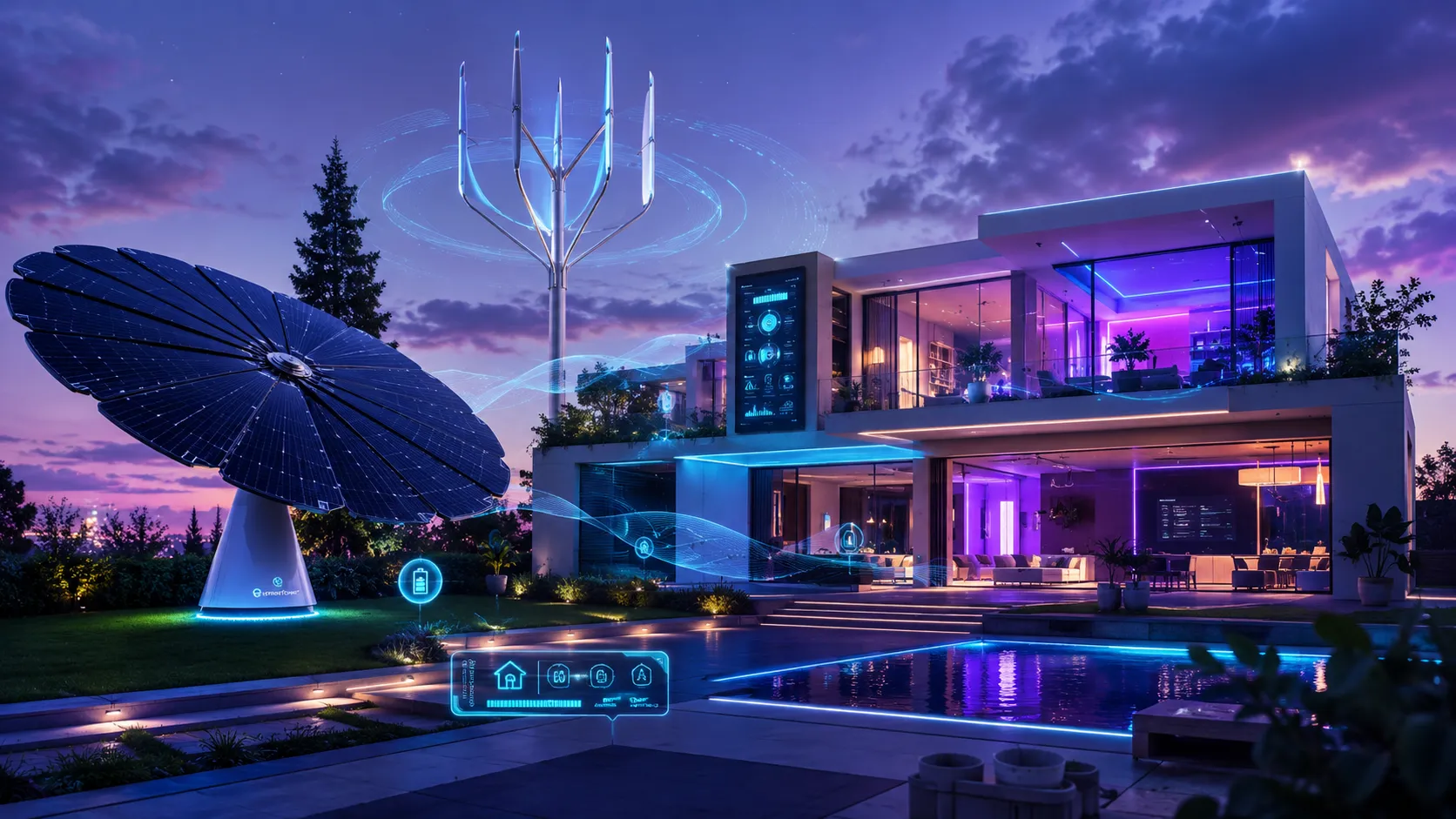
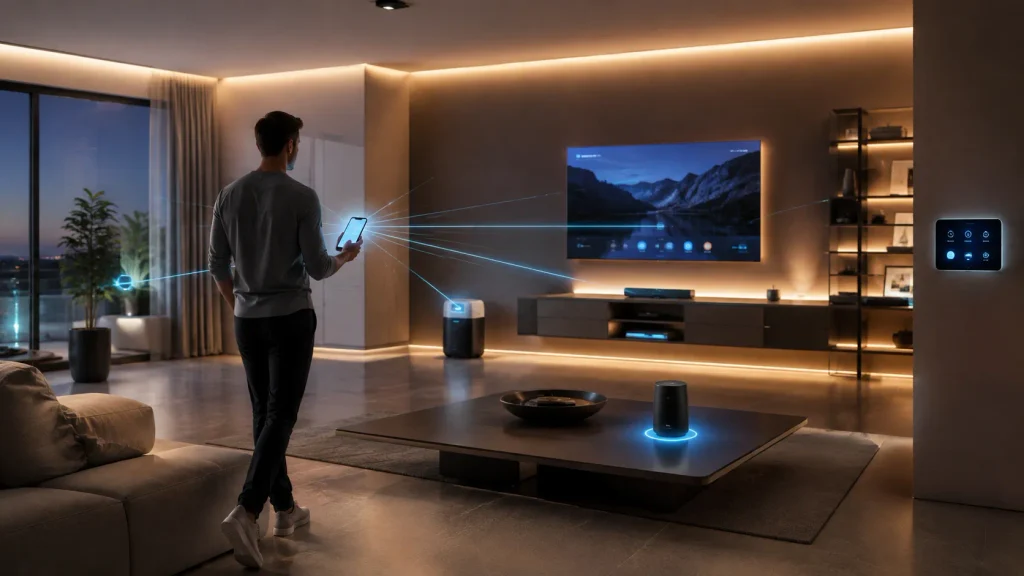
What if you could walk into your living room with your phone in your pocket and it simply started charging? What if the solar system in your garden opened itself every morning, followed the sun throughout the day, and folded itself away when darkness arrived? And what if the wind turbine in your backyard looked less like an industrial machine and more like a futuristic tree?
It sounds like something a science-fiction filmmaker invented to make the year 2050 look impressive. Yet several companies are already developing technologies that move energy generation and delivery in exactly these directions. Ossia Cota is designed to transmit power wirelessly through radio-frequency technology, while Smartflower uses a dual-axis tracking system to follow the sun, and New World Wind’s Aeroleaf transforms small wind turbines into leaf-shaped generators.
These innovations do not mean every house can disconnect from the electrical grid tomorrow. That would be an exaggeration. Instead, they offer something much more interesting: a preview of what the next generation of smart home energy systems could look like when electricity becomes more adaptive, more automated, and far less visually intrusive.
And once you see these three technologies, traditional cables, fixed solar panels, and giant wind turbines suddenly seem remarkably old-fashioned.
Why Home Energy Is About to Get Much Smarter
For decades, home energy has followed essentially the same script. Electricity travels through wires, appliances plug into outlets, solar panels sit in fixed positions, and wind turbines use large blades to capture moving air.
That system works. But it is not exactly imaginative.
The smart-home revolution is changing that mindset. Today’s connected homes already use sensors, software, automation, batteries, smart meters, energy monitors, heat pumps, EV chargers, and intelligent appliances. The next step is not simply adding more devices. It is creating energy systems that can react to their surroundings.
That is why these futuristic home energy innovations are so fascinating.
One technology attempts to make electricity behave more like Wi-Fi. Another turns solar hardware into a moving machine. The third borrows its appearance and engineering inspiration from nature.
Together, they suggest a future where your home does not merely consume energy.
It senses, generates, manages, and distributes it intelligently.
So let’s start with the invention that sounds the least believable of all.
Innovation #1: Ossia Cota — Electricity Through the Air
PRODUCT DEVELOPMENT COMPANY: https://www.ossia.com/
Imagine removing one of the most annoying objects in modern life: the charging cable.
Now remove the charging pad too.
Then imagine walking around your house while a compatible device continues receiving power without being physically connected to anything.
That is the idea behind Ossia Cota, a wireless power technology that the company describes as working similarly to Wi-Fi, except that the system is designed to transmit power rather than data. Instead of requiring a device to sit directly on a charging surface, Cota uses radio-frequency signals to send power through the environment toward compatible receivers.
The concept is genuinely strange at first because we tend to think of electricity as something that must travel through a cable.
Cota challenges that assumption.
How Does Ossia Cota Actually Work?
The system uses two important components: a Cota Power Transmitter and a compatible Cota Power Receiver.
According to Ossia, the receiver sends a beacon signal to identify itself to the transmitter. The transmitter then sends power back along the same pathways used by that signal. The communication happens extremely rapidly—Ossia says the exchange occurs 100 times per second—so the system can continually adjust as compatible devices move.
That last part is what makes the concept feel so different from ordinary wireless charging.
A conventional wireless charging pad has a very obvious limitation: the device has to be positioned on the pad. Move the phone away and charging stops.
Cota is designed around a much more flexible idea.
The company demonstrates devices moving around a room while the transmitter dynamically directs power. Ossia also describes the system as capable of delivering power without traditional line-of-sight positioning, using reflected paths around objects in the environment.
Think about it this way.
Your Wi-Fi router does not care whether your phone is sitting on the sofa, on a desk, or in your pocket. As long as the device remains within the wireless network, connectivity can continue.
Cota aims to create a similar kind of energy environment.
Could Your Phone Really Charge in Your Pocket?
This is where headlines can become misleading, so it is important to separate the technology from the marketing fantasy.
Cota can deliver wireless power to compatible devices, but an ordinary smartphone cannot simply walk into a Cota-enabled room and magically become compatible. The device needs appropriate receiving hardware integrated into it. Ossia specifically promotes its technology as something manufacturers can license and build into products.
That means the more exciting long-term possibility might not be your phone.
It could be the millions of tiny devices that make up a smart building.
Think about temperature sensors.
Door sensors.
Leak detectors.
Air-quality monitors.
Security devices.
Asset trackers.
Industrial sensors.
Medical or wearable electronics.
Many small connected devices depend on batteries, which creates a hidden maintenance problem. Somebody eventually has to replace those batteries. The larger the number of devices, the larger the problem becomes.
Wireless power could potentially reduce that burden by allowing compatible low-power electronics to receive energy without frequent physical intervention.
And suddenly, a house filled with sensors becomes much easier to imagine.
Why Wireless Power Could Change Smart Homes
The truly exciting question isn’t whether Cota can replace every charging cable.
It is whether electricity itself can become part of the invisible infrastructure of a building.
Imagine buying smart sensors without asking yourself where their batteries will go. Imagine furniture, shelves, appliances, or ceiling fixtures incorporating wireless power zones. Imagine devices operating continuously without needing someone to crawl behind furniture every few months to replace batteries.
Ossia has positioned Cota for exactly this broader IoT opportunity, describing applications where huge numbers of connected devices could receive continuous power without conventional wires or disposable batteries.
There is also an important regulatory point behind the technology. Ossia says Cota systems have received regulatory approvals, including FCC authorization in the United States for specified configurations. That does not mean every imaginable implementation is automatically approved, but it demonstrates that the technology has moved beyond a purely theoretical laboratory concept.
This is why wireless electricity at home deserves attention.
It is not magic.
It is not a replacement for every electrical wire.
But it could change how we think about powering the enormous number of small electronic devices that are becoming part of modern buildings.
And then things get even stranger.
Innovation #2: Smartflower — The Robotic Solar Flower
PRODUCT DEVELOPMENT COMPANY: https://www.smartflower.com/
Now imagine your solar panels opening like a flower at sunrise.
No, seriously.
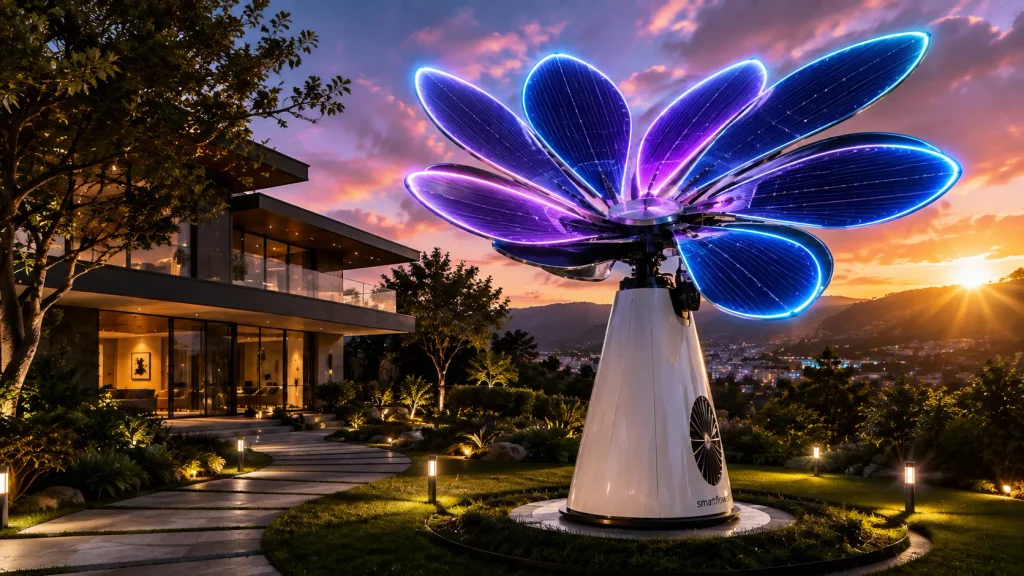
Instead of staring at a flat rectangle of photovoltaic modules permanently attached to the roof, imagine a large flower-shaped system that unfolds in the morning, tracks the sun throughout the day, and closes again at night.
That is Smartflower.
The system uses a dual-axis tracking mechanism that allows its solar panels to follow the sun across the sky. Smartflower says the system can generate up to 40% more energy than conventional fixed solar systems of comparable size, while its current product information also highlights automatic tracking, safety retraction, ventilation, and integrated cleaning features.
And visually?
It looks absolutely nothing like a traditional solar installation.
The Solar System That Moves
Traditional solar panels are mostly passive.
They sit there.
The Smartflower is active.
At sunrise, the petals unfold. During the day, the system tracks the sun. At night, it retracts.
The idea is based on dual-axis solar tracking, which allows the array to follow the sun’s movement across two dimensions instead of remaining fixed in one orientation. Smartflower says this allows its panels to maintain an optimal angle relative to the sun and is responsible for its claimed production advantage.
The company’s current product page specifically states that Smartflower panels autonomously follow the sun and can generate up to 40% more power.
That sounds futuristic because we are used to solar systems behaving like roof tiles.
Smartflower behaves more like a robot.
It is a mechanical system responding to its environment rather than simply accepting whatever angle the installer gave it.
And that difference matters.
It Doesn’t Just Follow the Sun
Tracking is the headline feature, but Smartflower has several other automated functions that make it feel more like a piece of intelligent machinery.
The current Smartflower product information says the panels can automatically close when strong winds are detected, moving into a safety position. The company also says the system has integrated brushes that clean away sediment and debris when the petals fold.
That means the movement isn’t just there to create an impressive visual effect.
The mechanical design serves several purposes at once.
It tracks sunlight.
It protects the equipment.
It helps with cleaning.
It provides ventilation around the solar modules.
And it creates a distinctive architectural appearance.
This is where Smartflower becomes particularly interesting for people who dislike the idea of covering an entire roof with visible solar panels.
A conventional solar system can be practical but visually dominant. Smartflower takes a completely different approach: turn the renewable-energy system into a feature.
Instead of asking, “How can I hide my solar panels?”
The question becomes:
“Why would I hide this?”
Is Smartflower Actually Better Than Rooftop Solar?
This is where a little realism is important.
The manufacturer claims up to 40% more energy production than a conventional fixed solar system under its comparison methodology. That is an important figure, but it should not be interpreted as a universal guarantee that every Smartflower will produce exactly 40% more electricity than every rooftop array. Actual production depends on sunlight, location, orientation, weather, shading, system size, and other factors.
There is also cost.
Smartflower’s current website positions it as a premium, specialised product rather than a low-cost solar alternative. The value proposition is therefore not simply “more electricity for less money.” It also includes aesthetics, automation, mobility, tracking, and the distinctive design of the system.
That matters because future renewable energy will not necessarily be judged only by kilowatt-hours.
People also care about:
How does it look?
How much space does it occupy?
How easy is it to maintain?
Can it be moved?
Can it integrate with batteries or EV charging?
Smartflower’s product information says the system can be connected with EV charging and can also operate with off-grid storage solutions.
So while it is not automatically the best choice for every homeowner, it demonstrates something fascinating:
Solar power does not have to look like solar power.
[BUTTON: Check Smartflower Price & Details]
And just when you think a flower-shaped solar generator is as futuristic as home energy can get, another company decides to turn a wind turbine into a tree.
Innovation #3: Wind Tree and Aeroleaf — The Silent Energy Tree

PRODUCT DEVELOPMENT COMPANY: https://www.aeroleaf.fr
Close your eyes and picture a wind turbine.
You probably see a giant tower.
Three enormous blades.
A huge structure spinning over an open field.
Now erase that picture.
Instead, imagine walking into a modern garden and seeing what looks like a minimalist futuristic tree covered with green leaves.
Then you notice that the leaves are moving.
And you realise they are turbines.
This is the basic idea behind New World Wind’s Aeroleaf and Wind Tree technology.
New World Wind describes Aeroleaf as a patented micro-wind turbine with a leaf-shaped vertical axis and a permanent-magnet synchronous micro-generator. The company says the system is designed to capture wind from 360 degrees and operate particularly well with weaker and turbulent airflow.
Suddenly, wind power has become architecture.
Tiny Turbines Hidden Inside Futuristic Leaves
The Aeroleaf is very different from a conventional wind turbine.
Instead of using enormous horizontal blades, the design uses a small vertical-axis turbine shaped like a leaf.
New World Wind currently lists Aeroleaf configurations from 300 W to 1,000 W, with hybrid versions combining wind and solar generation available at higher combined ratings.
The company’s technical data for its 300 W Aeroleaf says the system can begin exploiting wind from around 2.5 metres per second and uses a direct-drive generator without conventional belts or gears.
Why does that matter?
Because urban wind is messy.
Buildings create turbulence. Trees redirect airflow. Walls change wind direction. Rooftops can create unpredictable currents.
A conventional giant turbine is not necessarily designed for that environment.
Aeroleaf, on the other hand, is specifically marketed around its ability to use weaker and turbulent wind conditions. The manufacturer says each leaf can capture airflow from 360 degrees, making the technology conceptually different from the familiar giant wind-farm turbine.
[INSERT GIF/IMAGE HERE: A futuristic Wind Tree with its tiny green leaves spinning silently in a gentle breeze in a modern yard]
Does It Really Make Sense for a Home?
This is one of the most interesting questions.
The answer isn’t automatically yes.
Wind power depends heavily on location. A beautiful turbine sitting in a sheltered backyard with almost no usable wind will not suddenly produce large amounts of electricity just because it looks futuristic.
That is why site assessment matters.
But the design philosophy is fascinating.
New World Wind has developed a portfolio around biomimetic renewable-energy structures, including WindTree, WindBush, WindPalm, Aeroleaf, and hybrid wind-and-solar systems. Its product information shows that these systems can be configured for different environments and energy requirements.
The company says its Aeroleaf system starts operating from around 2.5 m/s and is intended to take advantage of weaker, turbulent winds. It also describes the direct-drive mechanism as quiet because it eliminates belts and gears.
That is why calling it a “silent wind turbine” needs a little nuance.
The manufacturer specifically describes the Aeroleaf’s rotation as producing no noise from its direct-drive mechanism, but the real-world sound experience of an entire installation can depend on its surroundings and other equipment.
Still, visually, the difference is enormous.
You aren’t looking at an industrial machine.
You are looking at something inspired by nature.
And that could be one of the most important design trends in future renewable energy.
What Happens When Solar, Wind, Batteries and Wireless Power Work Together?
Here is where this story becomes much bigger than three strange-looking inventions.
Picture a future smart home.
The house has solar generation.
It has a battery.
It has intelligent appliances.
It has an electric vehicle.
It has dozens or hundreds of small sensors.
Perhaps it also has a compact wind system.
Now imagine all of those components communicating continuously.
The solar system watches the sun.
The wind system responds to airflow.
The battery monitors electricity availability.
The EV charges when energy is abundant.
Smart appliances shift their consumption according to the home’s energy strategy.
Wireless power keeps small compatible devices operating.
An energy-management platform coordinates everything.
Suddenly, the house becomes less like a collection of appliances and more like a living energy ecosystem.
That is the real futuristic vision.
The three technologies in this article solve different problems.
Ossia Cota explores how power can reach devices without traditional cables.
Smartflower explores how solar collection can dynamically respond to the sun.
Aeroleaf and Wind Tree explore how wind generation can be distributed through smaller, nature-inspired structures.
And that leads to a fascinating possibility.
Maybe the future off-grid home will not be defined by one enormous energy source.
It could be defined by many small intelligent systems working together.
The End of Ugly Renewable Energy?
For years, renewable energy has sometimes been treated as something homeowners install because they care about efficiency or the environment, even when they don’t necessarily love the appearance.
But look at these technologies.
A flower.
A tree.
Wireless power.
The visual language is changing.
Smartflower turns solar hardware into an animated sculpture. Wind Tree turns wind generation into biomimetic landscaping. Cota tries to make charging infrastructure disappear altogether.
That may sound like a superficial change.
It isn’t.
Design influences adoption.
People are much more likely to embrace technology when it fits naturally into their homes rather than forcing their homes to adapt around it.
The house of the future might therefore be more sustainable and more beautiful.
Instead of seeing energy technology as equipment bolted onto the building, homeowners could increasingly see it as part of the building’s design.
That is an enormous psychological shift.
Are These Technologies Ready for Every Home?
Not yet.
And this is where the science-fiction fantasy needs to meet reality.
Cota requires compatible receiving hardware and commercial integration. Smartflower is a premium system with significantly different economics and installation considerations compared with conventional solar. Aeroleaf and Wind Tree systems depend on having an appropriate wind resource and a suitable installation environment.
So none of these technologies should be presented as a magic button for energy independence.
A homeowner considering renewable energy should still evaluate:
- Available solar exposure
- Local wind conditions
- Electricity consumption
- Battery requirements
- Installation and maintenance costs
- Local planning and electrical requirements
- Return on investment
- Grid connection or off-grid needs
Traditional rooftop solar may still be the most practical choice for many properties.
But practicality is not the only reason to pay attention to innovation.
These systems show where the industry could be heading.
The Future Could Be Stranger Than We Expect
Think about how quickly technology changed the average home.
The internet went from a luxury to basic infrastructure.
Smartphones replaced cameras, maps, radios, music players, notebooks, calculators, and dozens of other devices.
Now homes are becoming connected ecosystems.
Energy could follow the same path.
Instead of asking which appliance uses the most electricity, future homeowners may ask how intelligently the entire property can produce, store, distribute, and consume energy.
Maybe your solar generator follows the sun automatically.
Maybe your wind system looks like a tree.
Maybe your smaller devices never need a conventional charger.
Maybe your battery automatically stores electricity when renewable generation is high.
Maybe your house knows when to charge your car, heat your water, wash your clothes, or run your appliances based on the energy available.
That sounds futuristic.
But individual pieces of that future already exist.
And that is the part that should make us stop and think.
We aren’t waiting for one magical invention.
The future is arriving as a collection of weird, clever, experimental technologies.
Conclusion: Are We Already Living in 2050?
A few years ago, the idea of electricity travelling through the air, a solar panel physically following the sun like a flower, or a wind turbine disguised as a tree would have sounded completely absurd to most people.
Today, each concept has a real technology behind it.
Ossia Cota is exploring wireless power that can reach compatible devices without conventional charging cables or pads.
Smartflower has created a robotic solar system that automatically tracks the sun and can retract for safety and cleaning.
New World Wind’s Aeroleaf transforms micro-wind generation into leaf-shaped structures designed to fit more naturally into urban and architectural environments.
None of them makes every home completely off-grid today.
But they reveal something much more exciting.
The energy system of tomorrow may not look like an energy system at all.
It may look like a flower.
It may look like a tree.
It may not look like anything because the electricity could be delivered wirelessly.
So the next time you see a conventional rooftop panel, a charging cable, or a giant wind turbine, remember this:
The future may already be here.
It just happens to look a little weird.
Which of these 3 futuristic home energy innovations would you install in your dream home: wireless power, the Smartflower, or the Wind Tree?
Frequently Asked Questions
1. What are the most futuristic home energy innovations available today?
Some of the most visually futuristic examples include Ossia Cota wireless power, Smartflower solar tracking systems, and New World Wind’s Aeroleaf and Wind Tree technologies. They approach energy differently: Cota focuses on wireless power delivery, Smartflower focuses on dynamic solar generation, and Aeroleaf focuses on compact, nature-inspired wind generation.
2. Can Ossia Cota charge a normal smartphone wirelessly through the air?
Not without compatible receiving technology. Cota is designed to send power to devices containing a Cota receiver, so the concept is broader than simply making every existing smartphone charge through the air. Ossia presents Cota as a technology that manufacturers can integrate into compatible devices and products.
3. Does Smartflower really produce 40% more energy?
Smartflower states that its dual-axis tracking system can produce up to 40% more power than conventional fixed solar systems. Actual performance varies depending on location, weather, sunlight, system configuration, and the specific comparison being made, so the figure should be treated as a manufacturer claim rather than a universal guarantee.
4. Is the Wind Tree a real electricity-generating tree?
Yes. The Wind Tree is a real product concept from New World Wind that uses multiple Aeroleaf micro-wind turbines integrated into a tree-like structure. The company describes the Wind Tree as an electricity-generation system designed around its leaf-shaped vertical-axis turbines.
5. Can these technologies make a home completely off-grid?
They can contribute to an off-grid energy system, but none of them should be considered a guaranteed standalone solution. A genuinely self-sufficient home normally needs an appropriate combination of renewable generation, batteries, inverters, energy management, electrical infrastructure, and suitable site conditions. Smartflower itself says it can be integrated with off-grid storage solutions, while Cota and Aeroleaf address different parts of the broader energy ecosystem.
- For more information click here