Don’t Buy a New AC: This $25 Trick Tricks Your Old Unit Into Running Like a 2026 Model
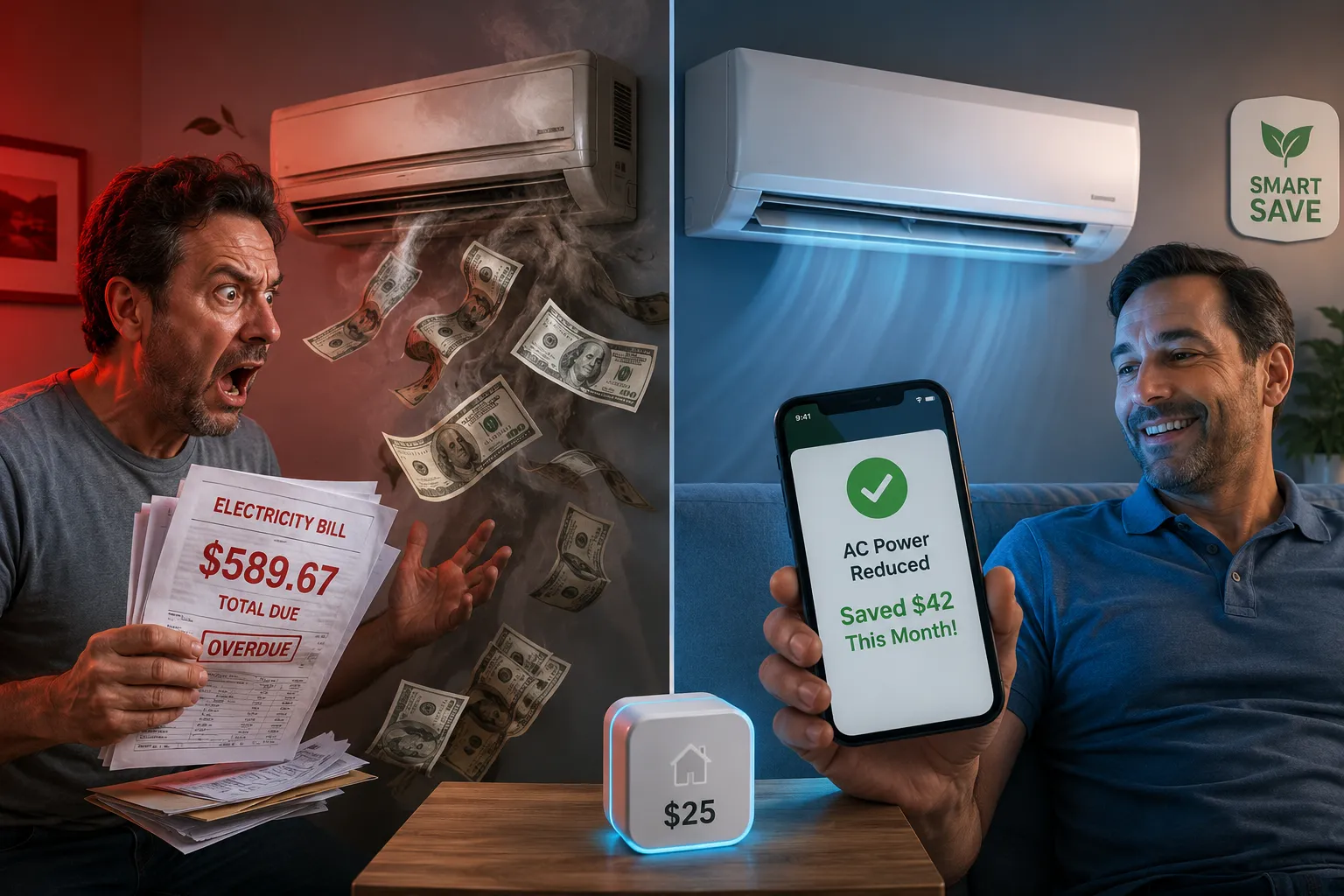
You open your summer electricity bill and your stomach drops.
You check the number again. Then you open your banking app. Another painful charge. Your old AC has been humming away for hours while you were at work, shopping, or asleep—and now your wallet is paying for every unnecessary minute.
But before you start shopping for an $800, $1,000, or even $2,000 replacement, stop.
There may be a much cheaper move.
A smart AC controller energy saver can add remote control, scheduling, temperature monitoring, and geofencing to many air conditioners that already use an infrared remote. Products such as Sensibo Sky are designed specifically to send the same type of infrared commands as your existing remote while adding smartphone-based automation.
That changes the question.
Instead of asking, “How much will a new AC cost me?” you can ask, “How much am I wasting because my existing AC is still operating manually?”
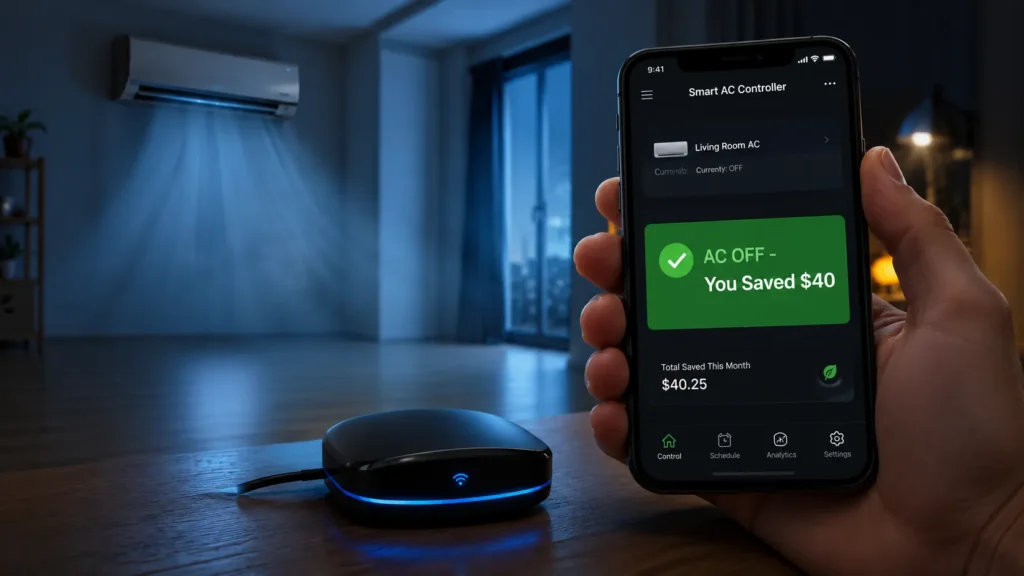
The Little White Lie of Old ACs
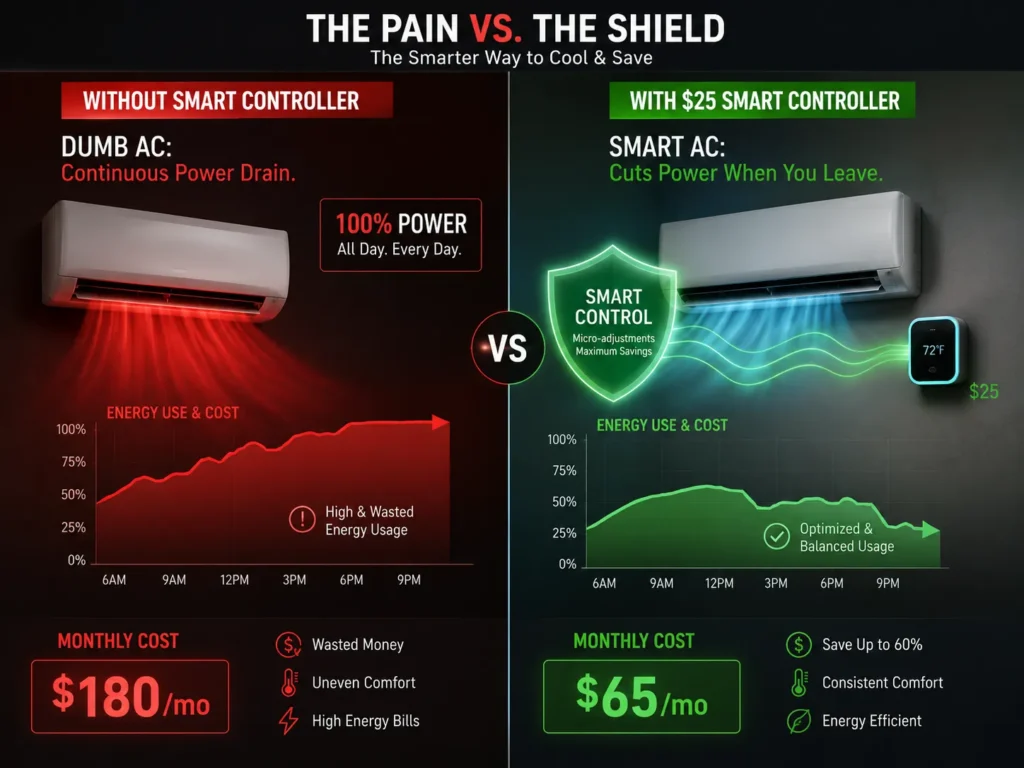
Your old air conditioner may still cool perfectly well.
The frustrating part is the control system.
A conventional remote-controlled AC generally waits for you to tell it what to do. You set the temperature, choose a mode, and walk away. If you forget to turn it off before leaving, the machine does not know that the house is empty.
That is where automation becomes interesting.
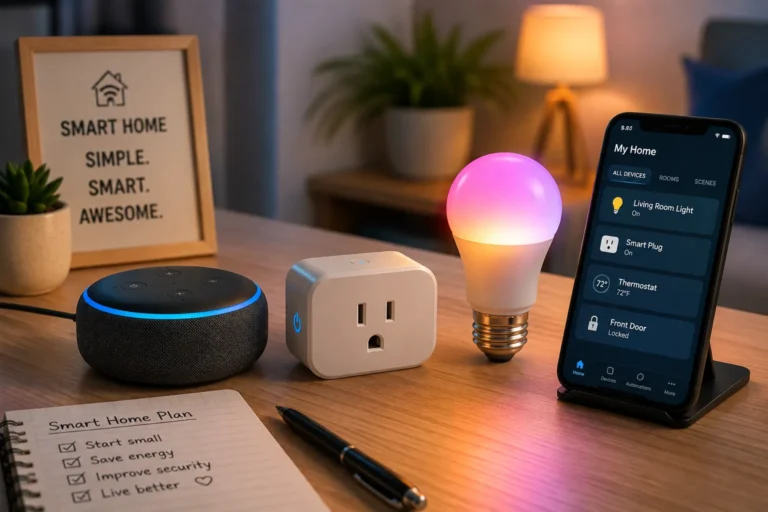
A smart AC controller energy saver essentially acts as a bridge between your phone and your existing air conditioner. Instead of replacing the compressor or rebuilding your cooling system, the controller can communicate with compatible ACs through infrared signals and let you manage them remotely.
Think of it as giving your old AC a new brain—not necessarily giving it a new engine.
And that distinction matters.
Research has found that automated temperature and occupancy-based control can produce meaningful electricity savings, although the actual result depends heavily on the home, climate, equipment, and operating habits.
So you don’t need to believe that a tiny gadget magically transforms an inefficient air conditioner into a brand-new high-efficiency system.
The real opportunity is simpler: stop paying for cooling when you don’t need it.
The $25 Revolt Against Wasted Cooling
Imagine leaving home at 8:00 a.m.
Your AC is still running.
You arrive home at 6:00 p.m.
Your AC has potentially been cooling an empty building for ten hours.
With a compatible controller, you can create rules that react to your schedule instead of relying entirely on memory. Sensibo, for example, offers geofencing that can automatically turn an AC on or off based on the user’s location, along with 7-day scheduling and remote control.
That’s the real “hack.”
You aren’t hacking the utility company. You aren’t bypassing your electric meter. You’re simply removing unnecessary AC runtime.
Geofencing Stops Cooling an Empty House
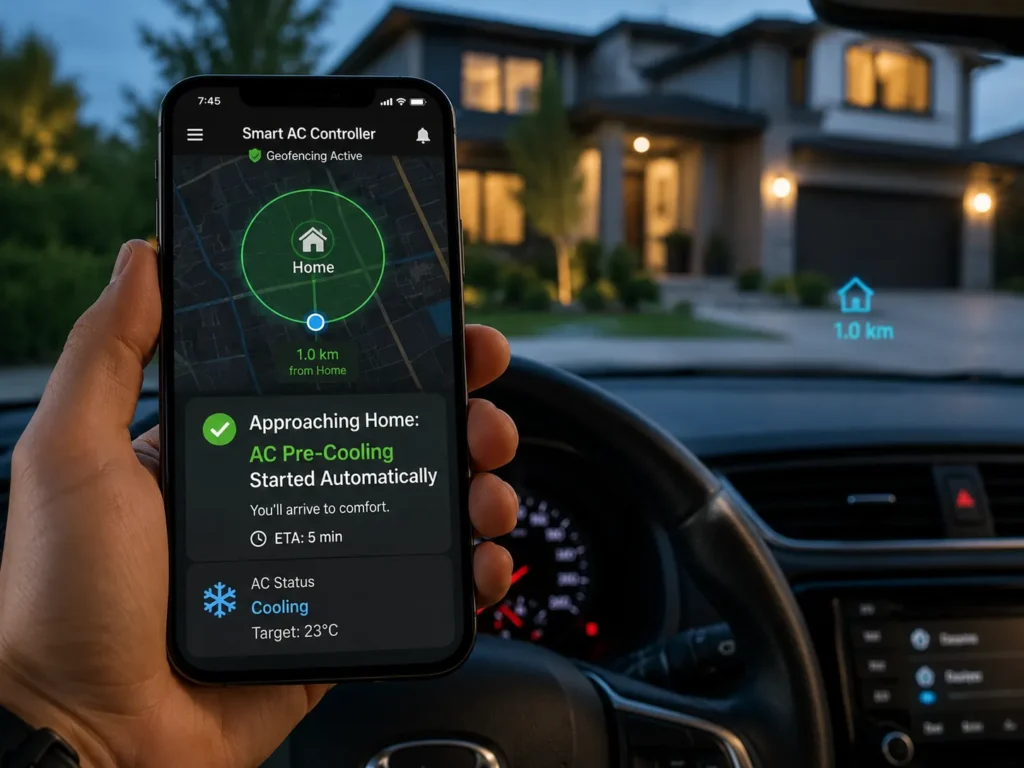
This is where a smart AC controller energy saver can become genuinely useful.
Your phone knows when you’ve left. The controller can use that information to change the AC’s operating state according to the rules you’ve configured.
Leave the house?
The AC can be told to switch off.
Head home?
The system can prepare the room before you arrive, depending on the controller and automation settings.
That means your AC doesn’t have to run at full comfort settings simply because you forgot about it.
And here’s the behavioral advantage: you don’t have to remember every day.
The automation remembers for you.
Smart Scheduling Adds Another Layer
Geofencing isn’t the only trick.
You can also create schedules around your real life.
Maybe you leave for work at 8:30 a.m. and return at 5:30 p.m. Maybe the house is empty every weekday afternoon. Maybe you prefer a slightly warmer bedroom while you’re sleeping.
A schedule can turn those habits into automatic commands.
The U.S. Department of Energy says programmable temperature controls can reduce heating and cooling costs by automatically adjusting temperatures when you’re away or asleep.
That doesn’t mean every smart controller will produce a guaranteed percentage of savings.
It means automation gives you something your old manual routine doesn’t: consistency.
How a Smart AC Controller Energy Saver Works
Here’s the part that sounds more complicated than it actually is.
A compatible controller sits in your room and communicates with the AC using infrared, similar to the signal from your original remote. The controller connects to Wi-Fi, while an app gives you access to settings, schedules, and automation.
You don’t need to rip your AC apart.
You don’t need to replace the compressor.
You don’t need to call an electrician just to create a basic schedule.
The Three-Minute Setup
The exact setup depends on the product, but the general process is straightforward.
1. Unbox the controller.
Place it somewhere with a clear line of sight to the AC’s infrared receiver.
2. Plug it in and connect it to Wi-Fi.
Products such as Sensibo advertise setup through the app and QR-code pairing, with installation taking roughly a minute.
3. Sync your phone and AC.
Once the controller recognizes your compatible unit, you can begin configuring remote commands, schedules, and automation.
Now your old remote-controlled AC can potentially become part of your smart-home system without replacing the entire machine.
That’s a very different proposition from spending four figures on a new cooling system.
The Brutal Math Behind the Upgrade
Let’s talk about the number that matters: your actual savings.
Suppose your electricity bill is higher because your AC regularly runs while you’re away.
Imagine—purely as an example—that automation reduces unnecessary usage enough to save you $35 on one monthly bill.
If you paid $25 for the controller, the simple payback calculation would be:
$25 ÷ $35 = 0.71 months.
That’s roughly three weeks.
After that, the savings would exceed the initial purchase price.
But don’t treat that example as a guarantee.
Your real savings could be dramatically different.
A small apartment with limited AC use won’t necessarily save the same amount as a large home where an air conditioner runs for many hours every day. Electricity prices, AC efficiency, climate, insulation, temperature settings, occupancy patterns, and automation behavior all matter.
One current smart-AC-controller analysis from Cielo estimates potential savings in the 10%–25% range, while noting that results depend on how the technology is used.
That’s why the smartest approach is not to believe a magical savings number.
Measure your own baseline.
Look at your previous bills. Track how long your AC normally runs. Then use automation to eliminate obvious waste and compare the results.
That’s much more powerful than blindly trusting an advertisement.
What to Check Before Buying
Before clicking the purchase button, check compatibility.
This is the part people skip because they’re excited about the savings.
Don’t.
A smart controller is only useful if it can actually communicate with your AC. Many current products are designed for remote-controlled mini-splits, window units, portable ACs, and other compatible systems, but compatibility varies by product.
Check whether your AC uses an infrared remote.
Check the manufacturer’s compatibility list.
Check whether the controller requires 2.4 GHz Wi-Fi.
And check whether the features you care about—especially geofencing, schedules, temperature monitoring, or advanced energy-saving automation—are included in the purchase price or require a subscription.
Price matters.
But compatibility matters more.
A $25 controller that doesn’t work with your AC isn’t an energy-saving device. It’s $25 sitting in a drawer.
The Choice: Keep Paying or Take Control
Here’s the uncomfortable question.
How much money are you willing to lose simply because your AC can’t tell whether you’re home?
You might be considering replacing an entire air conditioner because the electricity bill feels unbearable.
But if the equipment still cools your room effectively, a smart control upgrade may deserve a place on your shortlist before you spend hundreds or thousands on replacement equipment.
A smart AC controller energy saver won’t magically make an old compressor as efficient as the newest high-efficiency equipment.
It does something more practical.
It can help you control when, where, and how your existing AC operates.
And behavioral economics gives that idea some weight: research published in the American Economic Journal found that automation can help households reduce air-conditioning use during high-price periods, showing how automated controls can change energy behavior without requiring constant manual decisions.
Your biggest enemy may not be the AC sitting on your wall.
It may be the hours when nobody is there to enjoy the cooling.
Conclusion
You don’t have to rush into a massive AC replacement just because your summer electricity bill hurts.
First, look for the waste.
If your existing unit is mechanically sound and uses a compatible remote, a smart AC controller energy saver can give you tools your original remote never had: remote access, schedules, geofencing, and automated control.
The goal isn’t to “trick” your AC into becoming a completely different machine.
The goal is to stop letting it cool an empty house.
So you have two choices.
Keep relying on memory and continue paying for unnecessary runtime—or spend a relatively small amount on smarter control and see whether the numbers improve.
Check Current $25 Stock & Compatibility Here
FAQs
1. Can a smart AC controller work with my old air conditioner?
It can, provided your AC is compatible with the controller. Many controllers are designed for units operated by infrared remote controls, including various mini-split, window, portable, and other AC systems. Always check the manufacturer’s compatibility information before purchasing.
2. Will a smart AC controller automatically reduce my electricity bill?
Not automatically in every situation. The savings come from changing AC behavior—such as preventing unnecessary operation while you’re away or creating more efficient schedules. Actual savings depend on your AC, electricity rate, climate, occupancy, and settings.
3. Is $25 enough to replace an old AC?
No. A low-cost controller isn’t a replacement for a failing or severely inefficient air conditioner. Its purpose is to add smarter control to a compatible existing unit. If your AC has serious mechanical problems, professional repair or replacement may make more sense.
4. Does geofencing really matter?
It can be useful if you frequently forget to turn your AC off when leaving home. Geofencing allows compatible systems to use your phone’s location to trigger AC automation, potentially preventing hours of unnecessary cooling.
5. What’s the smartest way to calculate my potential savings?
Start with your actual electricity bills. Compare periods with similar weather and usage, then track AC runtime and automation changes. Don’t assume a specific percentage of savings until your own numbers prove it.
- For more information click here