
Are We Already Living in 2050? 3 Eco-Tech Inventions That Feel Impossible
Forget soggy paper straws and reusable shopping bags for a second.
What if saving the planet meant growing plants that glow in the dark, taking a two-hour hot shower with just 5 liters of water, or keeping a living plant that actually eats the pollution floating around your home?
It sounds like science fiction.
But these technologies are real — and they give us a pretty wild glimpse of what eco-friendly living could look like next.
1. Bioluminescent Plants: The Real-Life Avatar Glowing Flowers
Imagine turning off every light in your room.
It’s completely dark.
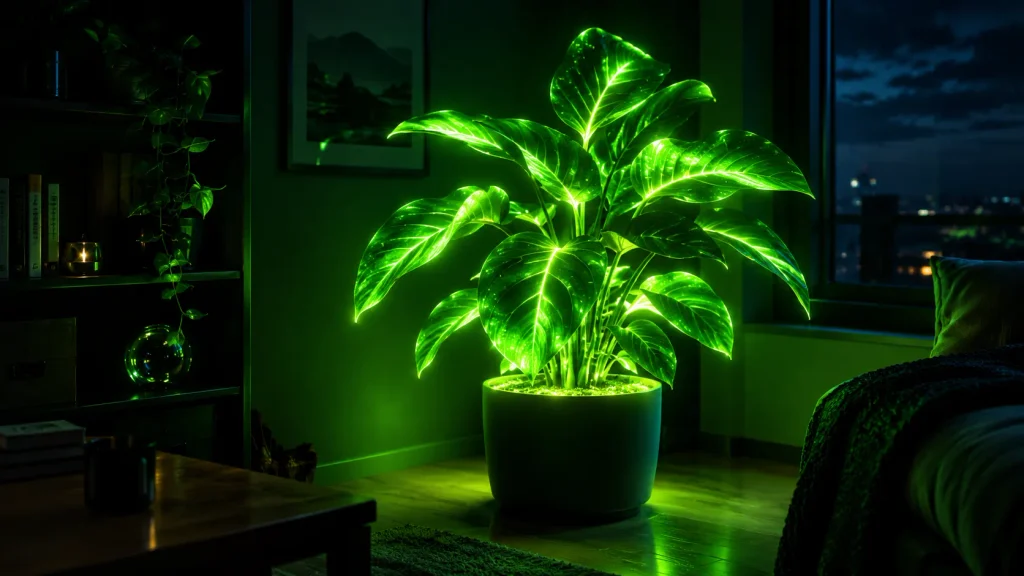
Then, sitting quietly on your desk, a plant starts glowing with an eerie green light.
No cable.
No battery.
No tiny LED hidden between the leaves.
Just a living plant.
That’s the strange beauty of Firefly Petunia, a genetically engineered petunia developed to produce visible light.
How can a plant actually glow?
The secret is genetic engineering.
Scientists introduced genes involved in bioluminescence — the same basic phenomenon responsible for the glow of fireflies and other organisms — into the plant’s genetic system.
The plant can then produce molecules involved in a chemical light-producing process.
And unlike an ordinary decorative lamp, the source of the glow is alive.
The result is subtle but genuinely surreal: leaves and flowers can give off a soft greenish glow that becomes much easier to notice in darkness.
Think of it as a tiny biological nightlight.
And there’s something fascinating about the idea.
Traditional lighting requires infrastructure. Electricity travels through wires, reaches a bulb and produces light.
A glowing plant?
It grows.
It needs water and nutrients.
And it produces its own faint illumination as part of its biology.
We’re still a long way from replacing household bulbs with glowing houseplants. Don’t expect your ceiling lamp to disappear tomorrow.
But that’s not really the point.
The exciting part is that biology itself is becoming something we can carefully redesign for new functions.
Yesterday, a plant was something you watered.
Tomorrow, it might also be part of your home’s lighting, sensing or environmental system.
And if a glowing flower sounds strange, wait until you see what engineers are doing with something we use every single day…
Water.
2. Orbital Systems Space Shower: The Infinite Water Loop
Here’s a question that sounds ridiculous:
Could you take a two-hour hot shower while using only about 5 liters of water?
With a conventional shower, absolutely not.
A normal shower continuously sends fresh water through the system and sends the used water straight down the drain.
Orbital Systems took a radically different approach.
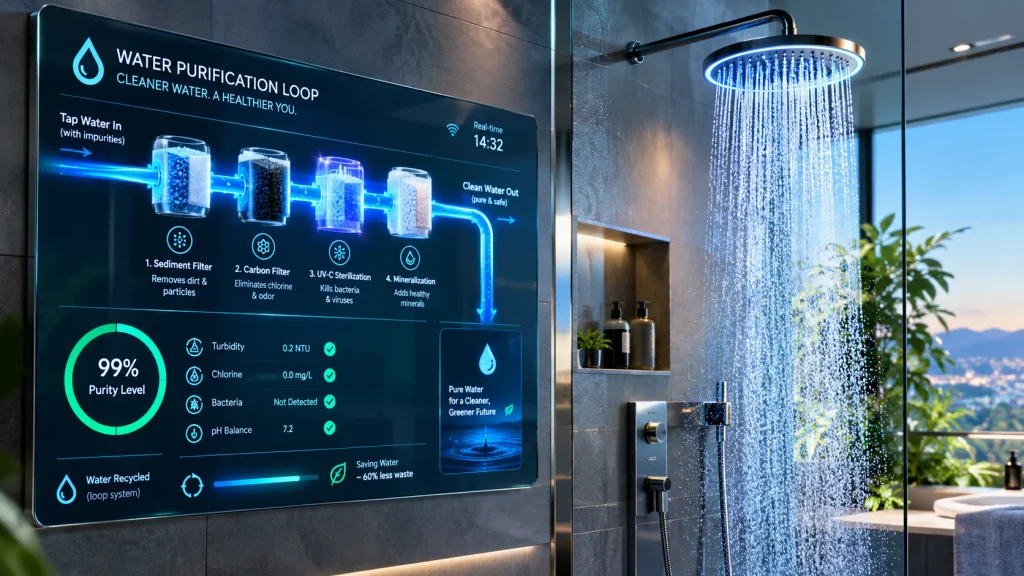
Instead of treating shower water as disposable, the company’s Orbital Shower technology is designed around a closed-loop system that continuously captures, cleans and recirculates the water.
In other words, your shower water doesn’t simply disappear.
It goes around again.
And again.
And again.
Inspired by space technology
The concept has an obvious connection to space travel.
Astronauts can’t exactly turn on a tap and let hundreds of liters of water run away.
Every drop matters.
Systems designed for extreme environments therefore focus heavily on recovering and recycling valuable resources.
Orbital Systems brought that thinking into the bathroom.
The shower collects used water and passes it through a purification system before returning it to the shower cycle.
Sensors monitor the water and the system continuously manages the loop.
The company has claimed that the technology can allow a two-hour hot shower using around 5 liters of water, with claims of roughly 90% less water consumption and up to 80% less energy consumption compared with a conventional shower.
That’s an absurd difference when you first hear it.
Five liters.
For two hours.
The important detail, however, is that this isn’t five liters being used once.
It’s approximately five liters circulating through the system rather than hundreds of liters being consumed as fresh water.
There’s also a bigger idea hiding behind this technology.
Our homes were traditionally designed around a simple principle:
Bring resources in. Use them. Throw them away.
Water comes in.
Wastewater goes out.
Energy comes in.
Heat disappears.
But closed-loop technology flips that model.
Instead of constantly demanding new resources, the home starts recovering what it already has.
That’s a much more interesting vision of sustainability than simply telling people to take shorter showers.
And yet, water isn’t the strangest resource scientists are learning to recycle.
Because the next invention tackles something you probably don’t even notice you’re breathing.
The invisible chemicals floating around your home.
3. Neoplants: The Super-Plant That Literally Eats Indoor Pollution
Your home can look perfectly clean while the air inside isn’t.
Furniture, paints, cleaning products, plastics, adhesives and other everyday materials can release volatile organic compounds, commonly called VOCs.
They’re invisible.
You can’t see them floating around your living room.
You might not even smell them.
But some VOCs can negatively affect indoor air quality.
So what if you could fight them with a plant?
Not just an ordinary plant.
A genetically engineered one.
That’s where Neoplants comes in.
The company developed bioengineered plants designed to remove certain airborne pollutants from indoor environments.
And the claim is where things get seriously weird:
One Neoplants Neo P1 is designed to provide air-purification performance comparable to as many as 30 ordinary houseplants, depending on the pollutant and testing conditions.
Thirty plants.
From one pot.
But the really fascinating part isn’t simply the number.
It’s what happens to the pollution afterward.
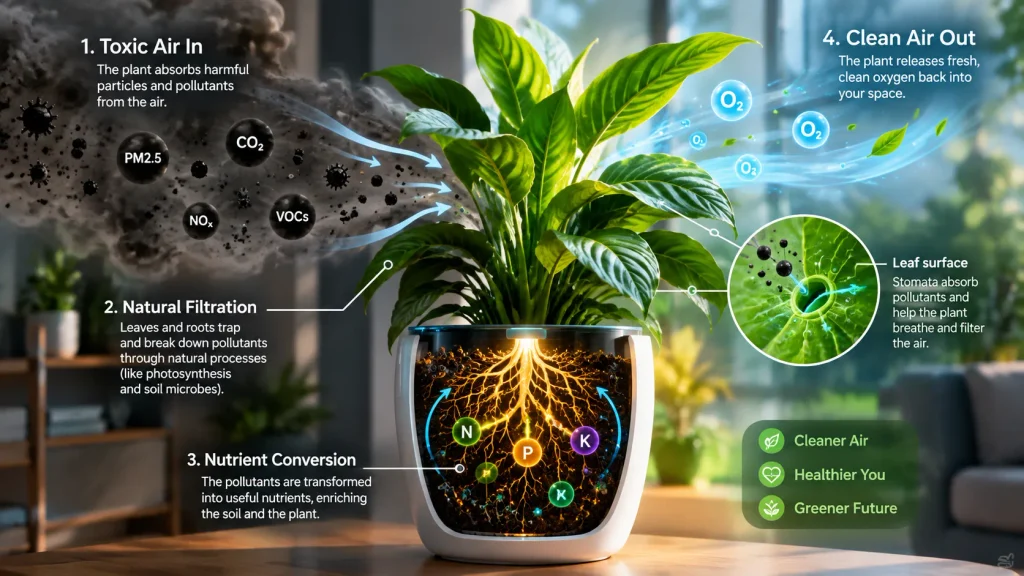
The plant doesn’t just trap the toxins
Ordinary plants can absorb certain compounds through their natural biological processes.
Neoplants takes that concept much further through genetic engineering.
Its plants are engineered with biological pathways that help them capture and metabolize certain VOCs.
Instead of simply holding pollutants inside their leaves, the engineered plant processes targeted compounds and converts them into substances the plant can use.
In extremely simplified terms:
Pollution goes in → the plant processes it → useful compounds come out.
The plant essentially turns certain unwanted chemicals into plant resources.
It’s almost like having a tiny biological air-treatment machine sitting beside your sofa.
Of course, there’s an important reality check.
One plant isn’t going to magically transform a polluted city apartment into pristine mountain air.
And “30 houseplants” is a performance comparison, not a promise that you can throw away every other air-quality measure in your home.
Ventilation still matters.
Source control matters.
And for serious indoor-air problems, proper air-quality equipment can still be useful.
But the underlying idea is fascinating.
For thousands of years, humans have looked at plants primarily as food, decoration, medicine or materials.
Now biotechnology is giving us another possibility:
Plants as engineered environmental tools.
And that opens up some seriously strange possibilities.
What if future buildings don’t just contain plants for decoration?
What if the plants are deliberately designed to remove specific pollutants, detect environmental changes, regulate indoor conditions or perform other useful biological jobs?
Suddenly, the humble houseplant doesn’t look quite so humble anymore.
The Future Might Be Much Stranger Than We Think
The most exciting thing about these three inventions isn’t that they’re futuristic.
It’s that they’re already pushing into the real world.
A plant can be engineered to produce visible light.
A shower can recycle the water you’re standing in.
A plant can be redesigned to process specific airborne pollutants.
None of these ideas require a spaceship.
They’re showing up in places much closer to home: bedrooms, bathrooms, desks and living rooms.
And that’s perhaps the most interesting direction for eco-tech.
The future may not simply mean more powerful machines.
It could mean smarter relationships between technology and biology.
Your house might one day grow some of its own lighting, recycle its own resources and use living organisms as part of its environmental systems.
Pretty strange, right?
If you could install just one of these technologies in your home today, which would you choose: the glowing plant, the ultra-efficient shower, or the pollution-eating super-plant?
- For more information click here