Residential Greywater Recycling System: How It Works
Why So Much Clean Water Goes Down the Drain
Think about your morning shower for a second. You turn on the tap, wait for the water to warm up, step underneath it, and let several litres of treated drinking-quality water run over your body before disappearing through a drain. Nothing unusual happened. That is simply how modern plumbing is designed. Yet the strange part is what happens next: water that may have been perfectly suitable for another household job is mixed with wastewater and sent toward the sewer or septic system. EPA data gives some perspective on the scale of this habit. Showering represents nearly 17% of residential indoor water use, while North American residential research used by EPA estimates average shower consumption at roughly 11.1 gallons, or about 42 litres, per person per day. For a four-person household, that theoretical average is around 168 litres of shower water every day, although actual consumption varies considerably with shower duration and flow rate. This is where a residential greywater recycling system becomes interesting. Instead of treating every drop leaving a shower or bathroom basin as something that must immediately become wastewater, a dedicated treatment unit can separate selected greywater streams, clean them, disinfect them and redirect the resulting non-potable water toward suitable household applications. The idea is surprisingly simple: use water more than once before finally sending it away.
What Exactly Is Greywater?
Greywater is household wastewater that comes from selected sources that have not been contaminated by toilet waste. Depending on the plumbing code and the particular system, this can include water from showers, bathtubs, bathroom hand basins and sometimes laundry. The exact definition matters because greywater is not automatically clean water, and it should never be treated as equivalent to drinking water simply because it did not come from a toilet. Soap, shampoo, hair, skin particles, cosmetics, detergents, suspended solids and microorganisms can all enter the stream. Kitchen wastewater is also commonly excluded from greywater definitions because food residues, grease and other organic material can create a significantly different treatment challenge. A properly designed home greywater filtration unit therefore begins by controlling exactly which wastewater sources enter the treatment process. The goal is not to create drinking water; the goal is to produce water of a quality appropriate for a defined non-potable reuse application. That distinction is critical. Modern onsite water-reuse standards such as NSF/ANSI 350 exist precisely because treatment performance has to be evaluated against the intended reuse rather than judged simply by whether the water looks clear. A system can produce water that looks beautifully clean and still require treatment and monitoring before it is suitable for a particular use.
Greywater vs Blackwater
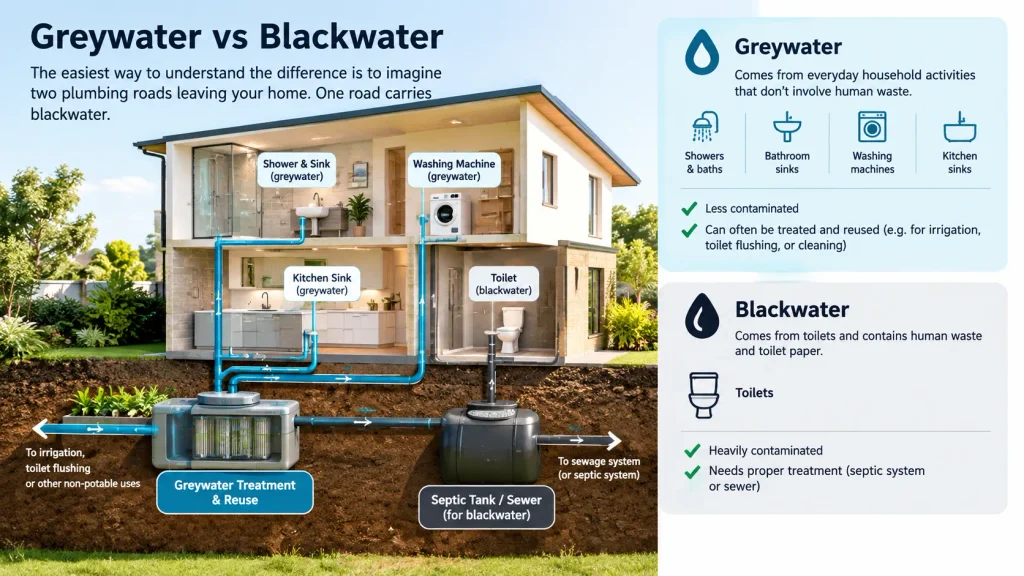
The easiest way to understand the difference is to imagine two plumbing roads leaving your home. One road carries blackwater, primarily toilet wastewater and other sewage streams, and the other carries selected greywater streams from places such as showers and bathroom basins. Blackwater has a much higher contamination risk because it can contain faecal matter and pathogens that require more intensive wastewater treatment. Greywater still contains contaminants, but its composition can make onsite non-potable treatment more practical. This is why a residential greywater recycling system normally starts with source separation rather than simply collecting everything that flows into a home’s main drain. A toilet cannot normally be connected to the greywater collection line just because the downstream treatment unit has a filter. The treatment plant must receive the wastewater stream for which it was designed and certified. Current NSF information describes NSF/ANSI 350 as a framework covering onsite systems treating greywater or combined wastewater, with physical, chemical and microbiological performance requirements intended to protect public health for non-potable applications. In other words, the plumbing layout is part of the safety system. A sophisticated filter cannot compensate for poor source separation, incorrect cross-connections or an installation that ignores the applicable plumbing rules.
What Greywater Can and Cannot Be Used For
Once treated to the required quality, greywater can potentially serve several jobs that do not require drinking-water quality. Toilet flushing is one of the most obvious because the water disappears immediately after use and does not normally contact people in the same way drinking water does. Landscape irrigation can also be an important application, although the exact irrigation method, plants, soil conditions and local regulations determine what is acceptable. Some onsite reuse frameworks permit additional non-potable applications, but homeowners should not assume that every treated greywater system is approved for every possible use. This is especially important with the idea of using recycled water for floor cleaning. A manufacturer may design a system to provide high-quality non-potable water, but whether that water can legally or safely be used for a particular cleaning task depends on the treatment performance and local requirements. The same principle applies to laundry, vehicle washing, decorative water features and any use where people could be exposed to the water. Never use recycled greywater for drinking, cooking, brushing teeth or preparing food. Regulations can also prohibit or restrict specific uses. For example, EPA’s summaries of state programmes show that toilet flushing and irrigation are established non-potable reuse applications in several jurisdictions, but treatment and disinfection requirements differ by location.
How a Residential Greywater Recycling System Works
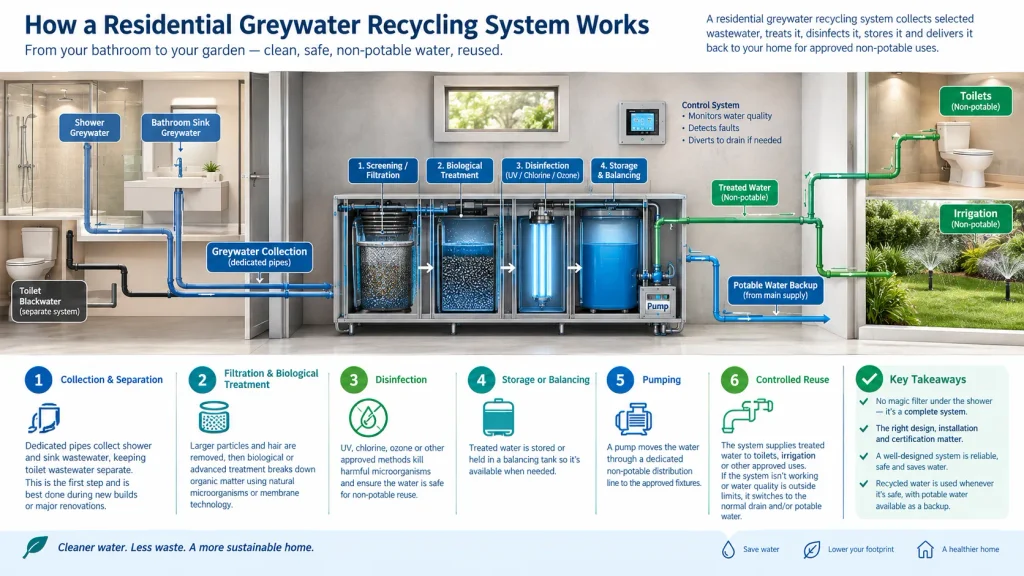
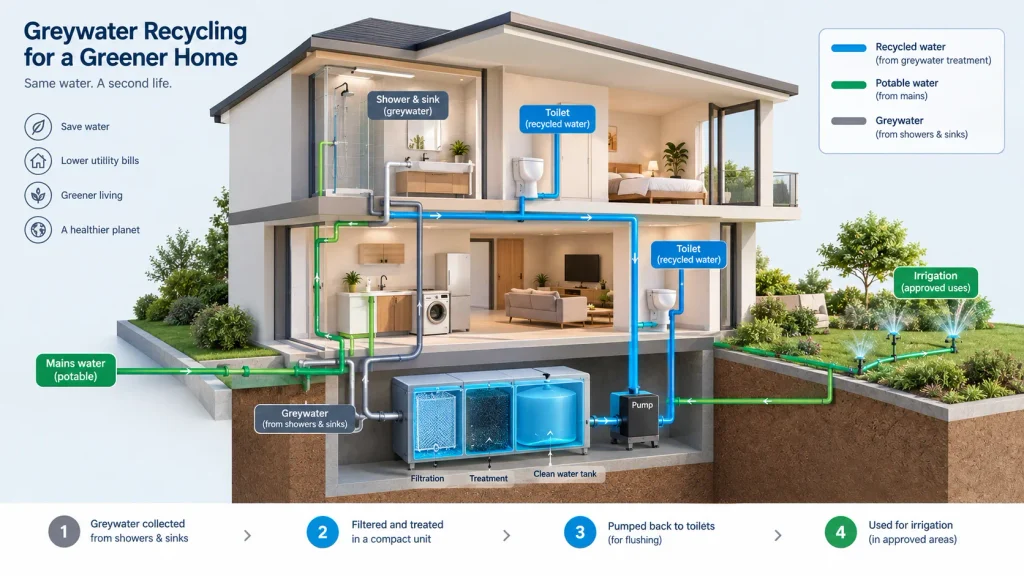
At its simplest, a residential greywater recycling system behaves like a small wastewater treatment plant hidden inside a house or service area. First, selected greywater is captured through dedicated drainage pipes instead of being mixed immediately with blackwater. The collected stream then enters the treatment equipment, where larger particles and suspended material are removed before additional treatment reduces dissolved and biodegradable contaminants. Depending on the technology, the treatment train can use physical filtration, biological treatment, membrane processes, UV, chlorine or other approved disinfection methods. After treatment, the system stores or holds the reclaimed water long enough to make it available when a toilet, irrigation circuit or other approved non-potable fixture demands it. A control system monitors the process and can divert wastewater to the normal drain if the treatment system is unavailable or water quality conditions are outside the permitted operating range. Finally, a separate non-potable distribution line carries the treated water toward the approved fixtures. The important concept is that there is no magic filter sitting under the shower. The complete system is a chain: collection → treatment → disinfection → storage or balancing → pumping → controlled reuse. If one part is poorly designed, the entire reuse strategy becomes less reliable. That is why professional installation and certification matter just as much as the filtration technology itself.
Step 1 — Collection and Separation
The first technical challenge is surprisingly physical: getting the right water to the right place. A house intended for greywater recycling needs a dedicated drainage arrangement so that shower and bathroom-sink wastewater can be routed toward the treatment unit while toilet wastewater remains on the blackwater system. This is one reason greywater recycling is much easier to incorporate during a new build or major renovation. The plumber can design the drainage network around the treatment equipment rather than trying to force new pipes through finished walls, floors and ceilings. Published Aquartis information describes its ECOVISION systems as accepting greywater from showers, baths and bathroom sinks, while earlier Aquartis documentation describes dedicated greywater and recycled-water plumbing connections. Once the greywater reaches the unit, the first treatment stage typically focuses on screening or filtration. Hair is removed. Larger particles are captured. Suspended material is reduced. That first barrier protects pumps, biological treatment components and downstream disinfection equipment. It also illustrates why putting kitchen wastewater into a system that was designed for bathroom greywater can be a bad idea. Grease and food particles can dramatically change the incoming wastewater characteristics and increase maintenance requirements. Source separation is therefore not merely a plumbing preference; it is the first treatment step.
Step 2 — Filtration and Biological Treatment
After the larger solids have been removed, the treatment process has to deal with the less obvious contaminants dissolved or suspended in the water. Some greywater systems use biological treatment, where naturally occurring microorganisms help break down biodegradable organic matter. Historical Aquartis ECOVISION documentation described a treatment sequence involving an automatically cleaned filtration module followed by biological treatment using a moving bacterial bed, before final chlorination. Other modern systems may use membrane bioreactors, ultrafiltration, biological media, advanced oxidation or combinations of these technologies. The exact method matters less to the homeowner than the verified performance of the finished system. A high-tech name does not automatically equal safe reuse. The treatment unit needs to be designed and tested for its intended application, rated capacity and influent type. NSF explains that certification to NSF/ANSI 350 involves technical review and testing of influent and effluent to demonstrate compliance with the standard’s requirements. This is why comparing systems by “number of filters” alone can be misleading. One manufacturer might advertise three filtration stages while another uses a biological reactor and membrane. What matters is the quality of the treated water, the intended use, reliability, monitoring, maintenance requirements and certification or approval applicable where the equipment will be installed.
Step 3 — Disinfection and Quality Control
Filtration is not the end of the story. Even water that looks completely transparent can contain microorganisms, so an appropriate disinfection stage is essential for many indoor non-potable reuse applications. Depending on the technology and local approval pathway, this may involve chlorine, ultraviolet light, ozone or another validated process. EPA’s state-level water reuse summaries show how different jurisdictions specify different treatment and disinfection requirements for greywater used in applications such as toilet flushing. California, for example, recognises treated greywater for toilet flushing and irrigation and specifies disinfection approaches including chlorination, UV or ozone when required by the applicable framework. This is also where automated monitoring becomes valuable. A modern system can monitor operating conditions, detect faults and divert incoming greywater to the normal wastewater route if the recycling process cannot operate correctly. Published Aquartis material describes automatic potable-water bypass in situations such as insufficient recycled water, electrical failure or an alarm. That fail-safe philosophy is important because the home should not become dependent on recycled water being available every minute of every day. The best architecture is not “recycled water at all costs.” It is recycled water whenever the treatment system can provide it safely, with conventional potable water available as backup where permitted and designed into the system.
Where the Recycled Water Goes
Once treated greywater meets the required quality for its intended application, the water becomes a useful non-potable resource rather than a disposable wastewater stream. The most straightforward application is toilet flushing because it consumes a substantial amount of household water while requiring no drinking-water quality. EPA’s supporting data puts average indoor toilet use at about 14.2 gallons per person per day in the REUW2016 dataset, showing why toilets represent an attractive target for water reuse. Landscape irrigation can also make sense, especially where local rules allow treated greywater to be distributed through an approved system. Some homeowners are also interested in using reclaimed water for cleaning tasks, but this should be treated as a specification question rather than an automatic benefit. If a system is explicitly designed and approved for a particular utility-water application, follow that specification; if it is only approved for toilet flushing and irrigation, do not improvise. The same caution applies to storing treated greywater for long periods. Water quality can change with time, temperature and biological activity, which is why engineered systems use controlled storage, circulation, treatment or automatic diversion rather than relying on a simple household tank filled with yesterday’s shower water. A good system makes reuse feel ordinary because the technology manages the complicated parts in the background.
Toilet Flushing, Cleaning and Irrigation
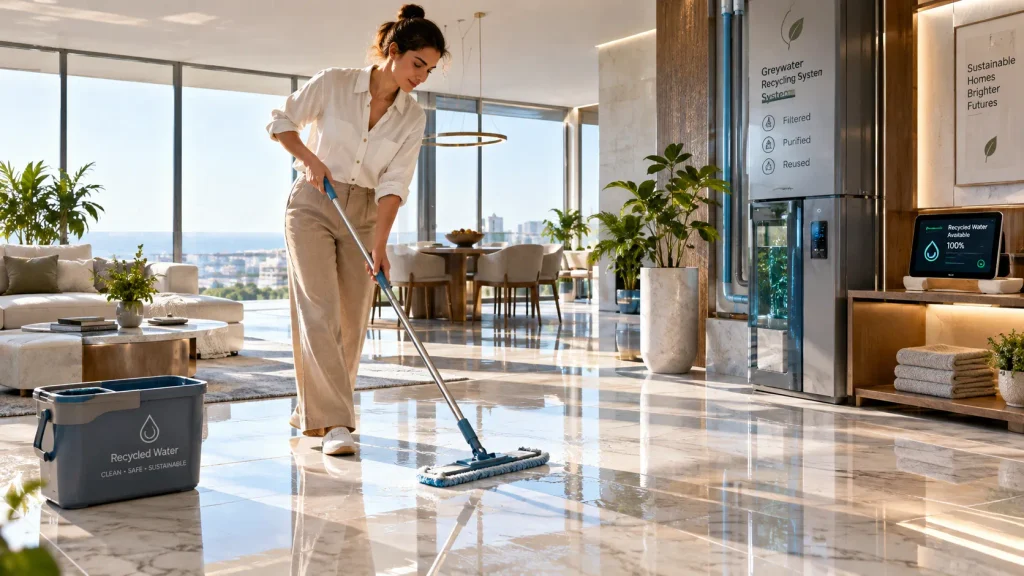
Imagine flushing a toilet with water that came from the shower instead of directly from the municipal drinking-water network. From a resource-efficiency perspective, that is a remarkably logical loop: drinking-quality water is reserved for uses that actually require it, while treated non-potable water handles a lower-grade task. Irrigation can create another loop, sending appropriately treated water toward plants instead of demanding fresh potable water for every watering cycle. Floor cleaning is more nuanced. If the manufacturer and local authority permit the use of the treated water for that application, it can potentially reduce freshwater demand for mopping, but users should follow the system’s approved end uses rather than assume “clear” means universally safe. Recycled water should never be treated as drinking water, and it should not be connected to fixtures where accidental consumption could occur. Proper labelling and plumbing separation are therefore essential. NSF’s current guidance emphasises that onsite reuse systems are evaluated against intended non-potable applications, while EPA examples demonstrate that allowable uses and water-quality targets vary between jurisdictions. That fit-for-purpose approach is the smart way to think about greywater: the objective is not to make every drop potable. The objective is to make each treated drop safe and useful for the job it has been assigned.
Aquartis Greywater Technology Explained
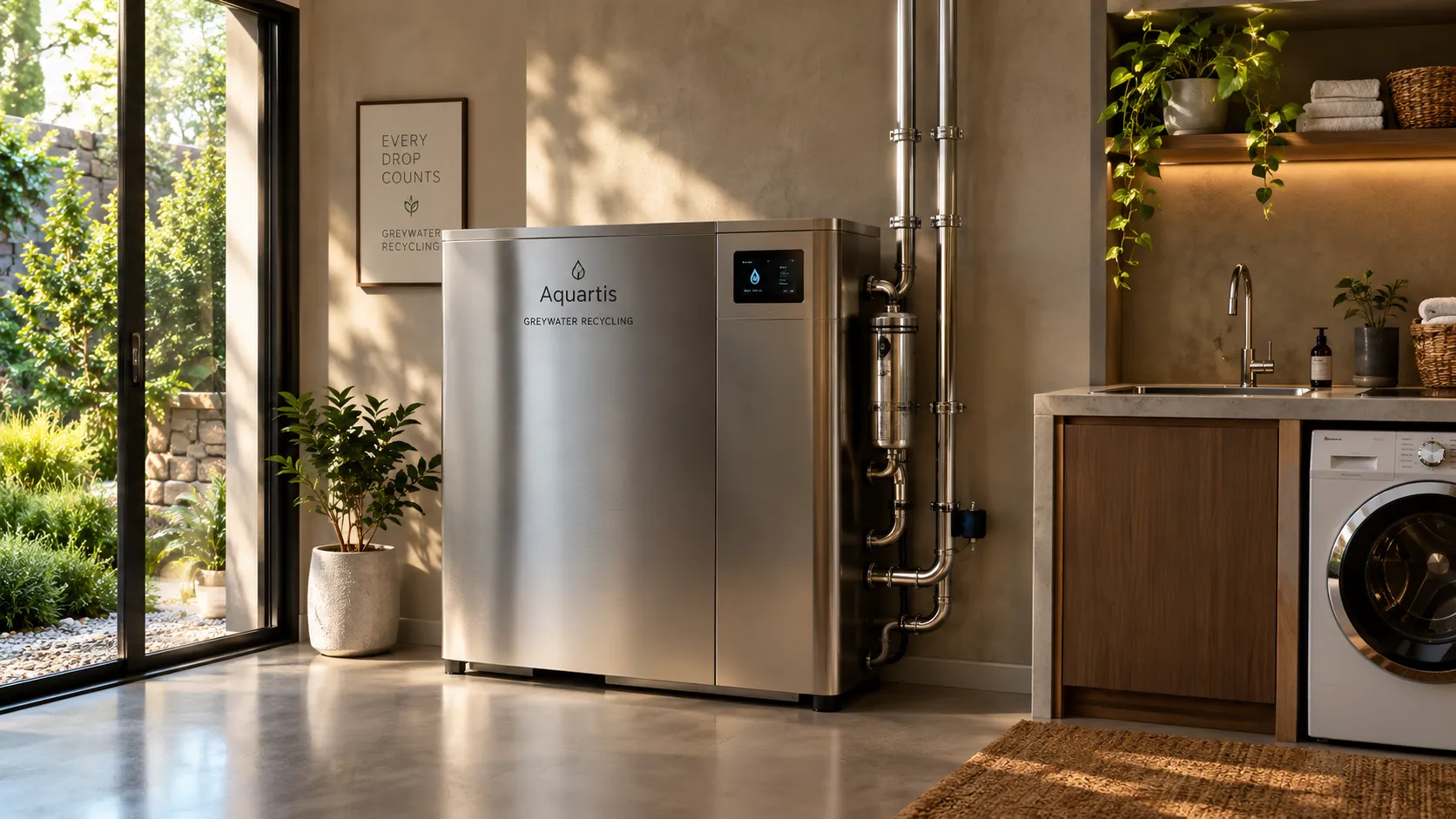
Aquartis is an interesting case because its ECOVISION line was developed specifically around automated greywater recovery for residential and small-to-medium buildings. Published product information describes systems that recover water from baths, showers and bathroom sinks and redirect treated water toward toilets, irrigation and other non-potable applications. Reported features include a compact all-in-one format, monitoring and control capabilities, BACnet and Modbus communication on listed models, and an automatic potable-water bypass when recycled water is unavailable or the system detects a fault. Older Aquartis documentation also describes automatic filtration and treatment, with published ECOVISION models sized for different numbers of users and building types. However, this is where a careful buyer should slow down. Some of the readily available Aquartis technical material is several years old, and the company’s current product range and certification status should be confirmed directly with the manufacturer or installer before specifying a system for a new project. Product generations can change, certifications can expire or be renewed, and local plumbing authorities may impose requirements that differ from the product’s original market. The useful lesson is not simply “buy Aquartis.” It is to look for the characteristics that make a greywater system practical: appropriate source-water compatibility, verified treatment performance, reliable automation, fail-safe operation, manageable maintenance, clear certification and a plumbing design that matches the equipment.
Automation, Monitoring and Fail-Safe Operation
Automation is one of the biggest differences between an engineered greywater system and a DIY bucket-under-the-shower approach. Nobody wants to manually inspect every litre of recovered water before pressing a button to flush the toilet. A properly engineered system can monitor water levels, treatment operation, alarms and other parameters, while controls decide when to collect, treat, store, reuse or divert the incoming stream. Aquartis documentation has described automatic standby operation after prolonged periods without use, automatic switching to potable water when recycled supply is insufficient and alarm-based diversion when a problem occurs. Those features address a fundamental weakness of untreated greywater storage: the longer wastewater sits around, the more complicated biological conditions can become. Automated management can reduce unnecessary stagnation and make the system behave more like an appliance than a miniature sewage plant. Still, automation is not maintenance-free operation. Filters, disinfectant supplies, sensors, pumps and treatment components have service requirements, and homeowners need to understand exactly what the installer expects them to do. A good buying question is therefore not “How smart is the system?” but “What happens when something goes wrong?” Ask whether the system automatically bypasses to conventional drainage, whether the non-potable network can fall back to potable supply where allowed, what alarms appear, what maintenance is required and how quickly the system can return to normal operation after a fault.
Plumbing Requirements for a Greywater System
A residential greywater recycling system is fundamentally a plumbing project, not simply an appliance purchase. The home normally needs separate collection piping for the greywater sources and a separate distribution network for the treated non-potable water. That creates a physical separation between drinking-water plumbing and recycled-water plumbing, reducing the risk of cross-connection. The treatment unit also needs appropriate drainage, ventilation where required, electrical power, access for maintenance and enough space around the equipment for servicing. Pumps may be necessary because the treatment unit and reuse fixtures are not always at the same elevation. Storage capacity also needs to match the home’s greywater generation and demand profile. A family may produce plenty of shower water in the morning but have most toilet demand spread throughout the day, so the system needs to balance supply and demand rather than simply collecting as much water as possible. Published Aquartis material has specifically highlighted the requirement for dual plumbing and suggested that the technology is particularly suited to new construction or major renovations. That makes sense. Installing a second drainage and supply network after a house is finished can involve opening floors, walls and ceilings, which can turn an elegant sustainability upgrade into a major building project.
New Construction vs Retrofit Installation
New construction gives greywater recycling a huge advantage because the architect, plumber and system designer can coordinate everything before the walls are closed. The shower drains can be routed to the treatment room, toilets can receive a dedicated non-potable supply, and service access can be planned into the utility space from day one. Retrofitting an existing home is still possible in some circumstances, but the economics become more complicated. A basement, crawlspace or accessible service shaft can make the plumbing work easier, while a slab-on-grade home with bathrooms scattered across multiple floors can require much more invasive construction. The best retrofit candidates are often homes undergoing major bathroom renovations or extensions where plumbing walls are already being opened. A professional should map every relevant fixture before quoting the work. The map should identify greywater sources, blackwater lines, existing potable-water lines, the proposed treatment location, recycled-water fixtures, drainage, electrical supply and access routes for equipment replacement. The installer should also confirm backflow protection and cross-connection controls required by the applicable plumbing authority. This is not an area where improvisation is attractive. A beautifully engineered treatment cabinet connected to poorly separated plumbing can defeat the entire purpose of the system. The plumbing architecture has to be treated as part of the water-treatment system itself.
Greywater Recycling System Installation Cost and ROI
The financial case for a greywater recycling system depends heavily on the building, local water prices, sewer charges, equipment capacity, installation complexity and the amount of water that can actually be reused. That makes a universal payback period impossible to promise honestly. Suppose, purely as an example, a household recovers and successfully reuses 100 litres per day, or about 36,500 litres per year. If the combined marginal cost of purchased water and wastewater service were the equivalent of $5 per cubic metre, that would represent roughly $183 of annual utility savings before maintenance, electricity, financing and other costs. At $10 per cubic metre, the same volume would be worth roughly $365 annually. Those numbers show why water tariffs matter enormously. A system costing thousands of dollars may make a strong resource-efficiency case but have a long financial payback where water is inexpensive. Conversely, a home with high water and sewer charges, substantial toilet demand and expensive alternative water supplies could see a faster return. The often-mentioned “50% water-bill reduction” should therefore be treated as a scenario rather than a guaranteed outcome. Aquartis materials have historically reported potential building water savings around 30–40% under their stated conditions, while other systems and buildings can produce different results. The right ROI calculation is simple: annual avoided water and wastewater cost + applicable energy benefits − annual operating and maintenance costs, divided into the installed project cost.
How Much Water Can a Home Actually Save?
The answer starts with demand rather than the size of the recycling machine. A four-person home might generate a substantial amount of shower and bathroom-sink greywater, but it can only reuse water when there is a suitable demand for it. Toilets provide a particularly useful demand profile because they require water throughout the day. EPA’s North American residential dataset estimates indoor toilet use at 14.2 gallons per person per day and shower use at 11.1 gallons per person per day. That means the theoretical shower-water supply and toilet-water demand are of comparable magnitude, although real homes vary and the streams will never match perfectly. Some shower water may be lost through treatment, cleaning cycles or periods when storage is full, while some toilet demand may occur when insufficient treated greywater is available. This is why system sizing should be based on actual occupancy, fixture use, greywater source volume and target reuse applications rather than simply choosing the largest tank available. A larger unit is not automatically better if the home cannot generate enough greywater to operate it efficiently. Conversely, an undersized unit may waste recoverable water because it cannot process peak flows. The sweet spot is a system sized around the household’s daily greywater production and non-potable demand, with enough flexibility to handle real-world variation.
Energy, Utility Bills and Environmental Benefits
Water conservation is not only about litres appearing on the utility meter. Every litre of mains water has a story behind it: extraction, treatment, pumping, distribution, use, wastewater collection and often further treatment. When a home reuses water onsite, it can reduce some of those repeated processes. EPA notes that onsite non-potable reuse can reduce demand for freshwater and decrease wastewater entering sewer systems, while reuse can also lower some energy demand and associated emissions because water does not need to be transported and treated repeatedly over long distances. There can be another interesting connection with hot water. A shower sends warm water down the drain, carrying thermal energy with it. Some Aquartis documentation described an optional heat-recovery module designed to transfer heat from greywater toward incoming cold water before it reaches the hot-water system. That is a separate engineering benefit from water recycling itself, and it should not be counted as a guaranteed feature of every current Aquartis model. The bigger point is that a well-designed eco-home looks at the entire water-energy relationship. Reducing shower flow can save both water and heating energy, for example, and EPA estimates that replacing a standard showerhead with a WaterSense-labeled model can save an average family 2,700 gallons annually while reducing associated energy use. Greywater recycling can then take the remaining water and give part of it a second job.
Maintenance, Odour and Everyday Operation
The dream is simple: install the system, forget about it and watch the water bill fall. Reality is slightly more hands-on, but modern systems can still make the process highly automated. Filters need inspection or cleaning, pumps and valves eventually require servicing, sensors need to remain functional and disinfection components have consumables or maintenance intervals depending on the technology. Odour is another issue people often worry about, and with good system design it should not be treated as an unavoidable feature of greywater recycling. The biggest risk comes from inappropriate storage, excessive stagnation or a treatment system that is not operating correctly. Published Aquartis material has described automatic diversion or standby behaviour during prolonged non-use and fault conditions, specifically to limit problems associated with stagnant greywater. The practical lesson is to ask for a written maintenance schedule before buying anything. How often does the filter need attention? Does the system use chlorine, UV or another disinfectant? What happens during a power failure? Where does untreated greywater go when the system is offline? What does a replacement pump or sensor cost? How long can the system remain unused before service is required? These questions are much more valuable than simply asking whether the system is “maintenance-free.” In water treatment, low maintenance is realistic; zero maintenance usually deserves scepticism.
Safety, Certification and Local Regulations
This is the section homeowners should never skip. Greywater reuse is regulated differently around the world, and the rules can change depending on the water source, treatment technology, building type and intended end use. NSF/ANSI 350 provides a widely recognised framework for testing onsite residential and commercial water-reuse treatment systems, and NSF’s current certification information describes performance requirements for greywater and wastewater systems used for non-potable applications. The 2026 edition of the standard was published this year, so buyers researching older articles should be careful when relying on outdated certification references. Local authorities still matter, however. Certification to a recognised standard does not mean that every installation is automatically legal in every country, municipality or building. For example, EPA’s regulatory summaries show different state-level requirements for treated greywater, including different disinfection, water-quality and allowable-use provisions. In Morocco, national water legislation includes provisions governing the reuse of treated wastewater and requires reuse to conform to applicable quality standards and regulatory conditions; the exact requirements for a residential greywater installation should therefore be confirmed with the relevant local authority and qualified plumbing professional before construction. The safe rule is straightforward: never connect a recycled-water system to household plumbing based only on an online diagram. Have the system, end uses, backflow protection, cross-connections and treatment performance checked against the rules that apply to the actual property.
How to Choose the Right Home Greywater Filtration Unit
Choosing a home greywater filtration unit should start with five questions: what water will enter the system, how much water will be generated, where will the treated water go, what treatment quality is required and what does the local authority permit? Capacity comes next. A small household does not necessarily need a commercial-scale treatment plant, while a large family or multi-unit building can quickly overwhelm a system designed for only a few users. Then examine the treatment train rather than the marketing language. Look for independently verified performance, appropriate certification, documented treatment capacity, automatic fault handling and clear maintenance instructions. Pay attention to what happens when the tank is full, the power goes out or the system detects a problem. A good system should have a defined fallback rather than leaving wastewater or toilets in an uncertain state. Then consider physical integration. Can the equipment fit through the access door? Is there enough space to service pumps and filters? Can the plumbing reach all intended fixtures without an enormous retrofit bill? Finally, calculate the economics using your own water and wastewater rates. Compare the annual value of recoverable water with electricity, consumables, maintenance and financing costs. Aquartis is one technology worth investigating, particularly for homeowners interested in automated greywater treatment, but the smartest comparison is always system against system, certification against certification and real household water demand against real installed cost. Published Aquartis material documents features such as compact equipment, automated treatment, monitoring and automatic potable-water bypass, but current specifications should be confirmed before purchase.
Conclusion
A residential greywater recycling system changes the basic philosophy of household plumbing. Instead of assuming that every litre of water gets one job and then immediately becomes wastewater, the home can treat selected streams and give that water another useful assignment. The shower becomes more than a place where water disappears; it can become part of a small circular water system serving toilets, irrigation or other approved non-potable applications. Technologies such as the Aquartis ECOVISION family show how this idea can be packaged into automated treatment equipment rather than requiring homeowners to manually manage wastewater. But the technology is only half the equation. Correct source separation, appropriate treatment, disinfection, certified performance, dedicated plumbing, fail-safe controls and local regulatory approval all have to work together. The economics also deserve a realistic calculation instead of a headline percentage copied from another building. For some homes, the strongest reason to install greywater recycling will be utility savings; for others, it will be reducing freshwater demand, preparing for water restrictions or building a more resilient smart home. Either way, the concept points toward a future where sustainable homes do not simply consume less water—they manage the water they already have much more intelligently. So, if you were designing your ideal eco-smart home today, would you rather keep sending perfectly reusable shower water straight to the sewer, or would you give that water a second job before it leaves the house?
Frequently Asked Questions
1. Is recycled greywater safe to drink?
No. Treated greywater is generally intended for non-potable applications, not drinking, cooking or food preparation. Even advanced treatment systems should be used only for the applications for which the system is designed, tested and approved.
2. Can shower water be recycled for toilet flushing?
Yes, appropriately treated shower greywater can be used for toilet flushing in jurisdictions and installations where it is permitted and the treatment system meets the applicable requirements. This is one of the most established residential applications for treated greywater reuse.
3. Does every greywater system need separate plumbing?
A properly engineered system generally requires separation between greywater collection, blackwater drainage, potable-water supply and recycled-water distribution. The exact configuration depends on the system and local plumbing requirements, but dedicated plumbing is a major consideration, particularly for new construction and major renovations.
4. How much can a residential greywater recycling system reduce water bills?
There is no universal percentage. Savings depend on household occupancy, shower and sink use, toilet demand, irrigation demand, water tariffs, sewer charges, system efficiency and the amount of treated water actually reused. Published Aquartis material has historically discussed approximately 30–40% reductions in building water consumption under stated conditions, but that figure should not be treated as a guarantee for an individual home.
5. Is Aquartis still worth considering?
Aquartis is worth researching as one example of automated greywater-recycling technology, particularly because published ECOVISION information describes automated treatment, monitoring, compact equipment and potable-water bypass functionality. However, some publicly available technical material is older, so prospective buyers should verify the current model, certification, availability, capacity, warranty, maintenance requirements and local approval status directly before making a purchasing decision.
- For more information click here