9 AI Applications in Agriculture That Are Transforming Modern Farming
Introduction
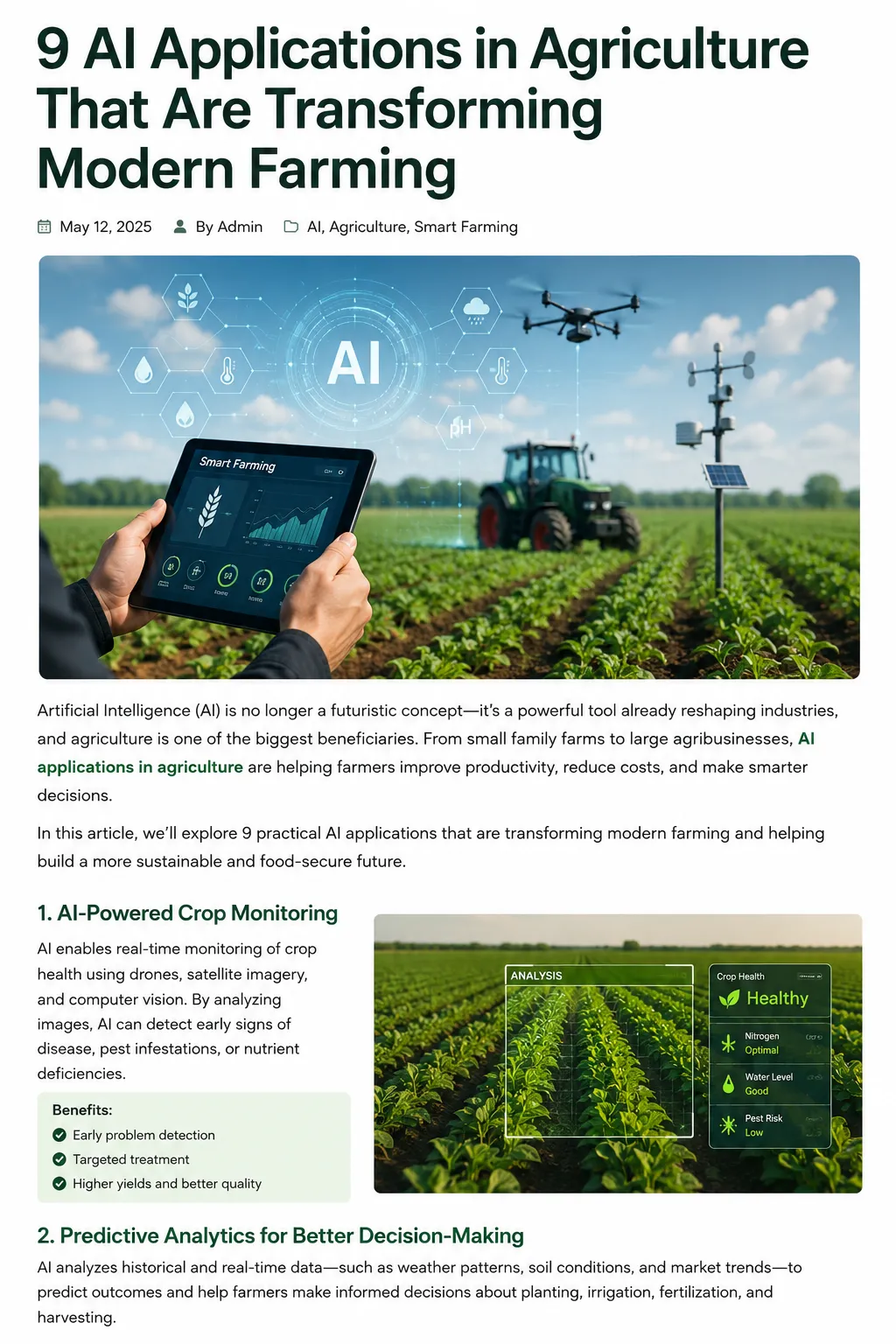
Agriculture is changing rapidly, and artificial intelligence is becoming one of the technologies helping farmers make better decisions with less waste. From identifying crop diseases to predicting yields and monitoring fields, AI applications in agriculture are giving farmers access to information that was once difficult or expensive to collect. Instead of relying only on traditional observation and experience, modern farms can combine human knowledge with data from satellites, drones, sensors, cameras, weather stations, and connected machinery.
The growth of AI applications in agriculture is especially important as farmers face challenges such as changing weather patterns, water limitations, rising input costs, labor shortages, and the need to produce more food efficiently. AI does not replace farmers or guarantee better harvests. Rather, it can help turn large amounts of agricultural data into practical insights that support faster and more informed decisions.
In this article, we will explore nine important AI applications in agriculture and explain how each one is being used in modern farming. Whether you are interested in precision agriculture, smart irrigation, agricultural robotics, crop monitoring, or predictive analytics, these applications show how artificial intelligence is reshaping farming from planting to harvesting.
What Are AI Applications in Agriculture?
AI applications in agriculture refer to the use of artificial intelligence technologies such as machine learning, computer vision, predictive analytics, robotics, and data-processing systems to solve agricultural problems. These technologies can analyze information from fields, crops, soil, weather, machinery, and other sources to identify patterns and support agricultural decisions.
For example, an AI system may analyze images of thousands of plants and identify signs of disease that are difficult to recognize consistently with the human eye. Another system may analyze historical weather and soil information to help estimate when irrigation could be needed. In both cases, AI is being used as a decision-support technology.
The important point is that AI in farming is not a single tool. It is a broad collection of technologies with different applications. Some are designed for large commercial farms, while others are becoming accessible to smaller operations through agricultural software and connected devices.
1. AI-Powered Crop Monitoring
One of the most important AI applications in agriculture is crop monitoring. Farmers need to know how their crops are developing throughout the growing season, but manually inspecting every plant across a large field can be extremely difficult.
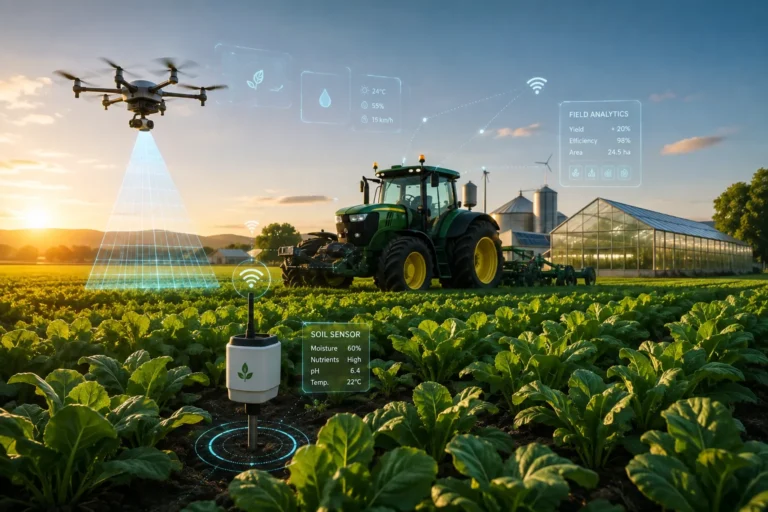
AI-powered crop monitoring systems can analyze images and other agricultural data to identify changes in crop health. Data may come from drones, satellites, agricultural cameras, or sensors installed throughout a field. Machine-learning models can then look for patterns associated with problems such as plant stress, uneven growth, nutrient deficiencies, or disease.
How AI Crop Monitoring Works
Computer vision is particularly useful in this area. Cameras capture images of plants, while AI models analyze characteristics such as color, shape, size, and visible abnormalities.
Instead of simply telling a farmer that something is wrong, more advanced systems can help identify where the problem appears to be concentrated. This allows farmers to investigate specific areas instead of treating an entire field in exactly the same way.
The result can be more targeted decision-making. Farmers may be able to identify potential problems earlier and determine where additional inspection or intervention is necessary.
2. AI for Detecting Crop Diseases
Crop disease can cause significant agricultural losses, which makes early detection extremely valuable. Another growing category of AI applications in agriculture focuses on recognizing disease symptoms using images and machine learning.
A farmer or agricultural worker can potentially use a camera or smartphone to capture an image of a plant. An AI system can compare visual characteristics with patterns learned from agricultural datasets and identify possible disease symptoms.
Why Disease Detection Matters
Traditional disease identification often depends on experience and careful observation. Experienced farmers can recognize many problems, but symptoms can sometimes be subtle or difficult to distinguish from nutrient deficiencies, insect damage, or environmental stress.
AI can provide an additional layer of analysis. If a system identifies a suspicious pattern, the farmer can investigate the plant or field more closely.
However, AI disease detection should not automatically be treated as a definitive diagnosis. Image quality, crop variety, environmental conditions, and the quality of the training data can affect results. Human expertise remains important when deciding what action to take.
3. Smart Irrigation and Water Management
Water management is another area where AI applications in agriculture can make a practical difference. Instead of applying the same amount of water everywhere, smart irrigation systems can use data to help determine where and when irrigation may be necessary.
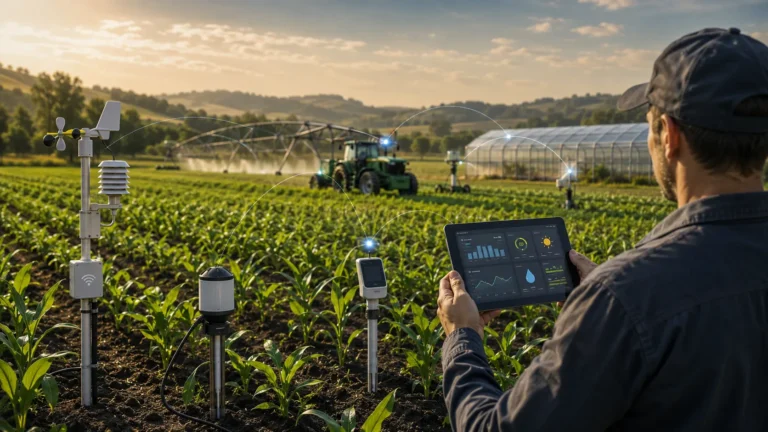
AI can analyze information such as soil moisture, weather forecasts, temperature, crop conditions, and historical irrigation patterns. Based on this information, an intelligent system can recommend or automate irrigation decisions depending on the technology being used.
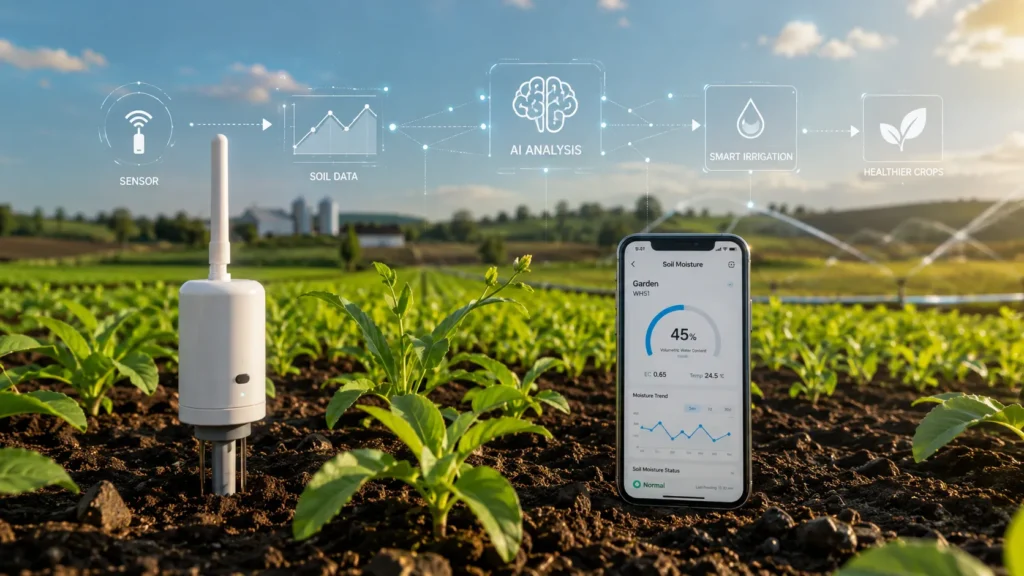
- Interested in this product? Check the link below for more details, or search for the product name directly on Amazon.
AI and Precision Watering
Imagine a large field where some areas retain moisture while others dry out more quickly. Traditional irrigation may distribute water relatively evenly across the field. An AI-supported precision system can potentially identify differences and help farmers apply water more selectively.
This approach can support more efficient water management while also giving farmers better visibility into field conditions.
The actual results depend on the quality of sensors, irrigation infrastructure, weather data, and AI models. AI does not eliminate the need for agricultural knowledge, but it can make water-management decisions more data-driven.
4. AI-Powered Weed Detection
Weeds compete with crops for resources such as water, nutrients, sunlight, and space. Identifying weeds is therefore another valuable application of artificial intelligence.
Computer vision systems can analyze field images to distinguish crops from unwanted plants. This is one of the most interesting AI applications in agriculture because it can support more targeted weed management.
From Field Images to Targeted Action
Cameras mounted on agricultural machinery can capture images while equipment moves through a field. AI software analyzes those images and attempts to identify weeds.
If the system is connected to precision application equipment, the information may potentially be used to target specific areas rather than applying treatment uniformly across an entire field.
This approach is part of a broader movement toward precision agriculture, where inputs are applied according to actual field conditions rather than assumptions that every section of a field is identical.
Accuracy remains essential. Different crop varieties, lighting conditions, soil backgrounds, and weed species can make computer vision challenging. Farmers should therefore evaluate the technology carefully before relying on automated systems.
5. Agricultural Robots and Autonomous Machinery
Robotics is one of the most visible examples of AI applications in agriculture. Agricultural robots can combine cameras, sensors, GPS, machine learning, and automated control systems to perform or assist with farming tasks.
Depending on the system, agricultural robots may be designed for activities such as crop inspection, harvesting, weeding, planting, or transporting materials.
Why Agricultural Robotics Is Growing
Labor availability is an important consideration for many farming operations. Certain agricultural tasks can be repetitive, physically demanding, or require workers during short seasonal windows.
AI-powered machines can potentially assist with these tasks while collecting useful information about the field. For example, a robotic platform might move through crop rows while simultaneously identifying plants and recording field conditions.
Autonomous machinery can also use computer vision and positioning technologies to navigate agricultural environments.
Still, agricultural robotics faces challenges. Farms are unpredictable environments with changing weather, uneven terrain, different crop varieties, and obstacles. Robots must operate safely and reliably under these conditions, which makes development more complicated than deploying automation in a controlled factory.
6. AI for Yield Prediction
Farmers make many decisions before they know exactly how much they will harvest. Yield prediction is therefore another important area where AI applications in agriculture can provide support.
AI systems can analyze historical harvest data together with information about weather, soil, crop development, planting dates, satellite imagery, and other variables. Machine-learning models can use these relationships to estimate potential yields.
How Yield Forecasting Helps Farmers
A more informed yield estimate can support planning throughout the agricultural operation. Farmers may use forecasts when considering storage requirements, harvesting schedules, labor needs, transportation, and marketing decisions.
Yield prediction can also help identify fields or areas that appear to be performing differently from expectations. This gives farmers an opportunity to investigate possible causes.
Of course, agricultural production is influenced by many variables, and no prediction model can know the future with certainty. Extreme weather, pests, disease, equipment problems, and unexpected environmental conditions can all affect the final harvest.
7. AI-Powered Soil Analysis
Healthy soil is fundamental to successful agriculture, making soil analysis another promising area for AI applications in agriculture.
AI systems can combine soil measurements with information about crop history, weather, topography, satellite imagery, and other data sources. The objective is to help farmers understand variations in soil conditions and make better-informed management decisions.
Understanding Field Variability
A single field can contain significant differences in soil characteristics. Some areas may drain quickly, while others retain more water. Nutrient levels can also vary from one location to another.
AI can help analyze these differences when enough quality data is available. Farmers can then use the information to develop more precise management strategies.
This can contribute to the broader concept of site-specific farming, where agricultural inputs and practices are adjusted according to local conditions.
AI should not replace laboratory soil testing or professional agronomic advice where those are appropriate. Instead, it can help organize and interpret large datasets that would otherwise be difficult to analyze manually.
8. AI-Based Pest Detection and Management
Pests can damage crops quickly, making early identification important. AI-powered pest detection systems use computer vision, sensors, and machine learning to identify signs of insect activity or crop damage.
This is another example of how AI applications in agriculture can move farming toward earlier intervention.
Cameras placed in fields can continuously capture images of plants. AI models can analyze those images for visual patterns associated with specific pests or damage. In some systems, additional sensors may provide environmental information that helps contextualize the observations.
Supporting More Targeted Pest Management
Instead of assuming an entire field has the same pest pressure, farmers can potentially use AI-generated information to identify areas requiring closer attention.
This can support precision agriculture by helping farmers investigate problems before they spread widely. It may also help improve the timing of management decisions.
As with disease detection, accuracy is critical. A model trained on one crop, pest, or geographic environment may not perform equally well in another setting. Farmers should understand what conditions the system was designed for and validate important recommendations before acting on them.
9. AI for Farm Management and Decision Support
The final category brings many of the previous applications together. AI can help farmers organize and analyze information across an entire operation, turning farming data into decision-support insights.
Modern farms can generate huge amounts of information from machinery, weather stations, soil sensors, field observations, satellite imagery, irrigation systems, and financial records. Without appropriate tools, managing all of this information can become overwhelming.
AI-powered farm management platforms can analyze multiple datasets and help identify patterns or potential problems. Depending on the system, they may support decisions involving planting, irrigation, crop monitoring, equipment use, labor planning, or harvesting.
Why Decision Support Matters
The real value of AI is often not the algorithm itself but the decision it helps a farmer make.
A farmer does not necessarily need thousands of data points. What matters is turning those data points into useful information: which field needs attention, when irrigation may be necessary, where crops are developing differently, or which areas require closer inspection.
This makes AI a powerful decision-support tool rather than simply another piece of agricultural technology.
Benefits of AI Applications in Agriculture
The growing use of AI applications in agriculture offers several potential advantages. These benefits vary depending on the technology, farm size, crop, location, and quality of implementation.
Better Decision-Making
AI can analyze large datasets much faster than a person manually reviewing the same information. This can help farmers identify patterns and make decisions using more information.
More Precise Resource Management
Precision agriculture technologies can help farmers manage resources such as water, fertilizer, pesticides, fuel, and labor according to specific field conditions.
Earlier Problem Detection
AI-powered monitoring can potentially identify signs of crop stress, pests, weeds, or disease before problems become obvious across an entire field.
Improved Operational Efficiency
Automation and intelligent decision-support tools can help reduce repetitive work and allow farmers to focus their time on higher-value activities.
Data-Driven Farm Planning
Yield prediction and farm analytics can help agricultural businesses plan operations using historical and current information rather than relying entirely on assumptions.
Challenges of Using AI in Agriculture
Despite the potential benefits, AI applications in agriculture also come with important challenges.
The first is data quality. AI systems depend on the information they receive. Poor sensor data, incomplete records, low-quality images, or inaccurate measurements can reduce the usefulness of the resulting analysis.
Cost is another consideration. Advanced agricultural equipment, sensors, software subscriptions, drones, robotics, and connectivity can require significant investment. The financial return may also differ dramatically between farms.
Technical knowledge can create another barrier. Farmers may need training to understand AI recommendations and integrate new systems into existing workflows.
Connectivity is also important. Some AI systems rely on reliable internet or cellular connections to transfer data. Rural areas may face connectivity limitations that affect how easily certain technologies can be deployed.
Finally, AI predictions are not guarantees. Agricultural environments are complex, and unexpected events can always influence results. Human judgment remains essential.
How AI Is Changing Precision Agriculture
Precision agriculture and artificial intelligence are closely connected. Precision agriculture focuses on managing fields according to variations in soil, crops, water, and other conditions, while AI can help process the large amounts of data needed to make those decisions.
For example, a farm could combine satellite imagery, soil sensors, weather information, and crop observations. An AI system could then analyze these sources to identify areas that deserve attention.
This creates a cycle of observation, analysis, action, and measurement. Farmers collect information, AI helps interpret it, farmers make decisions, and the resulting outcomes can provide new data for future decisions.
That feedback loop is one reason AI applications in agriculture are becoming increasingly important to modern farming.
The Future of AI Applications in Agriculture
The future of AI applications in agriculture will likely involve greater integration between technologies rather than isolated tools. A farm may increasingly use connected machinery, drones, sensors, satellites, robots, weather systems, and farm-management software as parts of one larger digital ecosystem.
AI could help connect these sources of information and make them easier to use. Instead of opening multiple systems and manually comparing data, farmers may increasingly receive integrated recommendations or alerts.
Robotics may also become more capable as computer vision, navigation, and machine-learning technologies improve. At the same time, AI-powered tools could become easier to use, making sophisticated agricultural analytics available to a wider range of farms.
The most successful systems will probably be those that solve specific farming problems rather than simply adding technology for its own sake.
How Farmers Can Start Using AI
Farmers interested in AI applications in agriculture do not necessarily need to transform their entire operation overnight. A practical starting point is to identify one specific problem.
For example, a farmer might start with irrigation management, crop monitoring, weed identification, or yield forecasting. The next step is to determine whether reliable data already exists or whether sensors and other equipment are required.
Before investing, farmers should compare the technology’s expected benefits with its total costs. This includes hardware, software, subscriptions, maintenance, training, connectivity, and staff time.
It is also useful to test a system on a limited area before expanding it across the entire operation. A small-scale trial can reveal whether the technology works effectively under local farming conditions.
Conclusion
The rise of AI applications in agriculture is changing how farmers collect information, monitor crops, manage resources, and make decisions. From crop disease detection and smart irrigation to agricultural robotics and yield prediction, artificial intelligence is becoming part of an increasingly connected farming ecosystem.
However, AI is not a replacement for farmers’ experience and judgment. Technology works best when it provides reliable information that helps people make better decisions. The quality of the data, suitability of the technology, local conditions, cost, and ease of use all influence whether an AI solution delivers meaningful value.
As agricultural technology continues to develop, AI applications in agriculture are likely to become more integrated into everyday farm operations. The biggest opportunity may not be a single revolutionary machine, but the ability to combine many sources of information and turn them into practical decisions that help farms operate more efficiently and sustainably.
Frequently Asked Questions
What are the most common AI applications in agriculture?
Some of the most common AI applications in agriculture include crop monitoring, disease detection, weed identification, smart irrigation, pest detection, yield prediction, soil analysis, agricultural robotics, and farm-management decision support.
How does AI help farmers?
AI can analyze agricultural data and identify patterns that may be difficult to detect manually. It can support decisions involving irrigation, crop health, pests, weeds, yields, soil conditions, and farm operations.
Can AI replace farmers?
AI is generally better understood as a decision-support and automation technology rather than a complete replacement for farmers. Agricultural decisions often require local knowledge, experience, physical inspection, and judgment.
Is AI expensive for farmers?
The cost varies significantly depending on the technology. Some software tools may be relatively accessible, while advanced robotics, sensors, drones, and connected machinery can require much larger investments.
What is the future of AI in agriculture?
The future will likely involve more connected agricultural systems in which AI combines information from sensors, satellites, machinery, weather data, drones, and farm-management platforms to support increasingly precise decisions.
Are AI recommendations always accurate?
No. AI systems can make errors, especially when data is incomplete, environmental conditions differ from the training data, or sensors and images are poor quality. Important agricultural decisions should therefore be evaluated using appropriate human expertise and field observations.
- For more informatin click here