11 Smart Farming Technology Solutions Every Modern Farmer Should Know
Introduction
Agriculture has always been about paying attention. Farmers watch the sky, feel the soil, inspect leaves, listen to animals, and make decisions based on years of experience. But modern farming is adding another powerful layer to that knowledge: data. Today, sensors can measure soil moisture, drones can scan crops from above, GPS can guide machinery with remarkable precision, and artificial intelligence can help identify patterns that would be difficult to spot from the ground.
This is where smart farming technology is changing the way farms operate. Instead of treating an entire field as if every square meter has identical needs, farmers can increasingly identify differences in soil, crop health, moisture, pests, nutrients, and yield potential and respond accordingly. The U.S. Department of Agriculture describes modern agricultural technology as including sensors, robotics, aerial imagery, GPS, and precision-agriculture systems that can help farms become more efficient, profitable, safe, and environmentally responsible.
The exciting part is that smart farming is no longer limited to enormous industrial operations. Depending on the crop, farm size, connectivity, and budget, individual technologies can be introduced gradually. A farmer might begin with soil-moisture sensors, add GPS guidance the following season, and later incorporate drones or AI-powered crop monitoring. The goal isn’t to replace agricultural knowledge with machines; it’s to give farmers better information so they can make better decisions at the right moment.
This article explores 11 smart farming technologies every modern farmer should know, how they work, where they can help, and what farmers should consider before investing.
1. IoT Soil and Crop Sensors
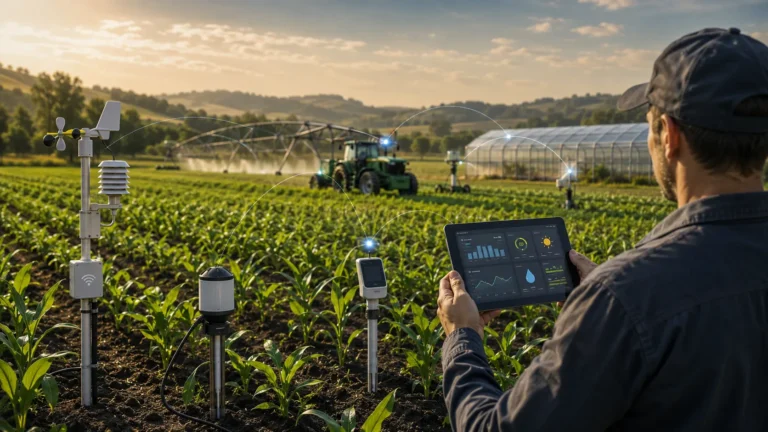
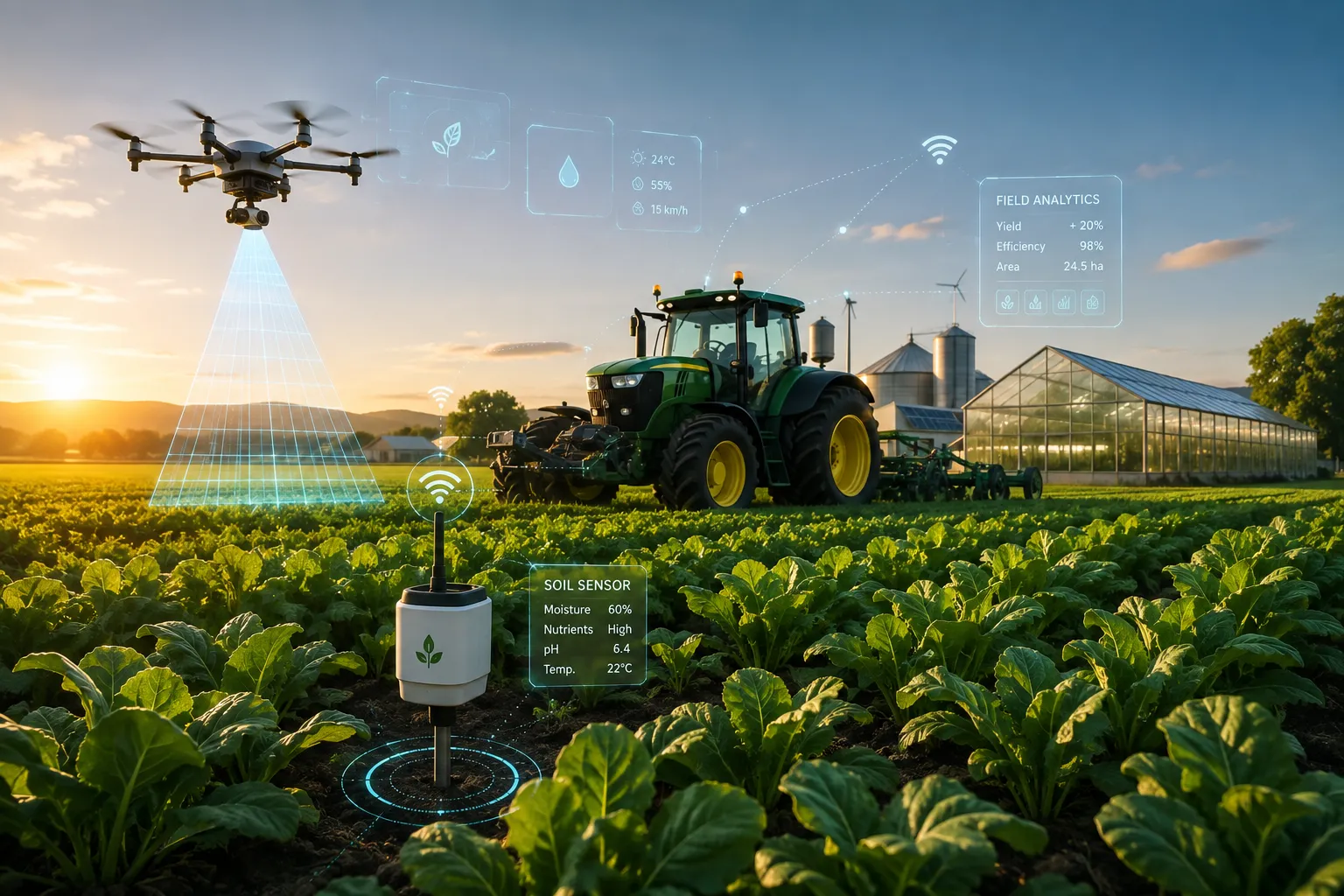
One of the foundations of smart farming technology is the Internet of Things, commonly known as IoT. In agriculture, IoT systems connect physical sensors in fields, greenhouses, irrigation systems, livestock facilities, and machinery so that information can be collected and communicated automatically. Instead of relying entirely on occasional manual measurements, farmers can receive a continuous stream of information about what’s happening on the farm.
Soil-moisture sensors are a particularly practical example. A sensor installed at an appropriate depth can measure how much moisture is available in the soil, helping farmers determine whether irrigation is actually necessary. Other sensors can monitor temperature, electrical conductivity, humidity, weather conditions, or other environmental variables. USDA-supported agricultural research is actively investigating IoT-based sensing networks capable of continuously collecting information about soil, water, crops, and environmental conditions.
Why does that matter? Imagine irrigating an entire field because one section looks dry from the road. Without measurements, the decision is based on an assumption. With sensors, the farmer can see where moisture is actually low and potentially adjust irrigation accordingly.
That can mean less wasted water, fewer unnecessary irrigation cycles, and a clearer understanding of how conditions change throughout the season. USDA’s National Institute of Food and Agriculture notes that modern precision systems can help farmers move away from applying water, fertilizer, and pesticides uniformly across an entire field and instead target resources where they are needed.
The real power comes when sensors don’t operate in isolation. Connect soil data with weather information, irrigation controls, farm-management software, and crop observations, and a simple sensor becomes part of a larger decision-making system.
2. GPS and Precision Agriculture Systems
GPS technology may not sound futuristic anymore, but it remains one of the most important building blocks of modern precision agriculture. Tractors, planters, sprayers, harvesters, and other equipment can use positioning data to understand exactly where they are in a field.
This allows farmers to create repeatable paths, reduce unnecessary overlaps, improve field operations, and manage inputs more precisely. USDA describes precision agriculture as using sensors and technological advances to apply the right amount of resources at the right place and at the right time.
For a farmer managing large fields, even small overlaps can become expensive. Imagine driving a sprayer across the same strip twice. That can mean wasted product, wasted fuel, and potentially excessive application. GPS guidance and automated steering can help reduce those unnecessary passes.
GPS also becomes more powerful when combined with yield maps, soil maps, satellite imagery, and variable-rate application systems. A farmer can build a digital picture of the field rather than treating it as one uniform block.
The technology can also reduce operator fatigue. Long days in a tractor require constant attention to steering and positioning. Automated guidance can handle some of that repetitive work while the operator focuses on the equipment and field conditions.
According to USDA’s 2025 Farm Computer Usage and Ownership report, precision agriculture practices include technologies such as GPS guidance, GPS yield monitoring, soil mapping, variable-rate input application, drones, electronic tagging, precision feeding, and robotic milking.
That list shows how GPS has evolved from simple navigation into part of a much broader digital farming ecosystem.
3. Agricultural Drones
Few technologies capture people’s imagination quite like agricultural drones. A drone can fly over a field and capture images that reveal patterns difficult to see from the ground. With suitable cameras and software, farmers can use those images for crop scouting, plant-health monitoring, weed identification, stand assessment, and other precision-agriculture applications.
Modern UAV systems can carry RGB, multispectral, thermal, hyperspectral, and other sensors. USDA Agricultural Research Service research published in 2025 highlighted UAV applications for monitoring variables such as chlorophyll, nitrogen content, canopy cover, leaf-area index, and crop height.
That’s an enormous shift in perspective.
A farmer walking through a field sees what’s immediately around them. A drone can provide a bird’s-eye view of the entire operation and reveal areas that deserve closer inspection. Instead of randomly scouting hundreds of acres, the farmer can potentially identify unusual zones first and then investigate them on the ground.
Drones are also becoming increasingly useful for weed detection. Recent USDA research compared RGB and multispectral UAV imagery for identifying weeds in soybean fields and reported high classification accuracy for both sensor types in the study, suggesting that less expensive RGB systems can sometimes be practical for precision-agriculture applications.
That is an important point for farmers considering smart farming technology: more advanced hardware isn’t always automatically the best investment. A sophisticated multispectral camera may be valuable for one operation, while an affordable RGB drone could provide enough information for another.
The value comes from turning aerial images into decisions.
4. Satellite Imagery and Remote Sensing
You don’t always need a drone to look at your farm from above. Satellites provide another layer of remote sensing that can help farmers monitor crops and field conditions over large areas.
Satellite imagery can reveal differences in vegetation, crop development, moisture conditions, and other characteristics depending on the sensor and data source. Some systems provide frequent imagery that allows farmers to compare the same field over time.
This becomes especially powerful when combined with other forms of smart farming technology. Satellite imagery can identify an area of interest, a drone can investigate it at higher resolution, and a farmer can then visit the location personally to determine what is actually happening.
For example, suppose one portion of a field begins showing unusual vegetation patterns. That could be caused by water stress, nutrient differences, disease, pests, drainage problems, soil variability, or something as simple as mechanical damage. Imagery doesn’t necessarily tell you the answer by itself. What it does is help you ask a better question.
Modern agricultural research is increasingly combining remote sensing with machine learning and other analytical techniques. USDA research has investigated multi-source data fusion involving remote sensing and machine learning for on-farm yield prediction.
The broader trend is clear: farmers are moving from occasional snapshots toward continuous observation.
5. Artificial Intelligence and Machine Learning
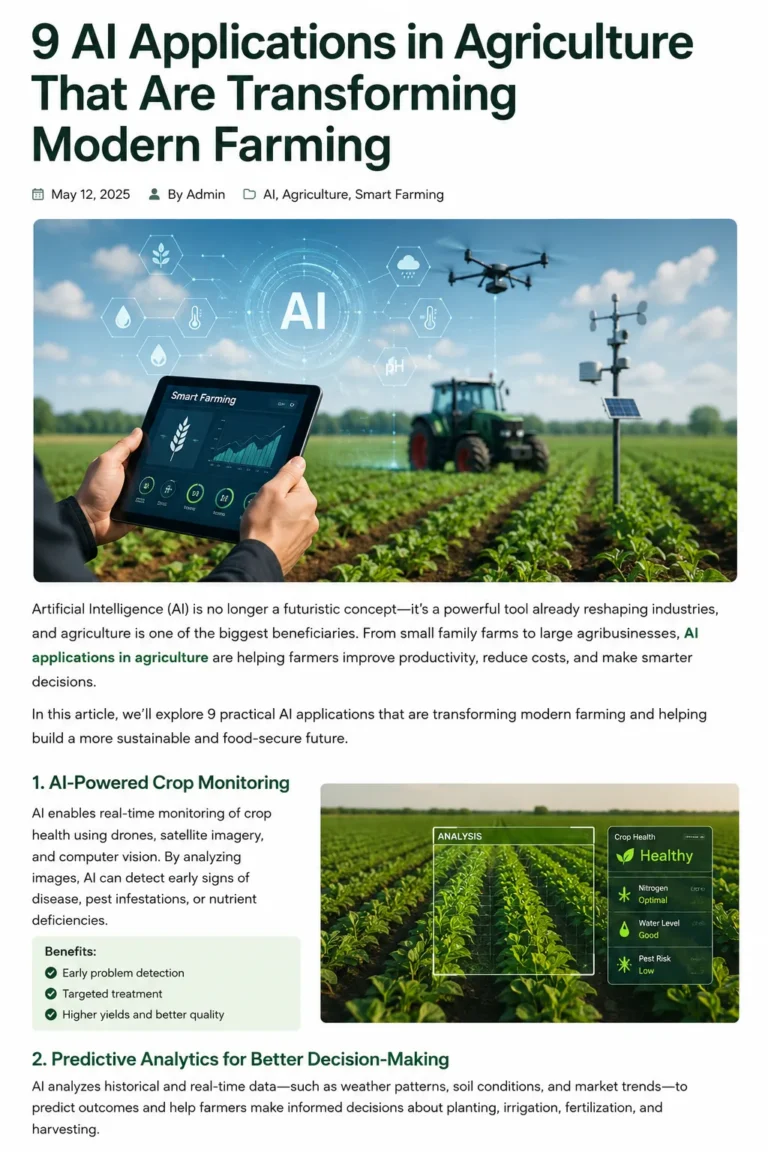
Artificial intelligence may be the most talked-about technology in agriculture right now, but its practical value comes down to a simple question: Can it help a farmer make a better decision?
AI systems can analyze enormous quantities of information much faster than a person can manually process it. In agriculture, those datasets might include weather records, satellite images, drone imagery, soil measurements, yield maps, machinery data, crop-development information, and historical farm records.
USDA’s National Institute of Food and Agriculture identifies agricultural AI applications involving machine learning, remote sensing, satellite imagery, drones, precision technologies, autonomous systems, and intelligent decision-support tools.
Consider crop disease detection. A camera can capture thousands of images, and a trained machine-learning model can analyze those images for visual patterns associated with disease or plant stress. The farmer can then investigate suspicious areas rather than inspecting every plant individually.
AI can also support yield prediction. USDA research published in 2025 has examined machine-learning models that combine multi-temporal UAV data with other information to predict corn yield.
But AI should not be treated like an agricultural crystal ball.
The quality of an AI recommendation depends heavily on the quality and relevance of the data behind it. A model trained under one climate, crop variety, soil type, or management system may not perform equally well somewhere else. Farmers should therefore treat AI as a decision-support tool rather than blindly following every automated recommendation.
The strongest applications are often those where AI handles the enormous volume of data while the farmer supplies the real-world context.
6. Variable-Rate Technology
Traditional farming often applies an input uniformly across a field. Every part receives roughly the same fertilizer rate, seed rate, irrigation treatment, or crop-protection product.
But fields aren’t uniform.
One area may have highly productive soil while another is sandy or compacted. One section may retain water while another dries quickly. One zone may have high nutrient availability while another requires additional nutrients.
Variable-rate technology allows agricultural inputs to be adjusted according to location.
This is one of the clearest examples of how smart farming technology can connect data with physical action. Soil maps, yield maps, crop imagery, GPS information, and sensor readings can help create management zones or prescription maps. Equipment can then adjust application rates as it moves through different areas.
USDA notes that precision agriculture allows farmers to target specific areas instead of applying water, fertilizer, and pesticides uniformly across entire fields.
The potential benefits extend beyond saving money. Applying inputs where they are actually needed can help reduce unnecessary nutrient losses and environmental pressure.
Of course, variable-rate technology requires good data and correctly calibrated equipment. A poor prescription map can produce poor decisions. That’s why data collection, agronomic knowledge, equipment maintenance, and field verification remain essential.
Technology doesn’t eliminate the need for good farming judgment. It gives that judgment better tools.
7. Smart Irrigation Systems
Water is one of agriculture’s most precious resources, and irrigation is an area where technology can make a particularly visible difference.
Traditional irrigation decisions may be based on schedules, experience, weather forecasts, or visual observations. Smart irrigation systems add measurements and automation to the process. Soil-moisture sensors, weather data, crop information, flow meters, and automated valves can work together to determine when and where water should be applied.
The idea isn’t simply to irrigate less. It’s to irrigate more intelligently.
A crop that genuinely needs water should receive it. A field that received substantial rainfall yesterday may not need another irrigation cycle today. An area with different soil characteristics may require a different strategy from the rest of the field.
USDA research is currently investigating precision irrigation through data-driven approaches involving AI, remote sensing, and integrated models.
Smart irrigation can also provide farmers with valuable operational information. If a line suddenly develops a leak or flow drops unexpectedly, monitoring systems may help identify the problem sooner.
For farmers facing water scarcity, rising energy costs, or increasingly unpredictable weather, this type of smart farming technology can become more than a convenience. It can be part of a long-term strategy for protecting one of the farm’s most important resources.
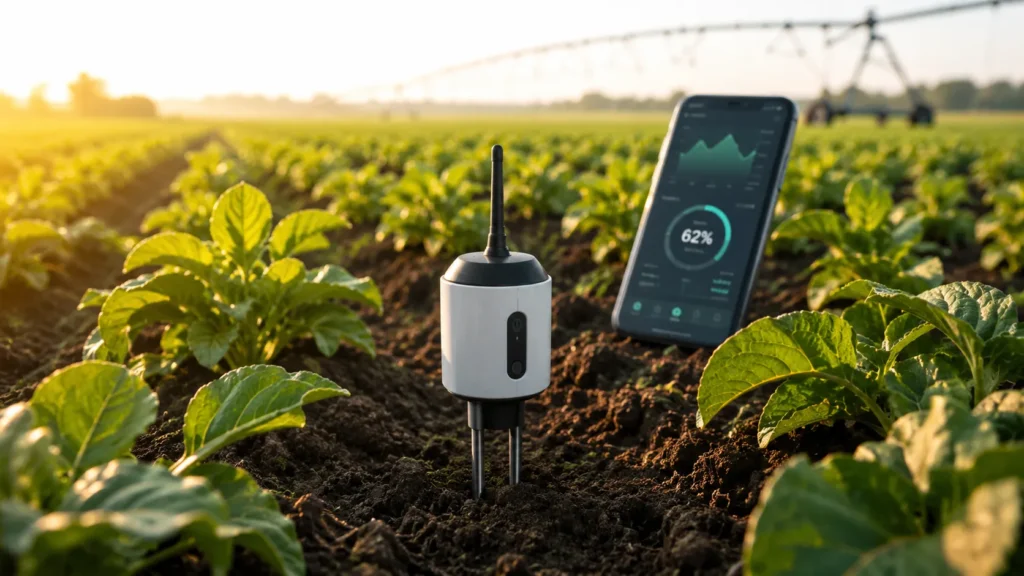
- Interested in this product? Check the link below for more details, or search for the product name directly on Amazon.
8. Autonomous Tractors and Agricultural Robots
The image of a tractor moving across a field without a driver once belonged mostly to science fiction. Today, autonomous and semi-autonomous agricultural systems are becoming an active area of research and development.
Autonomous tractors and robotic machines can use GPS, cameras, radar, LiDAR, sensors, artificial intelligence, and other technologies to navigate fields and perform specific tasks.
The potential advantage is not simply reducing labor. Autonomous systems can potentially operate with high consistency and perform repetitive tasks without requiring a person to manually control every movement.
Agricultural robots are also being developed for tasks such as harvesting, crop monitoring, weed management, and other labor-intensive operations. USDA NIFA specifically identifies autonomous robots as an area of agricultural AI research and notes their potential to perform tasks that have traditionally required substantial human labor.
Imagine a machine capable of moving slowly through a vegetable field while identifying weeds individually. Instead of treating the entire field, the machine could potentially target specific plants.
That concept represents the deeper evolution of precision agriculture: moving from field-level management toward plant-level management.
Still, autonomous equipment comes with serious considerations. Safety, reliability, terrain, connectivity, maintenance, cost, and regulatory requirements all matter. Farmers should evaluate the technology based on a real operational problem rather than buying autonomy simply because it sounds futuristic.
9. Smart Greenhouses and Controlled-Environment Agriculture
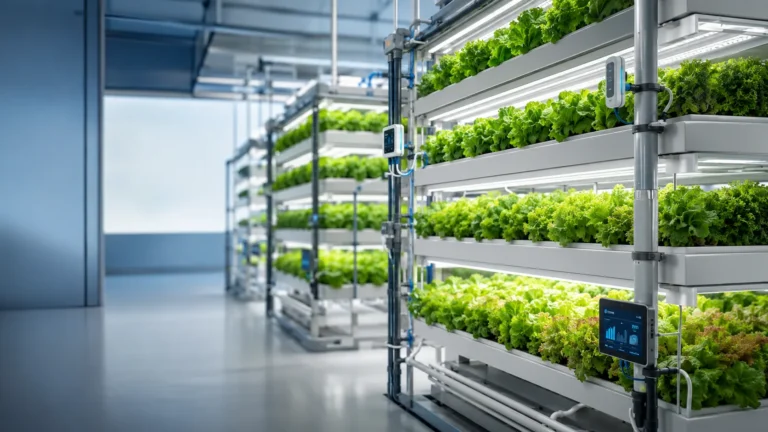
Smart farming isn’t limited to open fields. Greenhouses and controlled-environment agriculture are becoming increasingly sophisticated through the use of sensors, automation, software, and connected equipment.
Inside a smart greenhouse, sensors can monitor temperature, humidity, light, carbon dioxide, moisture, and other environmental variables. Automated systems can then adjust ventilation, irrigation, shading, lighting, or climate controls.
This gives growers a level of environmental control that is difficult to achieve outdoors.
Instead of simply reacting to the weather, growers can create a more stable environment for plants. The system can continuously monitor conditions and respond when measurements move outside desired ranges.
The most interesting part is the integration. A greenhouse sensor can detect low moisture. Software can evaluate the reading. An irrigation system can deliver water. Another sensor can verify the result.
That creates a feedback loop.
And feedback loops are at the heart of smart farming technology.
The technology can be particularly valuable for high-value crops where environmental precision has a strong relationship with quality and yield. However, controlled environments can require significant capital, energy, infrastructure, and technical expertise. Smart greenhouse technology should therefore be evaluated as a business system, not simply as a collection of gadgets.
10. Livestock Monitoring and Wearable Sensors
Smart agriculture isn’t just about crops. Livestock operations are also benefiting from connected sensors and digital monitoring systems.
Wearable devices can help monitor animal movement, activity, location, feeding behavior, temperature, or other indicators depending on the system. Electronic identification can connect individual animals to digital records, making it easier to manage health, breeding, feeding, and production information.
This technology can be especially valuable because animals cannot tell us directly when something is wrong.
A change in movement or behavior may provide an early indication that an animal deserves closer attention. Instead of discovering a problem after obvious symptoms appear, farmers can potentially investigate unusual patterns earlier.
USDA’s 2025 precision-agriculture statistics explicitly include technologies such as electronic tagging, precision feeding, and robotic milking among the practices used to manage livestock.
The goal isn’t to turn farming into a sterile laboratory. Good livestock management will always require observation and experience. Sensors simply provide another set of eyes.
When connected to farm-management software, these systems can also help organize records that would otherwise be difficult to maintain manually.
For larger operations especially, digital livestock monitoring can transform scattered observations into searchable, structured information.
11. Farm Management Software and Digital Platforms
You can have the best sensors, drones, GPS equipment, and machines in the world, but if all that information remains scattered across different systems, its value becomes limited.
This is why farm-management software is such an important part of the modern agricultural technology landscape.
A digital farm-management platform can bring together information about fields, crops, inputs, machinery, weather, irrigation, workers, yields, livestock, and finances. The exact features vary, but the underlying idea is the same: create a central place where farmers can organize information and make decisions.
Think of it as the farm’s digital memory.
Instead of trying to remember what was planted in a particular field, how much fertilizer was applied, when irrigation occurred, or what yield was achieved last season, the information can be recorded and retrieved.
Over time, that historical record becomes extremely valuable.
Farmers can compare seasons, identify trends, evaluate decisions, and improve future management. When connected with smart farming technology, software can also receive data automatically from sensors and equipment.
This is where individual technologies begin to become a real system.
A soil sensor produces data. A drone produces imagery. GPS equipment produces location information. A weather station produces environmental data. Farm-management software can bring those pieces together.
The result isn’t simply more data. Ideally, it is better information for better decisions.
How Smart Farming Technology Is Changing Modern Agriculture
The biggest change isn’t any single machine or sensor. It’s the shift from generalized management toward increasingly precise, data-driven decisions.
Traditional farming has always involved precision in its own way. Experienced farmers know which parts of their land drain poorly, where weeds tend to appear, which animals behave differently, and which fields respond best to particular management practices.
Smart technology doesn’t erase that knowledge.
Instead, it can help capture, measure, organize, and expand it.
A farmer might already know that one corner of a field tends to dry out. A soil sensor can quantify the moisture difference. A drone can show the crop response. A yield monitor can reveal what happens at harvest. Farm-management software can preserve the information for next year.
That creates a continuous learning cycle.
USDA NIFA emphasizes that agricultural technology can help improve productivity while reducing water, fertilizer, and pesticide use and reducing impacts on ecosystems.
The opportunity is particularly powerful because agricultural decisions are often highly location-specific. The best answer for one field may be completely wrong for another.
Smart farming technology makes that variability visible.
Benefits of Smart Farming Technology
The benefits depend on the technology and farm, but several themes appear repeatedly.
Better Resource Efficiency
Precision systems can help farmers target inputs more accurately. Instead of automatically applying the same amount everywhere, technology can help identify where water, fertilizer, or crop protection is most needed.
Earlier Problem Detection
Sensors, drones, cameras, and AI can identify unusual patterns before they become obvious from the ground. Earlier detection can give farmers more time to investigate and respond.
Better Record Keeping
Digital platforms can turn years of observations into useful historical data. That can improve planning and make it easier to compare management strategies.
Reduced Labor Pressure
Automation and robotics can take over certain repetitive or physically demanding tasks. This doesn’t eliminate agricultural workers, but it can change how their time is used.
Potential Cost Savings
Using fewer unnecessary inputs, reducing overlapping passes, detecting equipment problems earlier, and improving operational efficiency can all contribute to lower costs.
Environmental Benefits
More precise application can reduce unnecessary water, fertilizer, and pesticide use. USDA specifically identifies reduced resource use and environmental impact among the potential benefits of agricultural technology.
What Are the Challenges of Smart Farming?
It would be a mistake to present smart farming as a magic solution.
The technology has challenges.
Cost is an obvious one. A farmer may need sensors, connectivity, software subscriptions, compatible machinery, installation, maintenance, and training. The initial investment can be significant.
Connectivity can also be a problem. Some farms operate in areas where reliable high-speed internet or cellular service is limited. A smart system that depends on continuous connectivity may not perform as expected if the infrastructure isn’t available.
Data quality matters enormously. A faulty sensor can produce faulty information. A poorly calibrated machine can create inaccurate application maps. Bad data can lead to bad decisions.
Then there is the human side.
Farmers need to understand what the technology is actually telling them. A dashboard filled with colorful charts isn’t automatically useful. The best systems translate complex measurements into clear actions.
There are also concerns around data ownership and privacy. Farmers should understand who owns the data generated by their equipment, how it is stored, whether it can be shared, and what happens if they change software providers.
The smartest approach is therefore not to adopt technology simply because it is new.
Adopt it because it solves a real problem.
How to Choose the Right Smart Farming Technology
Before spending money, ask a simple question:
What problem am I trying to solve?
If irrigation is inefficient, start with soil-moisture monitoring and irrigation controls.
If crop scouting takes too much time, investigate drone imagery or satellite monitoring.
If machinery overlaps are costing money, GPS guidance may be a better investment.
If labor shortages are the biggest challenge, automation or robotics may deserve attention.
If you’re drowning in spreadsheets and disconnected records, farm-management software could have a higher return than another physical device.
Start small.
Choose one measurable problem, establish a baseline, introduce the technology, and compare the results.
That approach makes it easier to determine whether the investment is actually working.
You don’t need to transform your entire farm in one season.
In many cases, the most successful digital transformation happens one practical improvement at a time.
The Future of Smart Farming Technology
The future of agriculture is likely to become increasingly connected.
Sensors will generate more information. Drones will collect more detailed imagery. Satellites will provide increasingly useful observations. AI models will become better at recognizing patterns. Robots will become more capable. Farm-management platforms will connect more pieces of the operation.
But the real breakthrough won’t simply be collecting more data.
It will be turning that data into timely decisions.
Imagine a future system where soil sensors detect declining moisture, weather data predicts several hot days, crop imagery identifies early stress, and an intelligent irrigation system adjusts water delivery automatically. The farmer doesn’t need to manually examine every data point. Instead, the system highlights the situation and explains why action may be needed.
We’re already seeing pieces of this future emerge in agricultural research. USDA projects are combining UAVs, AI, remote sensing, machine learning, sensors, and predictive models for crop monitoring, yield estimation, water management, and precision agriculture.
The direction is unmistakable.
Agriculture is becoming more connected, more measurable, and increasingly capable of responding to differences within a field rather than treating everything the same.
Conclusion
Smart farming technology is changing agriculture from the ground up.
GPS guidance can make field operations more precise. IoT sensors can reveal what is happening beneath the soil. Drones and satellites can provide a new perspective from above. AI can analyze enormous datasets and identify patterns. Variable-rate systems can help farmers apply inputs according to local conditions. Smart irrigation can make water management more responsive, while robotics and autonomous machinery can tackle repetitive tasks.
Yet technology alone isn’t the answer.
The strongest farms of the future won’t necessarily be the ones with the most gadgets. They will be the farms where technology, agronomic knowledge, practical experience, and good decision-making work together.
A sensor cannot replace a farmer’s understanding of the land. A drone cannot replace walking a field when something looks wrong. An AI model cannot understand every local condition. But when these tools are used thoughtfully, they can give farmers something incredibly valuable: better information at the moment it matters most.
For farmers considering their first step into digital agriculture, the best approach is simple. Identify one real problem, choose technology that directly addresses it, measure the results, and expand only when the value becomes clear.
The future of farming isn’t about replacing the farmer.
It’s about giving the farmer better eyes, better information, and better tools.
And that may be the most powerful promise of smart farming technology.
Frequently Asked Questions
1. What is smart farming technology?
Smart farming technology refers to digital and connected tools used to monitor, manage, automate, and optimize agricultural operations. Examples include IoT sensors, GPS guidance, drones, satellite imagery, artificial intelligence, robotics, variable-rate equipment, smart irrigation systems, and farm-management software. USDA identifies sensors, robotics, aerial imagery, GPS, and precision-agriculture systems as important components of modern agricultural technology.
2. What is the most useful smart farming technology for beginners?
There isn’t one technology that works for every farm. Soil-moisture sensors, GPS guidance, basic farm-management software, and drone-based crop scouting can be practical starting points depending on the farm’s biggest challenge. The best first investment is usually the one that addresses a measurable problem and can demonstrate a clear return.
3. How can smart farming technology reduce water use?
Smart irrigation systems can combine soil-moisture measurements, weather information, crop requirements, and automated controls to make irrigation more targeted. Instead of following a fixed schedule regardless of conditions, farmers can use real-time information to determine when and where water is actually needed. USDA research is actively investigating precision irrigation using AI, remote sensing, and integrated models.
4. Can small farms benefit from smart farming technology?
Yes. Smart agriculture doesn’t have to mean purchasing autonomous tractors or installing an enormous network of sensors. Smaller farms can begin with relatively focused technologies such as weather stations, soil sensors, GPS tools, drone scouting, digital records, or automated irrigation. Starting with one specific problem can make adoption more affordable and easier to evaluate.
5. Will AI replace farmers?
AI is more likely to become a decision-support tool than a complete replacement for farmers. Agricultural decisions depend on local weather, soil conditions, crop history, equipment, markets, experience, and countless factors that cannot always be captured by a model. USDA describes agricultural AI applications in areas such as monitoring, predictive analytics, decision support, and autonomous systems, emphasizing its role in augmenting agricultural capabilities.
Learn more. Choose smarter . For more information, click here