9 Smart Farming IoT Solutions That Are Changing Modern Agriculture
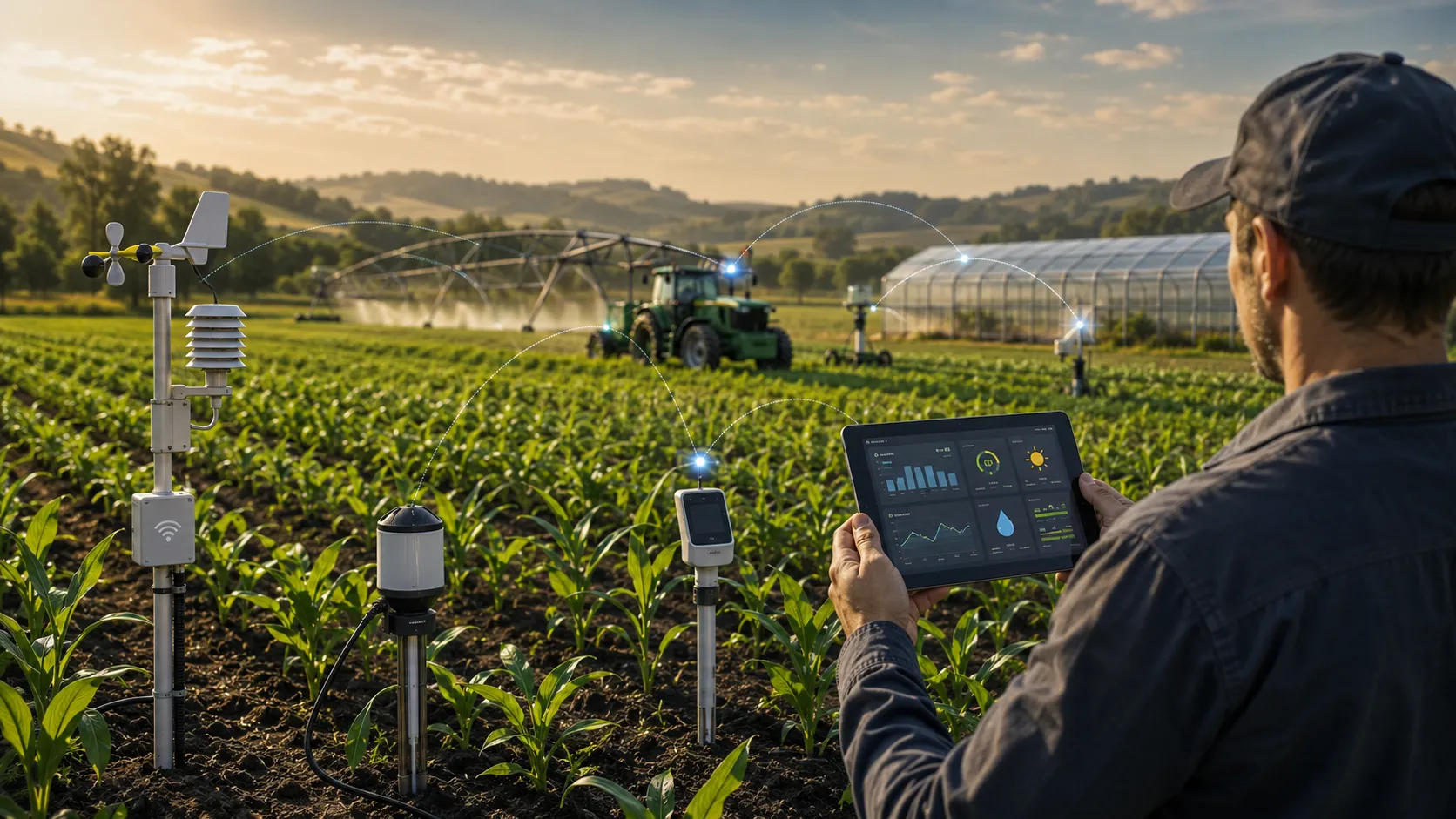
This is where smart farming IoT solutions are making a real difference. Internet of Things (IoT) technology connects sensors, equipment, software, irrigation systems, livestock-monitoring devices, and other farm assets so that information can be collected and shared in real time. Instead of asking, “What is happening in this field?” a farmer can increasingly look at a dashboard and see measurements from soil, crops, weather, machinery, or livestock without physically checking every location.
The idea isn’t to replace farmers with technology. Quite the opposite. The most useful systems are designed to give farmers better information so they can make better decisions. The U.S. Department of Agriculture’s National Institute of Food and Agriculture describes modern agricultural technology as increasingly combining sensors, devices, machines, information technology, precision agriculture, and automation to improve efficiency and resource management.
Agriculture has always depended on observation. Farmers watch the weather, examine their soil, monitor crops, check irrigation systems, and notice when animals behave differently. But modern farms are becoming far more connected, allowing farmers to collect information continuously instead of relying only on occasional inspections and experience.
For a farmer, that could mean knowing when a field actually needs irrigation, spotting an unusual crop condition earlier, tracking livestock activity, identifying equipment problems, or reviewing farm operations from a smartphone.
The technology is evolving quickly, but the underlying principle is remarkably simple: measure what is happening, understand the information, and act at the right time.
How IoT Works in Modern Farming
Before looking at the nine major solutions, it helps to understand what actually happens behind the scenes.
The Internet of Things in agriculture is essentially a connected chain. Physical sensors collect information from the farm, communication technology sends that information somewhere it can be stored, software organizes and analyzes it, and the resulting information helps a farmer or automated system make a decision.
The basic process looks like this:
Sensors → Connectivity → Cloud/Data Platform → Data Analysis → Farmer Decision or Automated Action
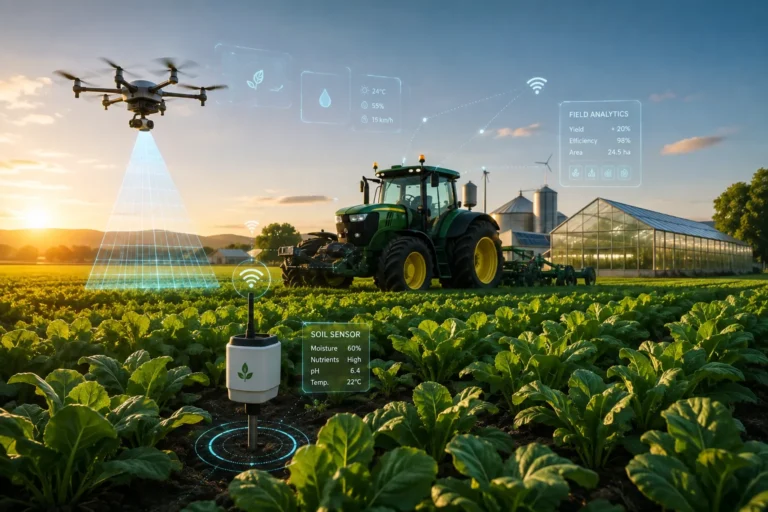
Imagine a soil-moisture sensor installed in a tomato field. The sensor measures moisture around the root zone. A low-power connection sends that reading to a gateway or cloud platform. The software displays the information and may compare it with weather conditions or irrigation thresholds. The farmer then receives an alert or the irrigation system automatically responds, depending on how the system has been configured.
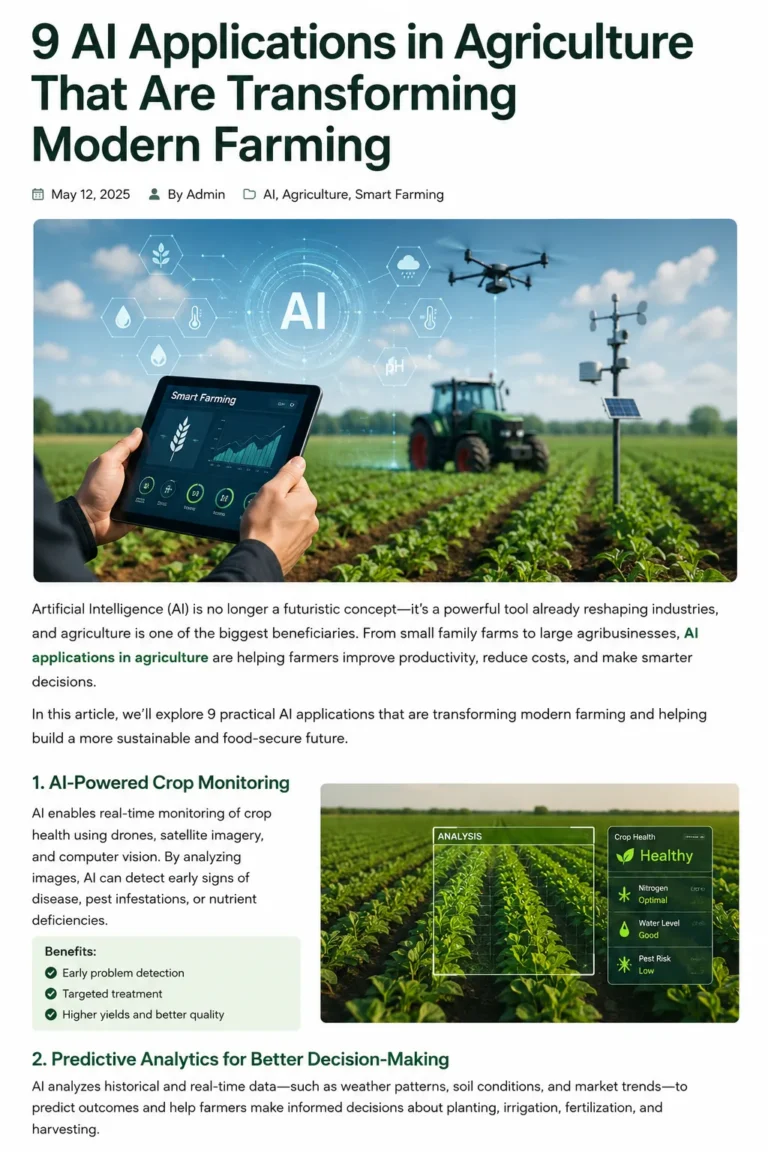
That simple example can become much more sophisticated. Modern research is combining IoT sensors with drones, satellite imagery, machine learning, and crop models to collect high-resolution information about soil, water, crops, and environmental conditions.
The important thing is that IoT isn’t one device. It is an ecosystem of connected devices and software.
A sensor on its own produces a measurement. A connected sensor produces information that can be used elsewhere. When that information is combined with other data and linked to an action, it becomes much more useful.
1. IoT Soil Moisture and Soil Monitoring Sensors
Soil is one of the most important parts of any farm, yet much of what happens beneath the surface is invisible. A field can look perfectly healthy while moisture levels vary significantly from one area to another. This is why soil-monitoring sensors are among the most practical smart farming IoT solutions available today.
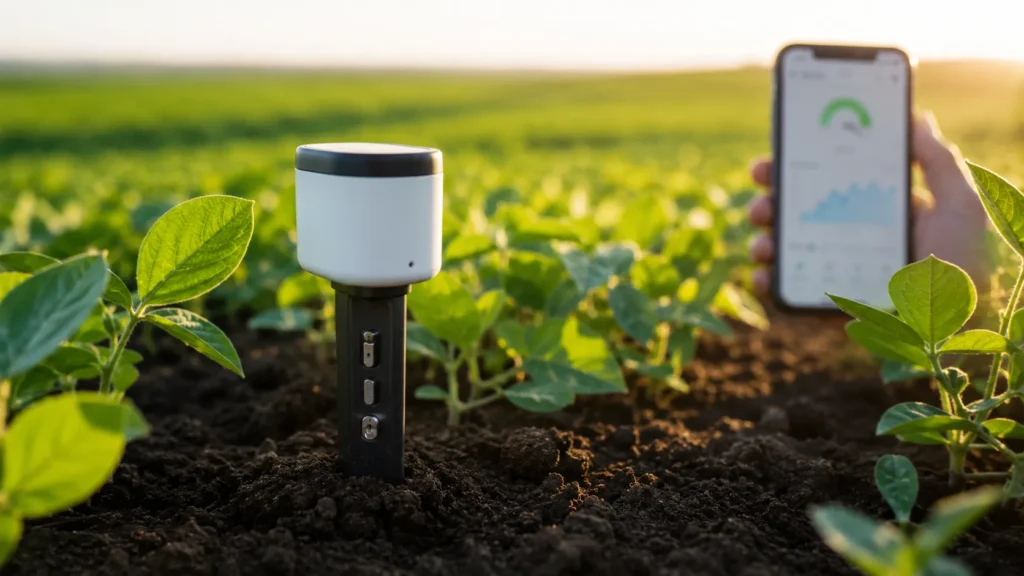
- Interested in this product? Check the link below for more details, or search for the product name directly on Amazon.
What Are IoT Soil Sensors?
IoT soil sensors are connected devices placed in or near the soil to measure conditions that matter for plant growth and farm management. Depending on the sensor, they may measure soil moisture, temperature, electrical conductivity, water tension, or nutrient-related characteristics.
The data can be transmitted wirelessly to a gateway or online platform, allowing farmers to monitor conditions without manually taking measurements throughout the field.
Recent USDA-supported research illustrates how far this technology is developing. Researchers are working with sensors that can measure soil water tension and nitrate levels, while other small sensors can monitor conditions directly on plant leaves and stems. The system can transmit readings through a low-power radio connection to an internet-connected gateway.
How Farmers Can Use the Data
Suppose one part of a field is drying much faster than another. A farmer who has soil sensors distributed across those areas can see the difference rather than treating the whole field identically.
That information can support better irrigation scheduling, help identify drainage problems, and provide a clearer picture of how soil conditions change throughout the growing season.
Main Benefits
The biggest advantage is visibility. Soil sensors can turn something that was previously difficult to observe into measurable information.
They can help farmers:
- Monitor root-zone moisture.
- Identify dry or excessively wet areas.
- Improve irrigation timing.
- Compare conditions between different field zones.
- Build historical soil-condition records.
Limitations and Challenges
Sensors aren’t maintenance-free. They need correct installation, calibration, power, protection from weather, and periodic checking. A sensor that becomes damaged or poorly positioned can produce misleading information.
Recent USDA-funded research provides a useful reminder of this reality: field trials found that some experimental sensors experienced hardware problems under harsh conditions, leading researchers to redesign components and improve power management.
In other words, good data starts with reliable hardware.
2. Smart Irrigation Systems
Water management is one of the clearest applications of IoT in agriculture.
Traditional irrigation can rely heavily on schedules and experience. Those methods can work, but they don’t always reflect what’s happening in the soil or what the weather is doing right now. Smart irrigation systems add sensors, connectivity, software, and automated controls to make irrigation more responsive.
How Smart Irrigation Works
A connected irrigation system may receive information from soil-moisture sensors, weather stations, flow meters, crop-monitoring devices, and forecasts.
The system can then determine whether irrigation is necessary and, depending on the setup, activate pumps, valves, or irrigation zones.
For example, imagine a farm divided into several irrigation zones. One zone received heavy rainfall while another remained relatively dry. A conventional schedule might irrigate both areas anyway. A smart system can potentially use sensor information to distinguish between them.
USDA research is actively exploring precision irrigation systems that combine sensors, remote sensing, AI, and data-driven models to improve irrigation management.
What Data Does It Collect?
Depending on the system, farmers may see:
- Soil moisture.
- Soil water tension.
- Irrigation flow.
- Water application.
- Weather conditions.
- Temperature.
- Humidity.
- Crop-related measurements.
Why It Matters
The objective isn’t simply to use less water. Crops need adequate water, and insufficient irrigation can be just as problematic as excessive irrigation.
The goal is better timing and better targeting.
When irrigation decisions are based on actual field conditions, farmers may be able to reduce unnecessary irrigation, improve resource management, and respond more quickly to changing weather.
Challenges
Smart irrigation requires reliable sensors, pumps, valves, communication networks, and power. If connectivity fails or a sensor gives an incorrect reading, an automated decision can also be wrong.
That is why farmers should maintain manual checks and establish fail-safe procedures rather than assuming automation will always work perfectly.
3. IoT Weather Stations
Weather can change the direction of an entire growing season.
A sudden heatwave, unexpected rainfall, strong winds, or a prolonged period of humidity can influence irrigation, disease pressure, spraying conditions, and crop development. An IoT-connected weather station gives farmers a much more localized view of what’s happening on their own property.
What Is an IoT Weather Station?
A connected agricultural weather station combines environmental sensors with communication technology. Depending on the equipment, it can collect information such as temperature, humidity, rainfall, wind speed, wind direction, solar radiation, and other weather-related measurements.
Instead of checking a weather application that represents conditions somewhere else, farmers can monitor conditions at or near their fields.
That distinction matters.
Weather can vary considerably across a region. A farm’s own measurements can provide valuable context when making field-level decisions.
Practical Example
Imagine a farmer preparing to spray a crop. Weather conditions may affect whether the application is appropriate. Having current local information about wind, temperature, humidity, and recent rainfall can support a more informed decision.
Weather information can also be combined with soil-moisture readings. If the soil is already adequately moist and rainfall is expected, irrigation may need to be reconsidered.
Benefits and Limitations
IoT weather stations can support irrigation planning, crop monitoring, disease-risk assessment, field operations, and historical record keeping.
But one weather station doesn’t necessarily represent an entire large farm. Placement matters, sensors require maintenance, and measurements should be interpreted in context.
The value comes from connecting weather data with other farm information, not simply collecting another number on a dashboard.
4. Connected Crop Monitoring Sensors
Walking through a field remains one of the best ways to understand crops. But modern connected crop-monitoring systems can give farmers another set of eyes.
Crop sensors can measure or estimate characteristics related to plant condition, environmental stress, temperature, moisture, canopy development, and other variables. Some systems use cameras, while others use specialized sensors.
How Crop Monitoring Works
Sensors can be positioned in fields, attached to equipment, installed in protected monitoring stations, or integrated with imaging systems.
The collected information can reveal changes over time.
For example, if one part of a field begins developing differently from the surrounding crop, connected monitoring may identify the change earlier than a farmer’s normal inspection schedule.
USDA-supported research is combining IoT sensing with RGB, multispectral, thermal, and other imaging technologies to monitor crops and environmental conditions at high spatial and temporal resolution.
What Can Farmers Learn?
Depending on the technology, crop-monitoring systems may help identify:
- Changes in crop growth.
- Temperature stress.
- Moisture-related stress.
- Differences between field zones.
- Development patterns.
- Areas requiring closer inspection.
This doesn’t mean the sensor automatically knows why a crop looks different.
A stressed plant could be suffering from insufficient water, nutrient issues, disease, pests, soil variability, or environmental conditions. The technology identifies a signal; the farmer still needs to investigate the cause.
The Main Advantage
The biggest benefit is earlier awareness.
Instead of discovering a problem after it becomes visually obvious across a large area, farmers can use connected monitoring to identify areas that deserve attention.
That can make field scouting more targeted and potentially save valuable time.
5. IoT-Based Pest and Disease Monitoring
Pests and diseases can move quickly, and timing matters.
A farmer who discovers a problem early may have more management options than someone who notices it only after substantial damage has occurred. This is where connected sensors, cameras, environmental monitoring, and IoT platforms can contribute.
How It Works
IoT-based pest and disease monitoring can combine different types of information. Sensors may monitor environmental conditions associated with disease development, while cameras or traps can help detect insects or changes in plant appearance.
The information can be sent to a central platform where farmers receive alerts or review trends.
Research summarized through the FAO’s AGRIS database identifies IoT-enabled equipment and unmanned aerial vehicles as tools that can support surveillance of pests and diseases in crops.
A Practical Example
Consider a greenhouse where temperature and humidity are continuously monitored.
If environmental conditions move into a range that increases concern about a particular crop problem, the system could alert the grower to inspect the plants more closely.
The alert doesn’t mean disease definitely exists. It means the conditions deserve attention.
That distinction is important because responsible agricultural technology should support scouting and diagnosis rather than pretend every alert is a confirmed problem.
Benefits
Connected pest and disease monitoring can help farmers:
- Detect unusual conditions earlier.
- Target field scouting.
- Monitor insect activity.
- Combine environmental information with crop observations.
- Build historical records.
Challenges
False alarms are possible. Sensors can fail. Disease symptoms can resemble other forms of plant stress. AI-based image recognition can also perform differently depending on crop variety, lighting, disease stage, and image quality.
The technology is most useful when it works alongside agronomic expertise.
6. Smart Greenhouse Monitoring and Automation
A greenhouse gives growers something that outdoor farming cannot provide to the same degree: greater control over the growing environment.
IoT makes that control even more sophisticated.
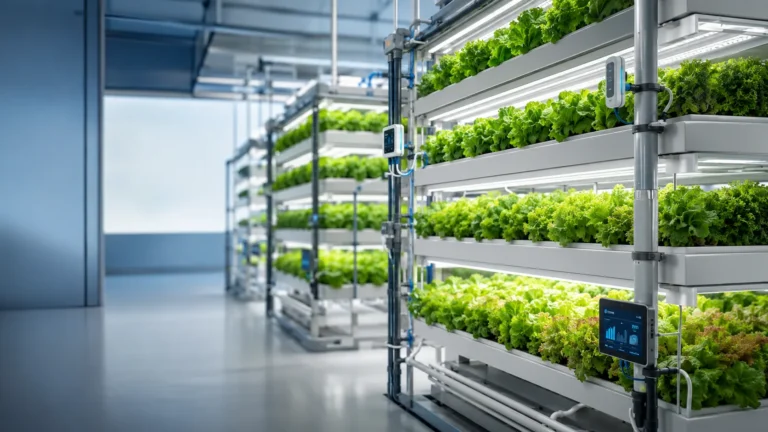
A smart greenhouse can use connected sensors to continuously monitor temperature, humidity, soil or growing-media moisture, light levels, carbon dioxide, and other environmental conditions. Automated equipment can then respond according to predefined rules.
What Happens Inside a Smart Greenhouse?
Imagine the temperature starts rising rapidly.
A connected sensor detects the change. The data reaches the control platform. The system determines that ventilation is required. Depending on the setup, automated vents, fans, shade systems, or other equipment can respond.
The same concept can apply to irrigation.
If growing-media moisture drops below a chosen threshold, the system can activate irrigation and then stop once the desired condition is reached.
This creates a continuous feedback loop.
Measure → Analyze → Act → Measure Again
Why Farmers Use It
The attraction is consistency.
Instead of manually checking greenhouse conditions throughout the day, growers can monitor them remotely and automate routine responses.
That can save labor and make environmental management more precise.
The Catch
Automation introduces more components that can fail.
If a temperature sensor fails or an automated ventilation system stops working, the consequences can be serious. This makes backup procedures, alarms, maintenance, and manual intervention especially important.
Smart greenhouse systems should therefore be designed with reliability in mind, not just convenience.
7. Livestock Tracking and Health Monitoring
IoT isn’t just for crops.
Connected technology is increasingly being used to monitor livestock, helping farmers understand animal activity, location, feeding behavior, and other indicators depending on the system.
How Livestock IoT Works
Animals can wear or carry connected devices such as tags, collars, or other sensors. These devices collect information and transmit it to a farm platform.
The exact data varies by technology, but the system may help farmers monitor movement, activity, location, or behavioral changes.
The principle is simple: an unusual change can be a reason to look closer.
For example, if an animal’s normal activity pattern changes, the farmer may investigate whether there is a health, feeding, environmental, or management issue.
This does not replace veterinary care or direct observation. It can simply help farmers notice changes sooner.
Benefits
Connected livestock monitoring can support:
- More organized animal records.
- Earlier identification of unusual behavior.
- Location tracking.
- Better herd management.
- Remote monitoring.
- More efficient use of labor.
USDA’s agricultural technology reporting includes electronic tagging and other precision livestock practices among the technologies being used in modern agricultural operations.
Challenges
Wearable devices need reliable batteries, durable construction, suitable connectivity, and proper attachment. Farmers also need to understand what the measurements actually mean.
A behavioral change is a signal—not a diagnosis.
The best systems help farmers decide which animal needs attention and when, allowing human expertise to take over from there.
8. Connected Farm Equipment and Machinery
Modern tractors and agricultural machines are becoming increasingly connected.
Equipment can generate information about location, operating conditions, fuel or energy use, work performed, maintenance needs, and field operations, depending on the machine and available systems.
What Makes Equipment “Connected”?
A connected machine can communicate information to other devices or a farm-management platform.
GPS can show where machinery is operating. Sensors can monitor machine conditions. Digital systems can record field operations.
This can create a detailed operational history.
Instead of asking, “When did we last work this field?” a farmer may be able to look at a digital record.
Practical Example
Suppose a tractor is operating in a large field.
A connected system may record its route and operation. The information can then be used to understand where work has already been completed and potentially reduce unnecessary passes.
The same principle applies to maintenance.
If machinery reports an abnormal operating condition, an alert may encourage the operator to inspect the equipment before a small issue becomes a larger problem.
Benefits
Connected machinery can support:
- Better equipment utilization.
- Operational tracking.
- Maintenance planning.
- Reduced unnecessary field passes.
- Better record keeping.
- Integration with precision-agriculture systems.
USDA identifies GPS, sensors, and precision technologies as major components of modern agricultural technology and notes their role in improving efficiency and management.
Challenges
Farmers should pay close attention to compatibility.
Different machines and software platforms may not communicate smoothly. Proprietary systems can also make it difficult to move data between platforms.
Before investing, ask whether the equipment can work with the systems you already use—and whether you can access your own data in a useful format.
9. IoT Farm Management and Real-Time Data Platforms
All these sensors produce something valuable: data.
But data sitting in separate devices isn’t nearly as useful as data that farmers can understand and act upon. This is why connected farm-management platforms are becoming an important part of smart farming IoT solutions.
What Is a Farm Data Platform?
A farm-management platform can collect information from multiple sources and present it in one place.
Depending on the platform, it may integrate:
- Soil sensors.
- Weather stations.
- Irrigation systems.
- Machinery.
- Crop monitoring.
- Livestock information.
- Field records.
- Satellite or drone data.
The goal is to turn scattered measurements into a clearer picture of farm operations.
USDA describes precision agriculture as a process involving high-resolution data collection, analysis, and precise implementation of treatments or management actions.
Why This Matters
Imagine having soil moisture on one application, weather information on another, equipment data somewhere else, and crop observations in a notebook.
You have information—but not necessarily insight.
A connected platform can bring these sources together.
For example, a farmer might see that soil moisture is declining, temperatures are increasing, and a particular field has not received enough rainfall. Instead of looking at each factor separately, the farmer can consider them together.
That is where connected farming becomes genuinely powerful.
Challenges
Data platforms can become complicated quickly. Too many alerts can overwhelm users. Poor-quality data can create confusion. Subscription fees may add ongoing costs.
The best platform is not necessarily the one with the most features.
It’s the one that gives farmers useful information in a form they can actually use.
Main Benefits of Smart Farming IoT Solutions
The appeal of IoT in agriculture isn’t technology for technology’s sake.
Farmers are interested in outcomes.
When properly implemented, connected systems can help improve several areas of farm management.
Better Resource Management
IoT allows farmers to measure conditions more precisely. Instead of treating an entire field identically, farmers can increasingly identify differences in moisture, crop condition, or environmental conditions.
USDA notes that modern agricultural technology can allow producers to target specific areas rather than uniformly applying water, fertilizer, and pesticides across entire fields.
Water Savings and Better Irrigation Decisions
Smart irrigation can combine soil and weather information to improve irrigation timing.
The goal isn’t automatically to use less water in every situation. The goal is to apply the appropriate amount based on actual crop and soil conditions.
That distinction protects both water resources and crops.
Improved Crop Monitoring
Connected sensors, cameras, drones, and satellites can provide more frequent observations than manual scouting alone.
This can help farmers identify areas that need investigation before problems become widespread.
Earlier Problem Detection
Whether the problem is soil moisture, unusual crop development, equipment performance, or livestock behavior, continuous monitoring can reveal changes earlier.
Earlier awareness gives farmers more time to investigate.
Reduced Labor Pressure
Automation can handle some repetitive monitoring and control tasks.
That doesn’t mean eliminating human workers. It means allowing people to spend more time on tasks where experience, judgment, and physical presence are genuinely valuable.
Better Farm Decision-Making
The strongest advantage of IoT may simply be better information.
A farmer doesn’t have to guess whether one area is drier, whether a greenhouse is overheating, or whether equipment has been operating normally.
There is data to examine.
Improved Operational Efficiency
When farm equipment, irrigation, sensors, and management software communicate effectively, operations can become more organized.
USDA describes agricultural technology as having the potential to improve profitability, efficiency, safety, and environmental performance.
Still, these are opportunities rather than guarantees. Results depend on implementation, crop, climate, equipment quality, data accuracy, and the decisions made from the information.
Challenges and Limitations of Agricultural IoT
The future looks exciting, but farmers should approach IoT with clear eyes.
Technology can solve problems, but it can also create new ones.
Initial Equipment Costs
Sensors, gateways, communication equipment, automation systems, software, and installation can require a significant upfront investment.
For a smaller farm, buying everything at once may not make financial sense.
A better strategy is often to start with the problem that costs the farm the most.
Internet and Connectivity Problems
Rural connectivity can be unreliable.
A sensor may be working perfectly, but if the communication network cannot transmit the data, the farmer may not receive it.
IoT systems should therefore be selected according to the connectivity conditions of the farm.
Sensor Maintenance
Sensors live in difficult environments.
They may be exposed to rain, dust, heat, mud, chemicals, animals, and machinery.
They need checking, cleaning, calibration, battery management, and sometimes replacement.
Data Accuracy
A sophisticated dashboard cannot fix inaccurate measurements.
Farmers should ask how sensors are calibrated, how frequently they require maintenance, and how the system handles missing or abnormal readings.
Cybersecurity and Data Privacy
Connected farms create new digital risks.
A farm’s data can include operational information, field records, equipment information, production details, and other commercially sensitive information.
Research on agricultural IoT has identified cybersecurity and data privacy as important challenges alongside connectivity, cost, technical knowledge, and data management.
Farmers should use strong passwords, keep software updated, limit unnecessary access, and understand how vendors store and use farm data.
Technical Knowledge
Farmers shouldn’t have to become software engineers to use a sensor.
Unfortunately, some systems can be complicated.
Training and support matter. A technically impressive system that nobody on the farm understands won’t deliver much value.
Compatibility Between Devices
This is one of the most overlooked issues.
A farmer might buy an excellent soil sensor, a separate weather station, and a different farm-management platform—only to discover that they don’t communicate properly.
Before purchasing equipment, check compatibility and data-export options.
How to Choose the Right IoT Solution for Your Farm
The smartest way to adopt agricultural IoT is not to ask, “What is the newest technology?”
Ask:
“What is my biggest operational problem?”
If water is expensive or irrigation decisions are difficult, start with soil sensors and smart irrigation.
If crop scouting takes too much time, consider connected crop monitoring, cameras, drones, or satellite data.
If livestock monitoring is becoming difficult, investigate connected tags or wearable sensors.
If machinery management is inefficient, look at equipment connectivity and farm-management platforms.
Once you’ve identified the problem, define what success would look like.
Maybe you want to reduce unnecessary irrigation events. Maybe you want to detect crop stress earlier. Maybe you want better equipment records.
Then evaluate the technology based on that goal.
Before buying, ask vendors:
- What exactly does the system measure?
- How frequently is data collected?
- How is the data transmitted?
- What happens if connectivity fails?
- How often do sensors require maintenance?
- Can the system integrate with equipment you already own?
- Who owns the data?
- Can you export your data if you change providers?
- What training and technical support are included?
- What is the total cost over several years?
That final question is particularly important.
Don’t compare only the purchase price. Consider installation, subscriptions, batteries, replacement sensors, connectivity, maintenance, training, and support.
A cheaper system that constantly causes problems may be more expensive in the long run.
The Future of IoT in Agriculture
The next stage of smart agriculture will probably not be defined by one revolutionary device.
Instead, it will be defined by integration.
Imagine a farm where soil sensors continuously monitor moisture and nutrients. Weather stations provide local environmental information. Satellites monitor large-scale crop patterns. Drones inspect areas that need higher-resolution imagery. AI analyzes the combined data. Robots or connected machinery carry out precise actions.
That may sound futuristic, but the individual pieces already exist in research and commercial agriculture.
USDA research is actively exploring combinations of IoT sensors, machine learning, drones, remote sensing, and crop models to support precision crop management.
AI could become particularly important because farms generate enormous amounts of information.
Instead of forcing farmers to examine hundreds of charts, future systems may identify meaningful patterns and present a smaller number of actionable recommendations.
Robotics could then turn some of those recommendations into physical actions.
For example:
Sensor detects low moisture → AI evaluates conditions → platform recommends irrigation → connected irrigation system responds → sensors verify the result.
That is a much more complete system than simply installing a moisture sensor.
The future of farming may therefore look less like a collection of individual gadgets and more like a connected agricultural ecosystem.
Drones, satellites, robots, sensors, machinery, AI, and farm software could increasingly communicate with each other.
But human judgment will remain important.
Technology can measure conditions and identify patterns. Farmers understand the realities of their land.
The most powerful future is likely to be the one where those two forms of intelligence work together.
Conclusion
Agriculture is entering an era where information can move almost as quickly as conditions change in the field.
From soil-moisture sensors and smart irrigation to weather stations, crop monitoring, pest detection, greenhouse automation, livestock tracking, connected machinery, and real-time farm platforms, smart farming IoT solutions are giving farmers new ways to see and manage their operations.
The real opportunity isn’t simply collecting more data. It’s using the right data at the right moment.
A farmer doesn’t need a dashboard filled with hundreds of measurements if none of them lead to a useful decision. The most valuable IoT system is the one that answers a real question: Does this field need water? Is this crop area showing unusual stress? Does this animal need attention? Is this machine operating normally?
That’s what makes IoT in agriculture so promising.
It can turn invisible conditions into visible information and turn scattered observations into connected knowledge.
But successful adoption requires realistic expectations. Costs, connectivity, sensor maintenance, data quality, cybersecurity, technical skills, and device compatibility all matter. Research and agricultural organizations continue to recognize these challenges alongside the opportunities presented by connected farming.
The best approach is to start with one meaningful problem, choose technology that directly addresses it, measure the results, and expand gradually.
Smart farming IoT solutions aren’t about replacing the farmer. They’re about giving farmers better information, better timing, and better control over increasingly complex agricultural decisions.
And as AI, robotics, satellites, drones, and connected equipment continue to converge, that relationship between technology and farming is likely to become even more powerful.
Frequently Asked Questions
1. What are smart farming IoT solutions?
Smart farming IoT solutions are connected technologies that use sensors, communication networks, software, and data platforms to monitor or manage agricultural operations. They can be used for soil monitoring, irrigation, weather tracking, crop monitoring, livestock management, machinery, greenhouses, and farm decision-making.
2. How does IoT help farmers?
IoT can help farmers collect real-time information about conditions that are difficult to monitor continuously. This information can support irrigation decisions, crop scouting, livestock monitoring, equipment management, and other farm operations. The actual benefits depend on the technology, farm conditions, data quality, and how the information is used.
3. Can IoT technology reduce water use on farms?
It can help farmers make more precise irrigation decisions by combining information from soil sensors, weather stations, flow meters, and other sources. The objective is to apply water according to actual conditions rather than relying only on fixed schedules. However, water savings are not guaranteed and depend on the crop, irrigation system, climate, sensor quality, and management practices.
4. Are IoT solutions suitable for small farms?
Yes. A small farm doesn’t necessarily need a large, complicated IoT network. A farmer can begin with one focused application, such as a soil-moisture sensor, weather station, livestock tracker, or digital farm-management system. Starting small can make it easier to understand the technology and determine whether it provides enough value to justify expansion.
5. What are the biggest disadvantages of IoT in agriculture?
Common challenges include equipment costs, unreliable rural connectivity, sensor maintenance, inaccurate data, cybersecurity concerns, technical complexity, and compatibility issues between different devices or software platforms. These challenges should be considered before investing.
6. What is the future of IoT in farming?
The future is likely to involve greater integration between IoT sensors, AI, robotics, satellites, drones, autonomous machinery, and farm-management software. Instead of each technology operating independently, connected systems may increasingly collect information, analyze it, recommend actions, and automate selected tasks.
- For more information click here