Best Eco-Friendly Cleaning Products Safe for Smart Tech
Smart homes are becoming part of everyday life. From smart thermostats and voice assistants to touchscreens, security cameras, robot vacuums, smart TVs, and connected appliances, more devices are sitting in our homes than ever before. But there is a surprisingly simple problem that many smart-home owners overlook: how you clean them. A powerful household cleaner may make a kitchen counter shine, but the same formula can be a poor choice for a touchscreen, camera lens, sensor, or protective coating.
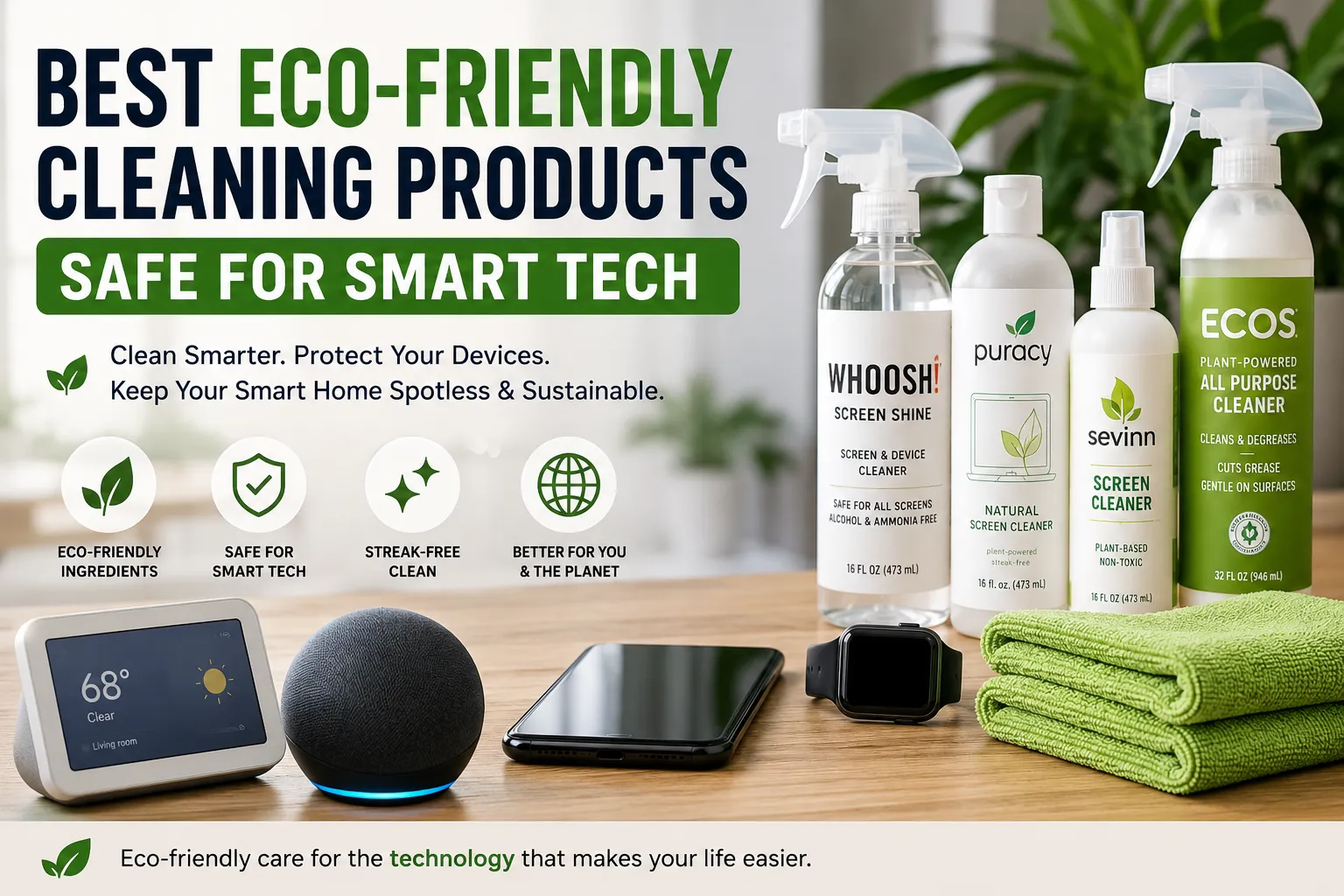
That is why choosing eco-friendly cleaning products safe for smart tech is becoming increasingly important. The goal is not simply to find something labeled “green” or “natural.” A product also needs to be gentle enough for delicate electronic surfaces, easy to use, and appropriate for the particular device you are cleaning. WHOOSH!, for example, specifically markets its Screen Shine formula as alcohol- and ammonia-free and designed for screens and protective coatings.
The good news is that you do not need an aggressive chemical cocktail to keep your smart home clean. In many cases, a quality microfiber cloth, a purpose-made screen cleaner, and a careful cleaning routine are all you need. In this guide, we will look at eco-friendly cleaning products safe for smart tech, explain which ingredients and features matter, review five options, and show you how to clean your devices without turning a simple wipe-down into an expensive repair.
Why Traditional Cleaners Damage Smart Tech
Traditional household cleaners are designed primarily for hard surfaces such as countertops, tiles, stainless steel, glass, and bathroom fixtures. Smart devices are different. A smartphone display, smart speaker, thermostat touchscreen, camera lens, or smart-watch screen can contain specialized coatings and components that are not designed to tolerate every cleaning chemical.
The problem is often not visible immediately. You might spray a strong cleaner onto a cloth, wipe a display, and think everything looks perfectly fine. Yet repeated exposure to unsuitable chemicals can affect surface coatings, leave residue, create streaks, or interfere with the appearance and feel of a touchscreen. The risk becomes even greater when liquid finds its way into openings around buttons, speakers, microphones, ports, sensors, or camera modules.
This is why eco-friendly cleaning products safe for smart tech should be selected based on both environmental considerations and device compatibility. “Natural” does not automatically mean “safe for electronics,” and “chemical-free” is usually an oversimplification. The better approach is to look for a product that clearly identifies its intended surfaces and follow the device manufacturer’s cleaning instructions.
Ammonia, Alcohol, and Sensor Coating Risks
Ammonia is a familiar ingredient in many glass and household cleaners, but a smart display is not simply a window. Displays can have anti-reflective, anti-glare, oleophobic, or other surface treatments. WHOOSH specifically highlights that its screen formula avoids alcohol and ammonia and is intended to protect anti-reflective, anti-glare, prescription-lens, and protective coatings.
Alcohol requires more nuance. Some electronics manufacturers permit particular concentrations of alcohol for specific external surfaces, while others give different instructions depending on the device. The lesson is not “alcohol is always bad”; it is that you should not assume a household disinfectant is appropriate for every smart device. A product that is suitable for a hard, non-porous surface may be inappropriate for a coated touchscreen or camera lens.
Sensors create another challenge. Smart thermostats, security cameras, robot vacuums, smart locks, and other connected products may depend on optical or motion sensors that need unobstructed surfaces. A film of residue can be just as troublesome as dirt. Instead of reaching for the strongest cleaner available, use eco-friendly cleaning products safe for smart tech that are designed for delicate surfaces and apply them sparingly.
What to Look for in Eco-Friendly Tech Cleaners
Shopping for eco-friendly cleaning products safe for smart tech can feel confusing because marketing terms are everywhere. “Green,” “natural,” “plant-based,” and “non-toxic” can describe different things, and none of these labels alone proves that a product is safe for your particular screen or device.
Start with the manufacturer’s instructions for the device. If the manufacturer says to use a dry microfiber cloth, that instruction takes priority over the cleaner’s marketing. If a particular screen-cleaning solution is allowed, then look for a product formulated specifically for electronics rather than simply choosing a general-purpose household cleaner.
It is also useful to separate two jobs: cleaning the screen or sensitive surface and cleaning the surrounding household area. A plant-derived all-purpose cleaner may be excellent for a countertop beneath a smart display but still be unsuitable for spraying directly onto the display itself.
Non-Abrasive & Streak-Free Formulations
A good electronics cleaner should remove fingerprints, dust, and light grime without requiring aggressive scrubbing. Microfiber is especially useful because its fine fibers can lift particles and oils without the roughness associated with abrasive paper towels or some household cloths.
Streak-free performance matters too. Nobody wants a smart thermostat covered in cloudy residue after cleaning. WHOOSH says its Screen Shine products are designed to leave screens clean and streak-free, and the company recommends using a small amount on its microfiber cloth rather than flooding the surface.
The less liquid you need, the better. Electronics and excess moisture are not a great combination. Even a gentle formula should generally be applied to the cleaning cloth rather than sprayed directly onto a device unless the manufacturer specifically instructs otherwise.
Plant-Based & Biodegradable Ingredients
For environmentally conscious households, ingredients are an important part of the buying decision. Plant-derived cleaning systems can reduce reliance on certain petroleum-derived ingredients, but “plant-based” should not automatically be interpreted as “safe for every electronic surface.”
Eco-Me, for example, describes its All Purpose Cleaner as using a plant-based cleaning system with plant extracts, essential oils, and vinegar. The company also states that its products avoid sulfates, dyes, harsh preservatives, and animal byproducts.
However, that does not mean an all-purpose cleaner should automatically be sprayed onto a smart TV or touchscreen. A household cleaner and a screen cleaner have different jobs. Use environmentally preferable products where they are appropriate, but always match the formula to the surface.
Anti-Static Properties and Safe Certification
Dust is one of the biggest enemies of a smart home because many devices have displays, vents, sensors, and other exposed surfaces. An effective cleaning routine should therefore remove dust without simply pushing it around.
Anti-static performance can be useful because reducing static attraction may help surfaces stay cleaner for longer, although it should not be treated as a universal requirement. Certifications and transparent ingredient disclosures can also provide useful information, but they should be considered alongside the manufacturer’s compatibility instructions.
The smartest approach is simple: choose products with transparent labeling, clear directions, reputable manufacturers, and a stated purpose that matches the device you intend to clean.
Some links are affiliate links. Click a product image to view it on Amazon. We may earn a small commission at no extra cost to you.
WHOOSH! Screen Shine Natural Screen Cleaner
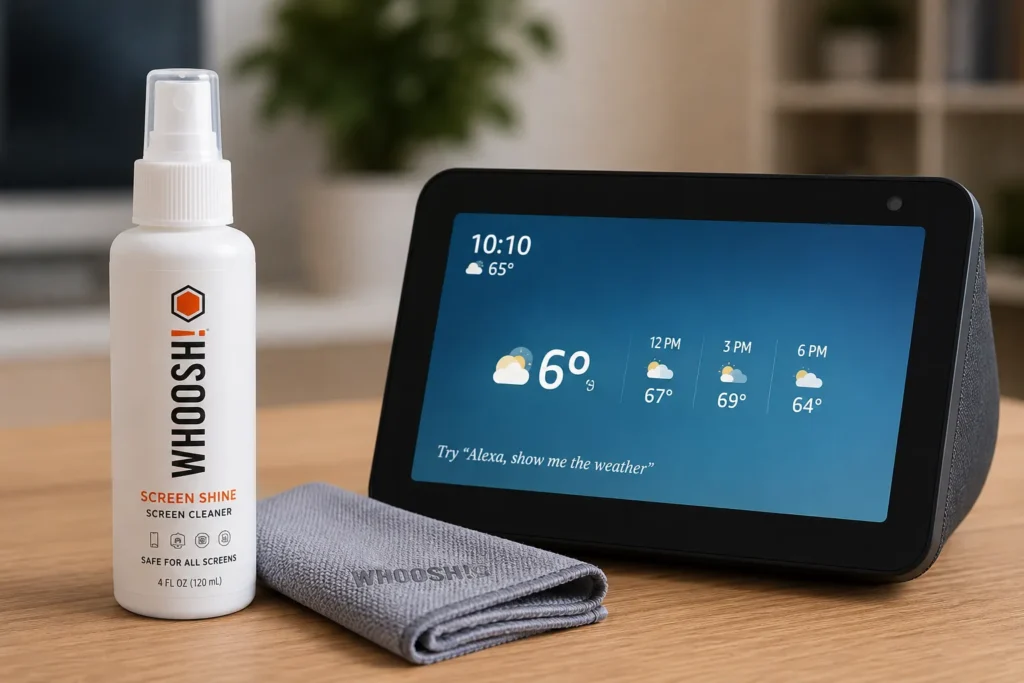
Among eco-friendly cleaning products safe for smart tech, WHOOSH! Screen Shine is one of the most directly targeted options because it was developed specifically for screens and electronics rather than being adapted from a kitchen cleaner. WHOOSH describes its formula as non-toxic and free of alcohol and ammonia, while its current product information says it is intended for screens and protective coatings.
The included microfiber cloth is another reason this product stands out. WHOOSH says its PROTX2-treated microfiber is soft and non-abrasive, with antimicrobial, antibacterial, and anti-odor properties. The company also says its bottles are recyclable and that it is transitioning bottles to 100% post-consumer recycled material.
For a smart home, this makes WHOOSH particularly convenient for smart displays, tablets, laptops, phones, televisions, and other compatible surfaces. Its compact versions are also useful for keeping a cleaner near frequently touched devices instead of storing it somewhere inconvenient.
The main limitation is that “natural” or “non-toxic” does not eliminate the need for proper technique. Use the amount recommended by the manufacturer and avoid saturating electronics. WHOOSH itself emphasizes that only one or two sprays onto the cloth can be enough for a streak-free result.
Pros:
- Specifically designed for screens and electronics.
- Alcohol- and ammonia-free formula.
- Includes a soft microfiber cloth.
- Designed for streak-free cleaning.
- Available in compact and larger formats.
- Company highlights recyclable packaging.
Cons:
- More expensive than simply using a reusable dry microfiber cloth.
- Still requires careful application around ports and openings.
- Product availability may vary by country.
- “Non-toxic” does not mean it should be sprayed directly into electronics.
Screen Mom Natural Screen Cleaner
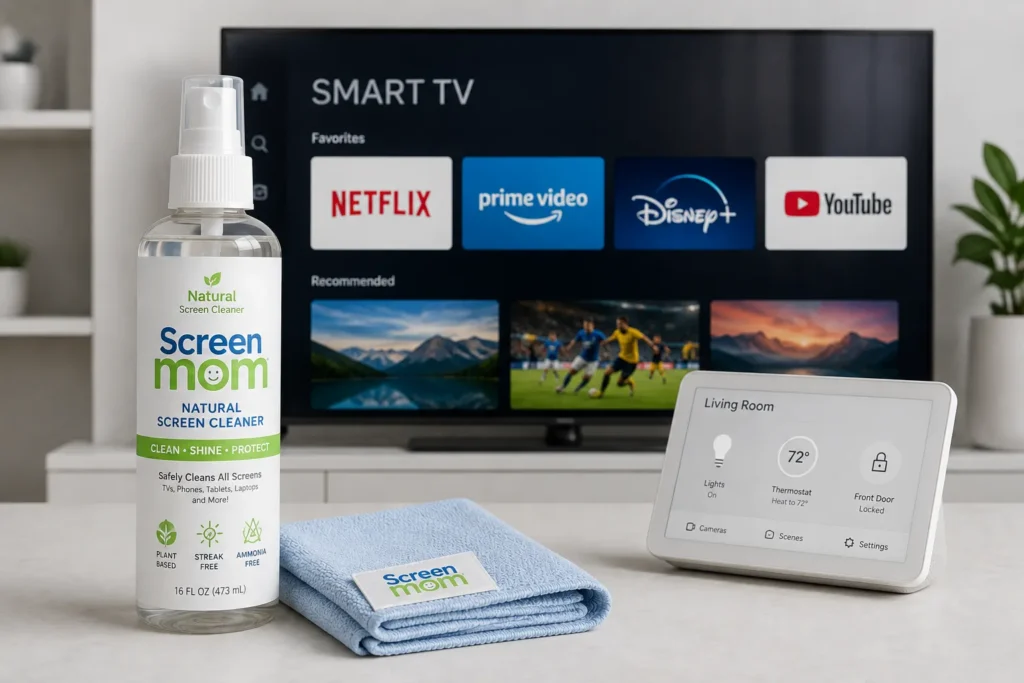
Screen Mom Natural Screen Cleaner is another product frequently considered by people searching for eco-friendly cleaning products safe for smart tech. Its appeal comes from its positioning as a screen-focused cleaner rather than a conventional household spray. That distinction is important because smart-home displays often need gentle cleaning rather than the aggressive degreasing power required for kitchen surfaces.
For a buyer considering Screen Mom, the most important step is to verify the current product label and the compatibility instructions for the exact version being purchased. Product formulations and packaging can change, and the manufacturer’s current directions should always take precedence over older reviews or marketplace descriptions.
This is particularly important when cleaning newer smart displays. Modern screens may have specialized coatings that react differently to cleaning products. A product being marketed for televisions, monitors, tablets, or phones is a useful starting point, but you should still confirm that the surface of your particular device is compatible.
Screen Mom can be especially appealing to households that want one dedicated product for several screens rather than keeping separate bottles for a television, computer, and smart-home display. Pairing it with a dedicated high-quality microfiber cloth also reduces the amount of liquid required.
Pros:
- Designed around screen cleaning.
- Convenient for households with multiple displays.
- Can help remove fingerprints and everyday smudges.
- More appropriate for electronics than a conventional bathroom or glass cleaner.
Cons:
- Always verify the current ingredient list and usage directions.
- Marketplace listings may contain outdated product information.
- Not every electronic surface should be treated identically.
- A dry microfiber cloth may be sufficient for light dust.
E-Cloth Microfiber Cloths for Electronics
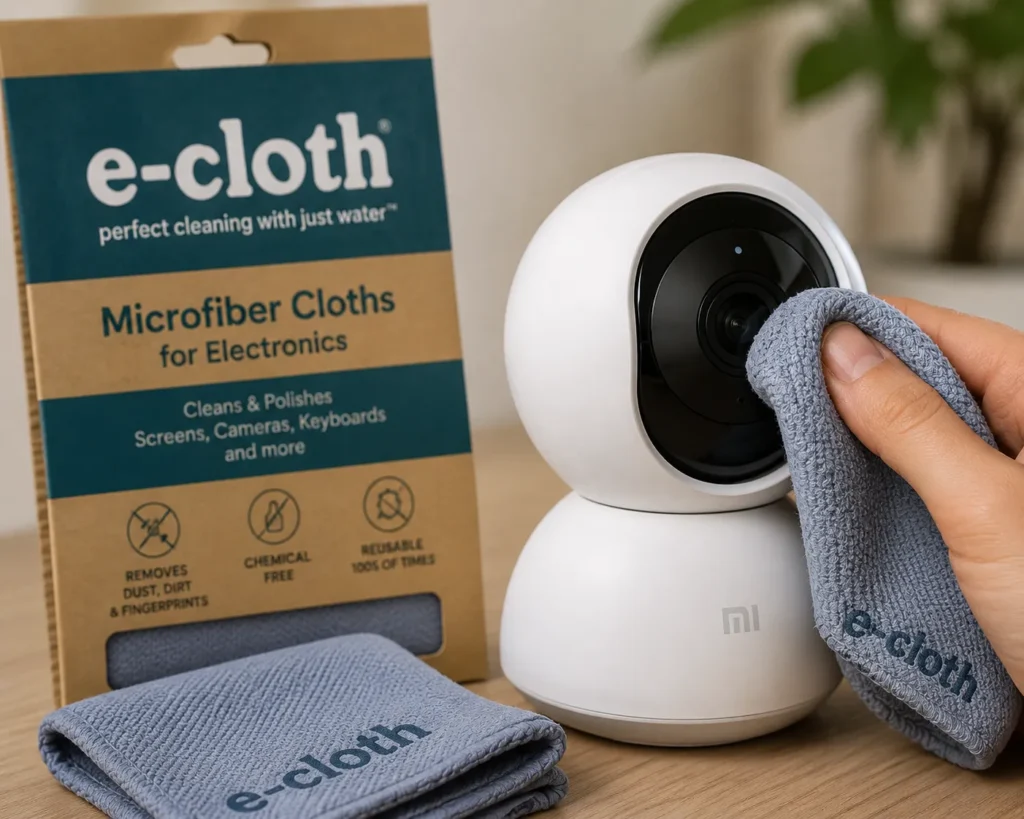
If your definition of eco-friendly cleaning products safe for smart tech includes minimizing liquid and disposable packaging, reusable microfiber cloths deserve serious attention. E-Cloth’s approach is particularly attractive because a high-quality microfiber cloth can often clean fingerprints, dust, and light surface grime with little or no cleaning solution.
This matters for electronics. Every time you spray liquid near a smart display, you introduce some risk of excess moisture. With a suitable microfiber cloth, you can remove everyday dust and fingerprints mechanically without introducing a liquid cleaner at all.
Reusable cloths can also be a more sustainable choice because they can be washed and used repeatedly. Instead of throwing away disposable wipes every time a smart speaker becomes dusty, you can wash the cloth and use it again.
The key is keeping the cloth itself clean. A microfiber cloth used on a greasy kitchen surface should not immediately be used on a touchscreen. Separate cloths for electronics and household cleaning are a simple way to avoid transferring oils, grit, or cleaning chemicals between surfaces.
Pros:
- Minimizes or eliminates the need for liquid cleaner.
- Reusable and washable.
- Excellent for dust and fingerprints.
- Reduces disposable wipe consumption.
- Simple enough for regular smart-home maintenance.
Cons:
- Heavy grime may require an appropriate cleaning solution.
- The cloth must be washed correctly.
- Dirty or contaminated microfiber can scratch or smear surfaces.
- It does not provide disinfecting performance by itself.
Some links are affiliate links. Click a product image to view it on Amazon. We may earn a small commission at no extra cost to you.
Seventh Generation Plant-Based Wipes (Electronics Safe)
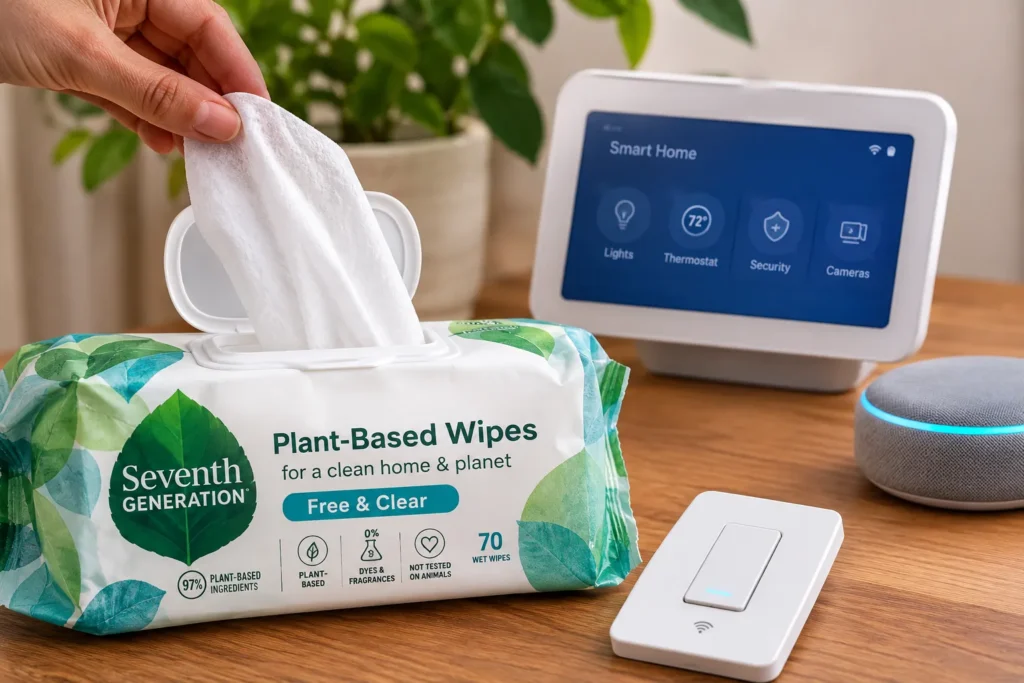
Seventh Generation is well known for plant-based and environmentally conscious household cleaning products, making its wipes an obvious product to consider when researching eco-friendly cleaning products safe for smart tech. The company emphasizes renewable, plant-based ingredients and ingredient disclosure as part of its product-development approach.
There is, however, an important distinction that should not be ignored: a general-purpose or disinfecting household wipe should not automatically be considered safe for every electronic screen. Seventh Generation describes its disinfecting wipes as being intended for hard, non-porous surfaces, and its guidance includes items such as appliances, countertops, toys, and other household surfaces.
That means these wipes may be more appropriate around smart technology—for example, on compatible hard exterior surfaces—rather than being used indiscriminately on touchscreens, camera lenses, or coated displays. Always follow both the wipe’s label and the electronics manufacturer’s instructions.
This is a good example of why “eco-friendly” and “electronics-safe” are two separate questions. A cleaner can have an environmentally preferable ingredient profile and still be the wrong choice for a delicate screen.
Pros:
- Strong focus on plant-based ingredients.
- Ingredient information is publicly disclosed.
- Convenient for compatible hard household surfaces.
- Useful for cleaning areas surrounding smart-home devices.
Cons:
- Do not assume the wipes are safe for every electronic screen.
- Disinfecting formulations may be unnecessarily aggressive for delicate displays.
- Moisture can enter device openings.
- Device manufacturer instructions should take priority.
Eco-Me Natural All-Surface Cleaner (Plant-Derived)
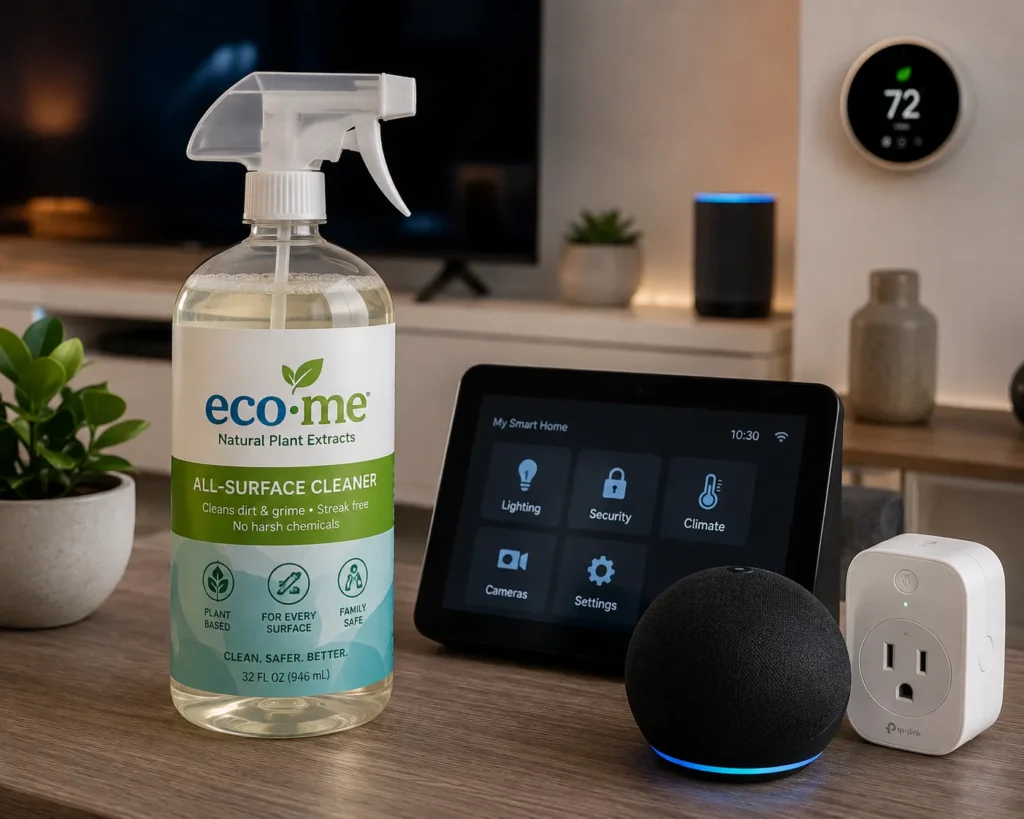
Eco-Me Natural All-Surface Cleaner is a useful option for the smart-home environment, although it should not be confused with a dedicated screen cleaner. Eco-Me describes its All Purpose Cleaner as a plant-based product designed for dirt, grease, grime, fingerprints, and other everyday household messes. The company says it contains plant extracts, essential oils, and vinegar and is free from harsh chemicals and residue.
This makes it potentially useful for the surfaces around your smart technology: countertops beneath smart displays, compatible furniture, shelves, cabinets, and other hard household surfaces. It can help create a cleaner smart-home environment without requiring a conventional harsh household spray.
But the distinction matters. A plant-derived cleaner is not automatically suitable for a touchscreen, camera lens, speaker grille, or sensor. Eco-Me itself positions the product as an all-purpose household cleaner rather than a specialist electronics screen cleaner. For sensitive electronics, a dry microfiber cloth or dedicated screen cleaner is the safer starting point.
Eco-Me also highlights its ingredient disclosure and plant-based approach, along with claims such as no synthetic fragrances, sulfates, colorants, or certain preservatives.
Pros:
- Plant-based cleaning system.
- Designed for everyday household dirt and grime.
- Useful for smart-home surfaces surrounding electronics.
- Company provides ingredient information.
- Available in fragrance-free and scented varieties.
Cons:
- Not a dedicated electronics screen cleaner.
- Should not automatically be used on touchscreens.
- Vinegar and other cleaning ingredients are not universally appropriate for electronics.
- Best used on compatible household surfaces rather than sensitive components.
Step-by-Step Guide: How to Safely Clean Smart Home Devices
Using eco-friendly cleaning products safe for smart tech is only half of the equation. Technique matters just as much as the bottle you choose. Even a gentle cleaner can cause trouble if you spray it directly into a speaker, flood a touchscreen, or scrub a camera lens with a rough cloth.
Start by checking the manufacturer’s cleaning instructions. This may sound boring, but it is the smartest step you can take. Manufacturers know what materials and coatings are used on their products, and those instructions can differ substantially between devices.
Then power the device down when appropriate. A powered-off screen also makes fingerprints and smudges easier to see, allowing you to clean the surface more accurately.
Step 1: Remove Dust First
Use a clean, dry microfiber cloth to gently remove loose dust. Do not immediately wet the surface because trapped dust particles can be dragged across the screen during wiping.
Step 2: Apply Cleaner to the Cloth
If the device manufacturer permits a cleaning solution, apply a small amount to the microfiber cloth rather than soaking the device. This keeps moisture under control.
Step 3: Wipe Gently
Use light pressure and smooth movements. There is no advantage to scrubbing aggressively. Fingerprints and light oils should disappear with gentle passes.
Step 4: Protect Openings
Keep liquid away from charging ports, microphones, speakers, buttons, vents, camera modules, and sensor openings. These areas often contain components that can be affected by moisture even when the device’s outer surface is designed to be cleaned.
Step 5: Dry and Inspect
Use a dry portion of the microfiber cloth to remove remaining moisture or streaks. Look at the display from different angles to make sure no residue remains.
Step 6: Clean the Cloth
Wash reusable microfiber cloths according to their care instructions. Avoid using fabric softener if the manufacturer warns against it because residue can reduce microfiber performance.
This simple process is generally more effective than using large quantities of cleaner. Think of cleaning smart technology like washing a delicate pair of glasses: controlled, gentle, and precise beats aggressive scrubbing every time.
How Often Should You Clean Smart Home Devices?
There is no universal schedule because different devices experience different amounts of contact. A smartphone or touchscreen thermostat may collect fingerprints daily, while a ceiling-mounted smart sensor may need attention much less frequently.
High-touch devices should be checked regularly, especially in homes with children, pets, or multiple users. Displays, remote controls, smart speakers with physical buttons, and smart locks can accumulate oils and dirt quickly.
Camera lenses deserve special attention because even a thin fingerprint can reduce image clarity. Instead of treating the lens like a household surface, use a clean microfiber cloth and follow the camera manufacturer’s recommendations.
The same principle applies to smart-home sensors. Do not aggressively clean or spray a sensor simply because it looks dusty. Identify the sensor first and check the manufacturer’s instructions. A gentle dry wipe may be all that is needed.
Common Mistakes to Avoid
One of the biggest mistakes is assuming that eco-friendly cleaning products safe for smart tech can be used universally. The phrase describes a category of products selected for both environmental and electronics considerations, not a license to use any plant-based cleaner on any device.
Another common mistake is spraying directly onto a screen. Even if the cleaner itself is mild, liquid can travel toward openings and edges. Applying a small amount to the cloth gives you much more control.
Paper towels are another questionable choice. Some may contain fibers or additives that are less suitable for delicate displays than a clean microfiber cloth. Old T-shirts can also contain dirt or rough fibers that make them less ideal for precision cleaning.
Finally, avoid using the same cloth everywhere. The cloth used to wipe a greasy kitchen counter should never become the cloth you use on your OLED television five minutes later. Separate cleaning cloths are inexpensive, reusable, and much easier to manage.
Frequently Asked Questions
What are the best eco-friendly cleaning products safe for smart tech?
There is no single best product for every device. Dedicated screen cleaners such as WHOOSH! are attractive because they are specifically formulated for screens and are marketed as alcohol- and ammonia-free. Reusable microfiber cloths are another excellent option because many everyday fingerprints and dust particles can be removed without liquid.
Can I use a plant-based cleaner on my smart TV?
Not automatically. “Plant-based” describes the source or formulation of ingredients, not universal compatibility with electronic coatings. Check your TV manufacturer’s cleaning instructions and use a cleaner specifically approved for that type of screen when liquid is necessary.
Is vinegar safe for smart-home electronics?
You should not assume it is. Eco-Me, for example, lists vinegar as part of its plant-based All Purpose Cleaner formulation, but the product is designed as a household all-purpose cleaner rather than a universal electronics cleaner. For screens and sensitive electronics, use a compatible screen cleaner or microfiber cloth instead.
Are disinfecting wipes safe for smart screens?
Not necessarily. Seventh Generation’s guidance describes its disinfecting wipes for hard, non-porous surfaces, and specifically discusses household surfaces such as appliances and countertops. That does not establish compatibility with every touchscreen or display, so always check the device manufacturer’s instructions before using a disinfecting wipe.
Can I clean smart sensors with a microfiber cloth?
Often, a clean dry microfiber cloth is a sensible starting point for removing dust from accessible exterior surfaces, but the device’s instructions should come first. Avoid pushing dust into sensor openings or using excessive liquid. For optical sensors and cameras, gentle cleaning is especially important because residue can affect performance.
Conclusion
A smart home is supposed to make life easier, not create a collection of fragile surfaces that require complicated maintenance. The best approach is surprisingly simple: use the right product for the right surface, minimize moisture, avoid unnecessary chemicals, and keep a clean microfiber cloth nearby.
When choosing eco-friendly cleaning products safe for smart tech, look beyond the word “eco-friendly.” Check whether the product is actually designed for screens or electronics, examine the ingredient information, look for clear usage instructions, and confirm compatibility with your device manufacturer. WHOOSH! is a particularly interesting specialist option because its current Screen Shine products are marketed as alcohol- and ammonia-free and designed for screens and protective coatings.
For the rest of the smart home, products such as Eco-Me can be useful for compatible surrounding household surfaces, while reusable microfiber cloths can dramatically reduce the amount of liquid and disposable material needed for everyday cleaning.
The most important rule is this: never assume that “natural” means “safe for electronics.” A product can be environmentally friendly and still be unsuitable for a particular touchscreen, coating, lens, or sensor. Your smart devices represent a significant investment, so a little caution can go a long way.
If you are building a greener smart home, start with a small cleaning kit: one or two dedicated microfiber cloths, a screen-safe cleaner for compatible displays, and a plant-based household cleaner for the surrounding surfaces. That simple setup can keep your technology looking cleaner while reducing your reliance on harsh household chemicals.
Which cleaning product do you use for your smart-home devices? Have you ever damaged a screen or discovered a cleaner that worked surprisingly well? Share your experience in the comments below—your tip could help another smart-home owner protect an expensive device.
- Affiliate Disclosure: This post contains affiliate links. If you click through and make a purchase, we may earn a small commission at no extra cost to you. Thank you for supporting Khamova.com!
- For more information click here