Replacing Oil Heat in Homes: A Smart Energy Transition
Introduction
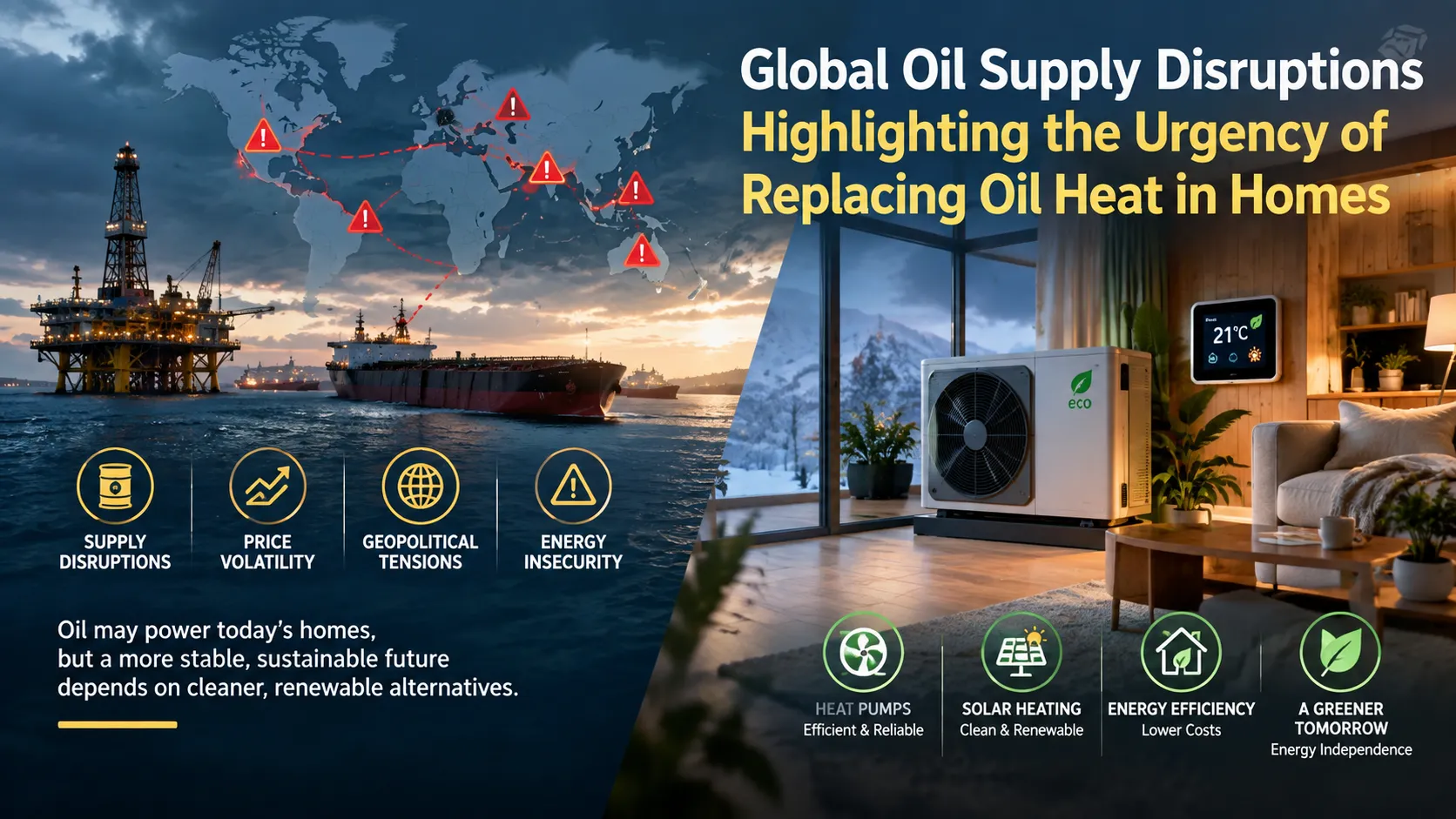
For decades, an oil furnace or boiler could seem like a dependable part of a comfortable home. Fill the tank, maintain the burner, turn up the thermostat and the house stays warm. But that simplicity hides a weakness: the household remains tied to a fuel whose price is determined by global supply, transportation, refining capacity and geopolitical events. Replacing oil heat in homes is therefore becoming a practical energy-security project, not simply an environmental upgrade.
Recent energy-market data illustrates the exposure. On 15 September 2026, the U.S. Energy Information Administration recorded New York Harbor No. 2 heating oil at $5.163 per gallon in its daily spot-price series, while Brent crude reached $130.80 per barrel. These are market reference prices rather than a universal household heating cost, but they demonstrate how quickly petroleum markets can move.
The answer is not necessarily to buy the most expensive technology available. A better strategy combines several improvements: reduce heat loss, replace inefficient equipment, introduce a properly sized heat pump, use smart controls and, where practical, connect the home to rooftop solar and battery storage.
The most interesting part is how these technologies reinforce one another. A better-insulated home needs less heat. A heat pump can supply that heat using electricity rather than heating oil. Smart controls can reduce unnecessary operation. Solar can produce some of the electricity required by the new system.
That turns replacing oil heat in homes from a single equipment replacement into a complete smart home energy transition.
[Rank Math Table of Contents]
The Real Cost of Oil-Dependent Homes
The cost of an oil-heated home is not simply the amount printed on a heating-oil invoice. There is the fuel itself, delivery, furnace or boiler maintenance, combustion equipment, storage infrastructure and the financial uncertainty created by buying a commodity whose price can change sharply.
This is why replacing oil heat in homes deserves to be considered before an old furnace finally fails on the coldest night of the year. Waiting until emergency replacement is required can leave homeowners with fewer choices, less time to compare contractors and greater pressure to accept whatever equipment can be installed immediately.
An oil heating system also has an efficiency ceiling. The U.S. Department of Energy’s guidance lists an 85% AFUE minimum efficiency for certain oil-fired residential furnaces under its federal purchasing requirements. Oil-fired residential boilers under 300,000 Btu/h are listed at an 87% AFUE minimum in the same guidance. AFUE measures annual heating output relative to fuel input, including certain seasonal losses.
That does not mean every oil furnace performs at exactly those levels, nor does it mean every heat pump will automatically cost less to operate. Actual performance depends on equipment, climate, installation, electricity prices, fuel prices and the building itself. The useful comparison is therefore not simply “oil versus electricity”; it is the total annual cost of delivering comfortable heat.
Rising Heating Oil Prices Create Household Exposure
Oil prices move because the global petroleum system is interconnected. A supply disruption in one region can affect crude prices, refined products, shipping costs and inventories far away from the original event.
The September 2026 EIA data provides a useful snapshot. On 15 September, New York Harbor heating oil was listed at $5.163 per gallon, compared with $4.539 on 8 September. Brent crude increased from $106.12 per barrel on 8 September to $130.80 on 15 September.
These numbers should not be converted directly into a household heating bill because retail prices include transportation, taxes, distribution and other factors. They do, however, illustrate the fundamental risk of petroleum dependence: the household cannot control the underlying commodity market.
Replacing oil heat in homes reduces that direct exposure by moving the main heating load away from delivered petroleum. If the replacement system is electric, the household’s energy costs become more closely linked to electricity prices instead.
That does not eliminate market risk. Electricity prices can also rise. But electricity provides something heating oil cannot: the possibility of producing part of the household’s supply locally through solar PV.
Oil Furnace Inefficiency Is Only Part of the Problem
Replacing an old furnace without improving the building envelope can produce disappointing results. Imagine trying to fill a bathtub with the drain wide open. Increasing the water supply does not solve the underlying problem.
The same principle applies to heating. If warm air escapes around windows, doors, attic penetrations and poorly insulated walls, a new heating system must work harder to maintain the desired temperature.
ENERGY STAR estimates that air sealing and adding insulation in specific parts of a typical existing U.S. home can reduce heating and cooling costs by an average of 15%, or total energy costs by around 11%, although actual savings vary significantly by climate and building characteristics.
That makes insulation one of the most important home heating alternatives to oil in a broader sense. Insulation does not generate heat, but it reduces the amount of heat the house needs.
For homeowners planning replacing oil heat in homes, this sequence matters:
- Assess heat loss.
- Seal obvious air leaks.
- Improve insulation where appropriate.
- Check ducts and distribution systems.
- Calculate the actual heating load.
- Size the replacement heating system accordingly.
The result can be a smaller and more efficient heating system than the one chosen simply by copying the capacity of the old oil furnace.
Supply Vulnerability Is a Design Problem
Oil heating also requires physical logistics. A household needs storage capacity, delivery access and a functioning supply chain. During periods of high demand or supply disruption, those dependencies can become more noticeable.
An electric heat pump has a different infrastructure requirement. It needs electrical service and suitable equipment, but it does not require a truck to deliver fuel to a tank every time the stored supply approaches empty.
This is one reason household energy independence should not be interpreted as complete disconnection from the grid. A more practical definition is the ability to reduce dependence on externally supplied fuels and increase flexibility in how energy is produced, stored and consumed.
That distinction is important. A home connected to the grid, equipped with a heat pump, smart controls, rooftop solar and possibly a battery can still be grid-dependent. But it can be substantially less dependent on oil.
Modern Alternatives for Replacing Oil Heat in Homes
The modern replacement strategy is not one technology. It is a system.
A successful transition usually combines building improvements with efficient electric heating and intelligent controls. Replacing oil heat in homes works best when the new heating system is installed into a house that has already been prepared to use less energy.
The main technologies include:
- Air-source heat pumps
- Ground-source heat pumps
- Improved insulation and air sealing
- Smart thermostats
- Zoned climate controls
- Rooftop solar PV
- Battery storage
- Home energy monitoring
Each solves a different part of the problem.
Heat Pumps vs Oil Furnaces
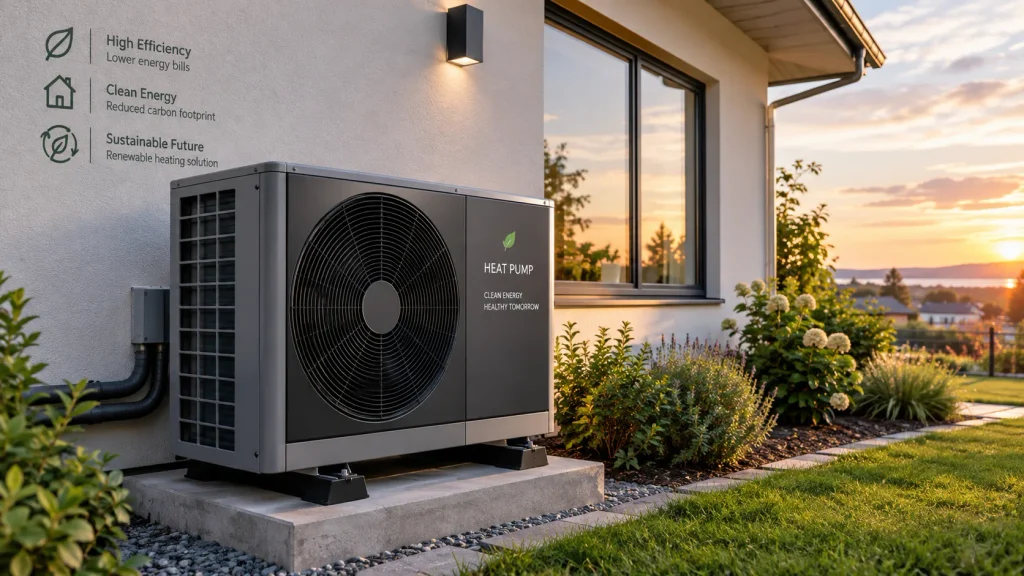
The most important comparison in many oil-heated homes is heat pumps vs oil furnaces.
An oil furnace burns fuel to create heat. A heat pump uses electricity to move heat from one location to another. That difference is fundamental.
The U.S. Department of Energy explains that heat pumps can be two to four times more efficient than electric resistance heating because they move heat rather than creating it directly through resistance.
That comparison is not exactly the same as comparing a heat pump with an oil furnace, so homeowners should avoid simplistic claims that every heat pump will automatically be cheaper. The economics depend on local fuel and electricity prices, outdoor temperatures, equipment efficiency, installation quality and how the home is insulated.
Still, the architecture of the system offers a major advantage: electricity can come from multiple sources. It can be purchased from the grid, generated by rooftop solar and, where available, stored in a battery.
Oil cannot be generated on the roof.
That makes a heat pump particularly interesting as part of replacing oil heat in homes. The heating system becomes compatible with the rest of a home’s electrification strategy.
[Insert Image 2 Here: Placeholder for a modern heat pump installed outside a smart home]
Alt text: Modern heat pump system for replacing oil heat in homes
Air-Source Heat Pumps
Air-source heat pumps are often the most accessible option because they extract or reject heat using outdoor air. Modern cold-climate models can operate in conditions where older heat-pump designs would have struggled.
The correct system needs to be selected according to local climate and the building’s heating load. Oversizing can cause inefficient cycling, while undersizing can leave the system unable to meet peak demand without backup.
This is why a professional heat-load calculation is more useful than simply telling a contractor, “I have a 100,000-Btu oil furnace, so I want a 100,000-Btu heat pump.”
The old furnace capacity may have been selected when the house was less efficient, or it may have been oversized from the beginning.
Ground-Source Heat Pumps
Ground-source systems exchange heat with the ground rather than directly with outdoor air. Because ground temperatures are generally more stable than outdoor air temperatures, these systems can offer strong seasonal performance.
The challenge is installation. Ground loops require appropriate land, drilling or excavation, engineering and higher upfront investment in many cases.
For a homeowner specifically focused on replacing oil heat in homes, a ground-source system may make sense when the property has suitable conditions and the long-term economics justify the initial expense.
It is not automatically the best choice. A high-performance air-source heat pump combined with insulation, smart controls and solar may provide a simpler path for another property.
Insulation Before Heat Pump Installation
A heat pump should not be treated as a magic machine that fixes a poorly performing building.
ENERGY STAR describes comprehensive air sealing, insulation and high-performance windows as components of a thermal enclosure that can improve comfort, reduce energy use and lower utility costs.
For someone planning replacing oil heat in homes, insulation has another benefit: it reduces the required heating capacity.
Suppose an old oil system was selected for a building with substantial heat loss. If the homeowner reduces that heat loss before installing a heat pump, the replacement equipment may be able to operate more efficiently and maintain indoor temperatures with less energy.
Air sealing also deserves attention. ENERGY STAR estimates that sealing and insulating typical existing homes can produce average heating-and-cooling savings around 15%, although actual results vary by location and building.
The important point is sequence. Do not simply remove the oil furnace and install the biggest heat pump available.
Make the house easier to heat first.
Rooftop Solar Integration
Once heating is electrified, rooftop solar becomes much more relevant.
A household that previously burned oil for heat may now consume significantly more electricity because the heat pump becomes one of its largest electrical loads. Solar can offset part of that demand.
The relationship is particularly useful during shoulder seasons when solar production can be strong while heating or cooling loads remain moderate. Smart controls can also help schedule flexible electricity consumption around periods of high solar production.
Battery storage adds another option. The U.S. Department of Energy notes that solar-plus-storage can allow stored energy to be used at night and can provide benefits during outages when the system is appropriately configured. Local electrical requirements and equipment design still matter.
Solar does not make replacing oil heat in homes free. The solar system has an upfront cost, and winter solar production may be lower precisely when heating demand is highest in colder climates.
But over the life of the equipment, solar can change the economics of electrified heating by allowing the homeowner to generate some electricity locally.
Smart Home Technologies That Reduce Energy Waste
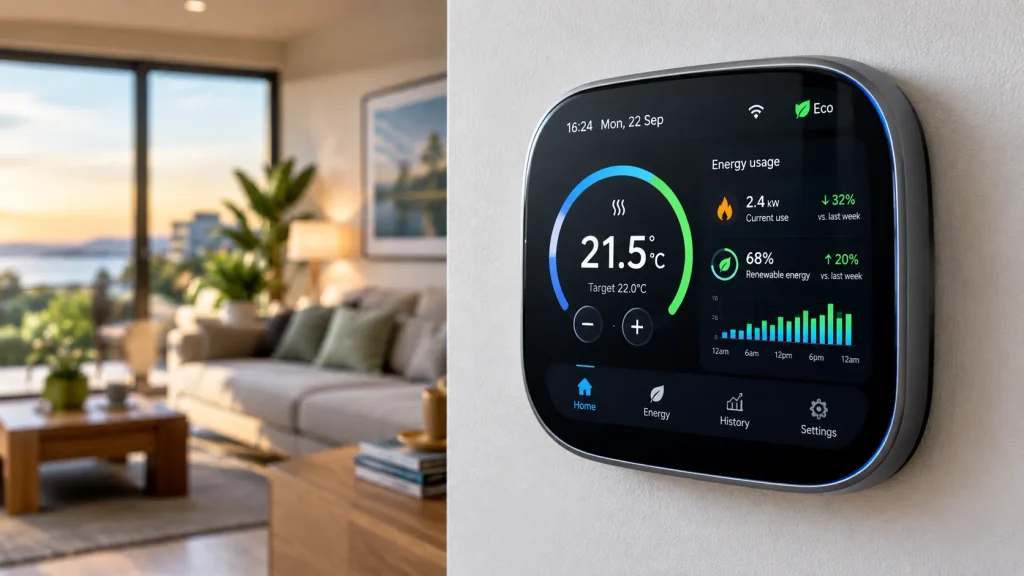
The next step is intelligence.
A heat pump can be highly efficient, but it still wastes energy if it heats an empty house unnecessarily. Solar can generate abundant electricity, but the benefit is smaller if the household cannot coordinate consumption with production.
This is where the smart home energy transition becomes important.
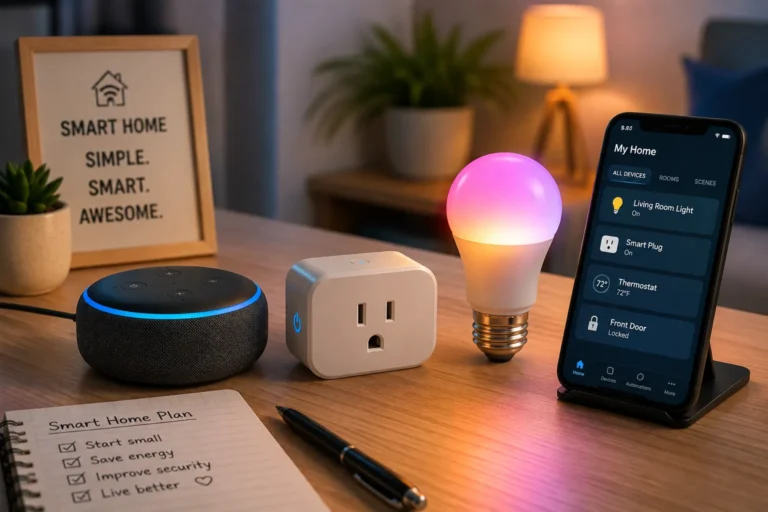
The smart home should not simply mean voice-controlled lights or a thermostat you can operate from your phone. In an energy-focused house, smart technology should coordinate heating, cooling, occupancy, electricity consumption and renewable generation.
Smart Thermostats
A smart thermostat can adjust temperature settings according to schedules, occupancy, geofencing and other inputs.
ENERGY STAR says certified smart thermostats are independently evaluated using real-world field data. Its current criteria include requirements around energy-use feedback, scheduling, heating and cooling runtime reductions and compatibility with certain utility programs.
ENERGY STAR also reports average savings of approximately 8% of heating and cooling bills, or about $50 per year, although actual savings vary by climate, equipment and household behaviour.
The technology becomes more interesting after replacing oil heat in homes because heat pumps often benefit from intelligent control rather than aggressive temperature changes.
A poorly configured thermostat can cause unnecessary cycling or trigger inefficient backup heating. A properly configured control strategy can maintain comfort while allowing the system to respond to outdoor temperatures and household schedules.
Automated Climate Zones
Why heat the entire house equally when only some rooms are occupied?
Zoning can divide a home into separate temperature areas. Depending on the HVAC design, this can involve duct dampers, multiple indoor heat-pump units, room sensors or other controls.
A smart zoning system can reduce heating or cooling in rooms that are rarely occupied while maintaining comfort in bedrooms, living areas and workspaces.
This is especially useful in larger homes where the heating demand varies considerably between rooms.
The key is to design the system around the equipment. Simply closing large numbers of vents on a forced-air system can create airflow problems if the system was not designed for that configuration.
Home Energy Monitoring
Energy monitoring answers a deceptively simple question: Where is my energy actually going?
Without measurement, homeowners often guess. They may assume the refrigerator is expensive to operate while ignoring a resistance water heater, inefficient heating system or EV charger.
A whole-home energy monitor can reveal consumption patterns over time. Submetering can provide even more detail for individual circuits.
This information is extremely useful during replacing oil heat in homes because the household is moving from a fuel-based heating system to an electrical one. Electricity consumption may rise even if total energy costs fall.
That distinction matters.
A homeowner should evaluate the transition using total energy expenditure and delivered heating, not simply whether the electricity meter spins faster.
[Insert Image 3 Here: Placeholder for a smart home energy dashboard/thermostat]
Alt text: Smart home energy management system reducing fossil fuel consumption while replacing oil heat in homes
Smart Controls and Solar Coordination
The most advanced residential systems can coordinate several devices.
Imagine a winter afternoon. Solar panels are producing electricity. The battery is partly charged. The home is comfortable, but the water heater needs energy. The smart controller can prioritize flexible loads according to programmed rules.
The same principle can apply to an EV charger or other controllable appliances.
This is the real promise of a smart home energy transition. Individual technologies become components of a coordinated system rather than isolated gadgets.
The homeowner can potentially reduce peak demand, increase solar self-consumption and operate heating equipment more intelligently.
It is not futuristic. The technology already exists. The challenge is choosing equipment that communicates reliably and configuring the system correctly.
Financial Return and Steps to Transition Away From Oil

The financial side of replacing oil heat in homes deserves careful attention because upfront costs can be significant.
There is no universal payback period. Anyone promising that every homeowner will recover a heat-pump installation in exactly five years is ignoring the variables that actually determine the result.
The calculation should include:
- Existing annual heating-oil consumption
- Local heating-oil price
- Electricity price
- Heat-pump efficiency
- Annual heating demand
- Installation cost
- Insulation improvements
- Maintenance requirements
- Available rebates or incentives
- Expected equipment lifespan
- Financing costs
The correct comparison is the total cost of ownership rather than the purchase price alone.
A Practical Transition Sequence
A sensible replacing oil heat in homes plan can be divided into stages.
Stage 1: Measure the existing home. Collect at least one year of heating-oil consumption if possible. Record electricity use, indoor temperatures and major heating problems.
Stage 2: Improve the building envelope. Address major air leaks and insulation deficiencies before sizing the replacement heating system.
Stage 3: Assess the distribution system. Check radiators, ducts, electrical capacity and existing ventilation. The replacement system must work with the house, not just fit inside it.
Stage 4: Calculate the heating load. Have the contractor perform a proper heat-loss calculation instead of copying the old furnace size.
Stage 5: Compare heating technologies. Evaluate air-source and ground-source heat pumps where appropriate, while considering climate and backup requirements.
Stage 6: Install smart controls. Use temperature scheduling, occupancy information and monitoring to reduce unnecessary operation.
Stage 7: Consider solar. Once electrical demand is understood, evaluate whether rooftop solar can economically offset part of the home’s electricity consumption.
Stage 8: Add storage if justified. A battery may provide additional flexibility, backup capability or solar self-consumption depending on local electricity tariffs and system design.
This sequence avoids a common mistake: purchasing expensive technology before understanding the house.
Calculating the Return on Investment
Imagine a hypothetical oil-heated home spending $3,000 annually on heating oil. If a new heat pump and efficiency improvements reduce the relevant heating cost to $1,800, the gross annual operating-cost difference would be $1,200.
If the transition costs $12,000 after applicable incentives, a simple payback calculation would be:
$12,000 ÷ $1,200 = 10 years
But that is only an illustration, not a prediction.
Actual savings could be higher or lower. Oil prices can fall. Electricity prices can rise. The heat pump’s efficiency can vary with outdoor temperature. Maintenance costs can differ. Financing can change the economics.
A professional evaluation should therefore use realistic local prices and expected system performance.
Does Replacing Oil Heat Increase Home Value?
Energy improvements can make a property more attractive to buyers because they can improve comfort, operating costs and resilience. However, homeowners should avoid assuming that every dollar spent on an energy upgrade will automatically return an equivalent amount in resale value.
The more defensible argument is that a modern heating system can improve the home’s functionality and reduce dependence on delivered fuel.
A property with a modern heat pump, improved insulation, smart controls and rooftop solar may also appeal to buyers interested in lower operating costs.
But local property markets determine actual resale effects.
Avoiding the Cheapest-Installation Trap
One of the biggest risks in replacing oil heat in homes is focusing exclusively on the equipment’s sticker price.
Installation quality can have a major impact on performance. ENERGY STAR states that improper installation can reduce heating and cooling system efficiency by up to 30%.
That is why contractor selection matters.
Ask for:
- A documented heat-load calculation
- Equipment efficiency ratings
- Expected cold-weather performance
- Electrical requirements
- Noise specifications
- Warranty details
- Maintenance requirements
- Backup-heating strategy where necessary
- Total installed price
- Commissioning and performance verification
The cheapest quotation is not necessarily the lowest-cost system over its lifetime.
The Long-Term Goal: Household Energy Independence
The end goal is not simply removing an oil tank.
It is building a home that can use energy intelligently.
A highly efficient building requires less heat. A heat pump provides heating and cooling using electricity. Smart controls reduce unnecessary operation. Solar generates electricity locally. Batteries can shift energy through time. Energy monitoring shows where consumption remains high.
Together, these technologies create a pathway toward household energy independence.
Complete independence is uncommon and may not even be economically sensible for every property. Staying connected to the grid can provide valuable flexibility and reliability.
The smarter objective is resilience: fewer fossil-fuel deliveries, lower exposure to petroleum prices, better control over consumption and multiple ways to obtain energy.
[Insert Image 4 Here: Placeholder for a cozy, energy-efficient modern living room]
Alt text: Energy efficient eco-friendly home after replacing oil heat in homes and reducing oil dependence
Conclusion
Replacing oil heat in homes is not simply a matter of swapping one furnace for another. The strongest transition treats the entire property as an energy system.
Start with the building envelope. Seal major air leaks, improve insulation and address distribution problems. Then calculate the home’s actual heating requirement before selecting a replacement system.
For many properties, heat pumps can become the central technology for replacing combustion-based heating. Their advantages become more powerful when paired with smart thermostats, zoning, energy monitoring and properly designed controls.
Then look beyond heating.
Rooftop solar can generate electricity locally. Battery storage can provide additional flexibility where the economics and local rules make sense. Smart controls can coordinate heating, storage and other electrical loads.
The result is a very different type of home.
Instead of buying a fuel whose price is determined by global oil markets, the household can increasingly rely on electricity and locally generated renewable energy. Instead of allowing heat to escape through poorly sealed walls and attics, the building can retain more of the energy it receives. Instead of manually adjusting a thermostat throughout the day, intelligent controls can respond to schedules and occupancy.
That is the real meaning of replacing oil heat in homes.
It is not about one appliance. It is about moving from a fuel-dependent house toward a more efficient, connected and flexible home-energy system.
For homeowners looking at home heating alternatives to oil, the best starting point is not a shopping list. It is an energy assessment.
Measure the home. Reduce heat loss. Calculate the load. Compare technologies. Install quality equipment. Add smart controls. Then consider solar and storage.
Step by step, the house becomes less vulnerable to fuel-price volatility and more capable of producing, managing and conserving its own energy.
And that is where household energy independence becomes practical rather than theoretical.
Frequently Asked Questions
1. What is the best option for replacing oil heat in homes?
There is no universal best system because climate, insulation, electricity prices, existing distribution equipment and household heating requirements differ. Air-source heat pumps are an important option for many properties, while ground-source heat pumps can suit some larger or appropriately designed sites. The building should be assessed before selecting equipment.
2. Are heat pumps cheaper than oil furnaces?
They can be, but the answer depends on local oil and electricity prices, heat-pump efficiency, outdoor temperatures and installation quality. A proper comparison should use annual delivered heating costs rather than comparing the price of one litre or gallon of fuel with one unit of electricity.
3. Should I insulate my home before replacing an oil furnace?
In many cases, yes. Reducing heat loss first can lower the home’s heating requirement and help prevent oversizing the replacement system. ENERGY STAR estimates average heating-and-cooling savings of around 15% from cost-effective air sealing and insulation improvements in typical existing U.S. homes, although actual results vary.
4. Can solar panels power a heat pump?
Yes. Rooftop solar can generate electricity that is used by a heat pump, although solar production and heating demand do not always occur at the same time. Grid connection, load management and battery storage can help bridge that difference.
5. How can a smart home help after replacing oil heat in homes?
A smart home can monitor energy consumption, schedule temperature changes, manage zones and coordinate flexible electrical loads. ENERGY STAR-certified smart thermostats are independently evaluated using real-world data and can reduce heating and cooling runtime under its certification criteria.
- Fore more information click here