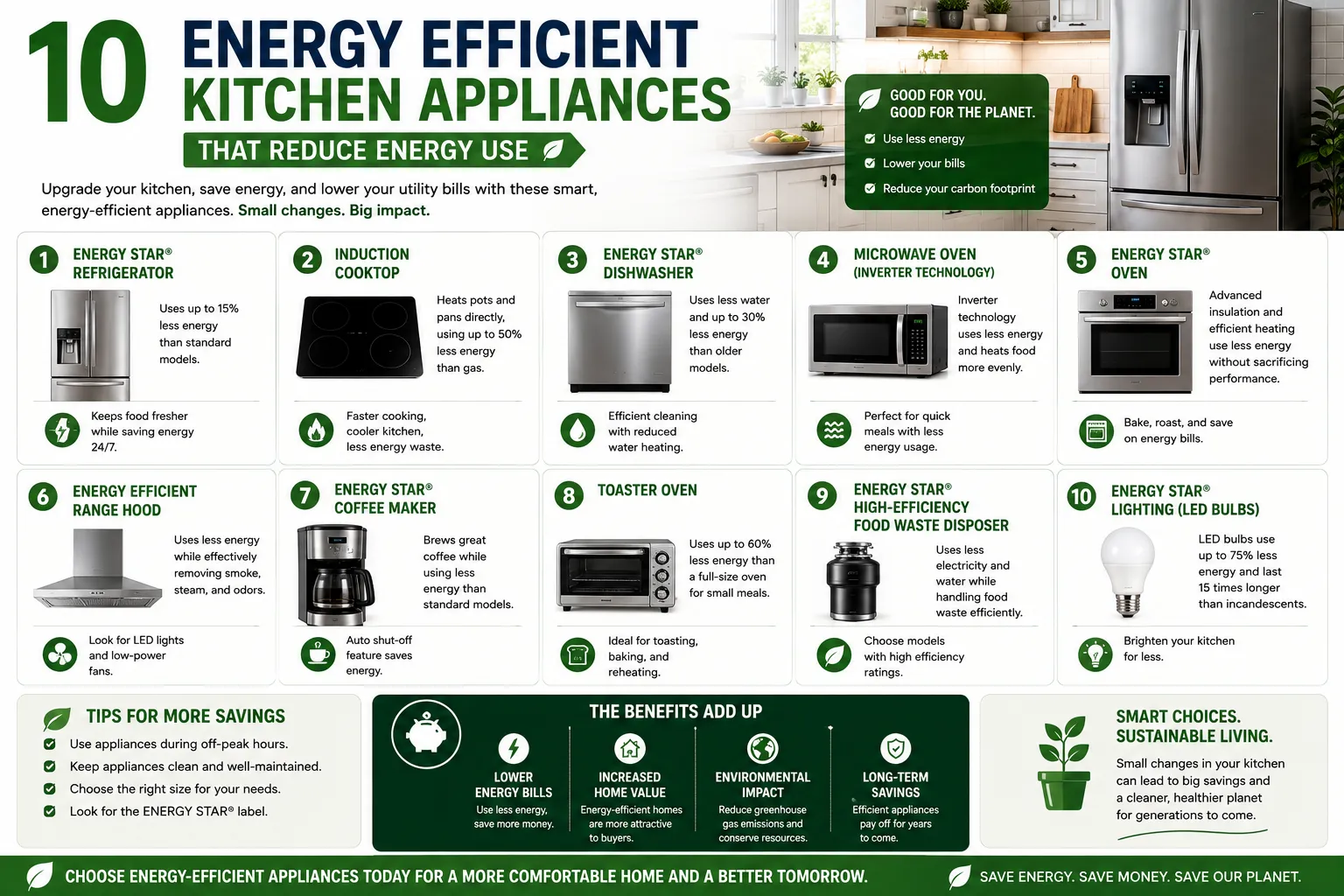
10 Energy Efficient Kitchen Appliances That Reduce Energy Use
Your kitchen may be one of the busiest rooms in your home, but it can also be one of the biggest places where energy disappears. Think about everything happening there during a normal day: your refrigerator runs continuously, the dishwasher heats water, the oven prepares dinner, the coffee maker starts your morning, and smaller appliances quietly consume electricity whenever they are plugged in. When you add everything together, those little energy demands can become a meaningful part of your household electricity use. The good news is that choosing energy efficient kitchen appliances and using them intelligently can help reduce unnecessary energy consumption without forcing you to give up the convenience you love.
Modern appliances have become considerably smarter and more efficient. ENERGY STAR says certified products are designed to meet strict efficiency requirements established by the U.S. Environmental Protection Agency or U.S. Department of Energy, while still providing the features consumers expect. Refrigerators, dishwashers, electric cooking products, and other kitchen equipment can now incorporate better insulation, sensors, improved motors, more precise controls, and smarter operating cycles. That means the appliance you buy today can potentially perform the same job while consuming substantially less energy than an older model.
This guide explores 10 energy efficient kitchen appliances that reduce energy use, explains what makes each one efficient, and shows you how to get more savings from the appliances you already own. Whether you’re replacing an old refrigerator, remodeling your kitchen, or simply trying to lower your electricity bill, these ideas can help you build a kitchen that works smarter rather than harder.
Why Energy Efficient Kitchen Appliances Matter
Energy efficiency is not simply about buying appliances with fancy technology. It is about getting the same useful result while using less electricity or other energy. A highly efficient refrigerator still keeps food cold, an efficient dishwasher still cleans dishes, and an efficient cooktop still prepares meals. The difference is that better engineering allows the appliance to accomplish its job with less wasted energy. Over the lifetime of an appliance, those small differences in daily electricity consumption can become significant.
This matters because kitchen appliances often operate frequently, and some operate continuously. Your refrigerator, for example, never really gets a day off. Even when nobody is home, it continues cycling to keep food at a safe temperature. ENERGY STAR reports that certified refrigerators are about 9% more energy efficient than models that meet the federal minimum efficiency standard, while replacing an old refrigerator with an ENERGY STAR certified model can provide additional lifetime savings.
Dishwashers provide another interesting example. Modern ENERGY STAR certified dishwashers use advanced technologies such as soil sensors, improved filtration, efficient spray jets, and redesigned racks to reduce water and energy consumption. ENERGY STAR says a standard-size certified dishwasher costs about $50 per year to operate and can save about 5,800 gallons of water over its lifetime compared with less efficient alternatives.
The lesson is simple: energy efficient kitchen appliances can reduce energy use every time you cook, clean, cool, freeze, or prepare a drink. You don’t need to change your entire lifestyle. Sometimes, the smartest energy-saving move is simply replacing a heavily used appliance with a more efficient model when it is time for an upgrade.
How Kitchen Appliances Affect Your Energy Bill
Your electricity bill is essentially a record of how much energy your home consumes over time. Every appliance adds something to that total, but not every appliance contributes equally. A refrigerator running 24 hours a day has a very different energy profile from a toaster that operates for three minutes each morning. Likewise, an oven used for an hour every day has a different impact from a coffee maker used for ten minutes.
This is why energy efficient kitchen appliances should be evaluated according to both efficiency and frequency of use. Replacing an inefficient refrigerator can be more impactful than replacing a rarely used countertop appliance. However, smaller appliances can still matter when they are used frequently or left plugged in continuously.
When shopping, don’t look only at the sticker price. Look at the estimated annual energy consumption, available efficiency certifications, expected operating cost, capacity, and how long you plan to keep the appliance. A slightly more expensive appliance may become the better financial choice if it consumes significantly less energy over many years.
ENERGY STAR’s product categories include refrigerators, freezers, dishwashers, and electric cooking products, making certified products easier to identify when shopping for efficient kitchen equipment.
1. Energy Efficient Refrigerators
The refrigerator deserves the number-one spot because it is one of the few appliances in your kitchen that works around the clock. You may switch off the oven after dinner and unplug the coffee maker when you’re finished, but the refrigerator continues cooling day and night. That constant operation makes refrigerator efficiency particularly important.
Modern energy efficient refrigerators use technologies such as improved insulation, high-efficiency compressors, better temperature controls, and more efficient defrost systems. ENERGY STAR says certified refrigerators are approximately 9% more efficient than models that meet the federal minimum standard.
Size also matters. A huge refrigerator may look impressive, but more storage space generally means more energy consumption. ENERGY STAR recommends considering appropriately sized refrigerators and notes that the most energy-efficient models are typically around 16–20 cubic feet.
Configuration matters as well. ENERGY STAR notes that top-freezer models tend to use less energy than bottom-freezer or side-by-side configurations. That doesn’t mean you should automatically buy a top-freezer refrigerator, but it demonstrates why design choices matter when comparing appliances.
If you’re replacing an older refrigerator, recycling it properly is also important. Don’t simply move the old unit into the garage and keep both refrigerators running unless you genuinely need the additional storage. An old secondary refrigerator can quietly consume electricity for years.
How to Make Your Refrigerator More Efficient
Buying one of the best energy efficient kitchen appliances is only half the equation. How you use the appliance matters too.
Keep your refrigerator at the manufacturer’s recommended temperature. ENERGY STAR recommends approximately 35–38°F for refrigerators, while freezer temperatures should follow manufacturer guidance.
Check the door seals regularly. If cold air escapes around a damaged gasket, the compressor has to work harder to maintain the desired temperature. Also, keep the refrigerator away from direct sunlight and major heat sources such as ovens whenever possible. ENERGY STAR specifically recommends positioning refrigerators away from heat sources and allowing adequate airflow around the unit.
And perhaps the simplest habit of all: don’t stand with the refrigerator door open while deciding what to eat. Know what you’re looking for, grab it, and close the door. It sounds trivial, but repeated unnecessary door openings force the appliance to remove additional heat.
2. Energy Efficient Dishwashers
If you’ve ever wondered whether using a dishwasher really saves energy compared with washing dishes by hand, modern efficient dishwashers make the answer surprisingly interesting. Today’s energy efficient dishwashers are designed to optimize water temperature, spray patterns, filtration, and cycle duration. ENERGY STAR certified models use sensors to determine how dirty dishes are and can adjust their operation accordingly.
ENERGY STAR says certified dishwashers are approximately 20% more energy efficient and 30% more water efficient than standard models, according to its consumer guidance. The technology has changed dramatically over the years, meaning a modern efficient dishwasher can perform its job with far less water than older approaches.
One important habit is to stop rinsing dishes unnecessarily before loading them. ENERGY STAR recommends scraping rather than rinsing, because modern dishwashers and detergents are designed to handle food residue.
Running full loads is another simple way to save. A dishwasher uses roughly the same amount of energy and water during a cycle regardless of whether it is completely full or only partially loaded. If you run half-empty cycles repeatedly, you’re essentially paying to heat and move water for unused space.
Look for features such as soil sensors, energy-saving cycles, efficient drying, and the option to disable heated drying. ENERGY STAR specifically recommends using no-heat drying where appropriate because it can reduce energy consumption.
3. Induction Cooktops
Induction cooking is one of the most interesting technologies in the world of energy efficient kitchen appliances. Unlike traditional gas or conventional electric cooking, induction uses electromagnetic energy to heat compatible cookware directly. Instead of spending as much energy heating the surrounding air or a large heating surface, induction transfers energy directly into the pan.
ENERGY STAR reports that induction cooking transfers about 85% of heating energy to cookware, compared with approximately one-third for gas cooking products. That difference helps explain why induction has become increasingly popular among people looking for efficient cooking technology.
Induction also has a practical advantage: speed. ENERGY STAR notes that boiling water with induction can take nearly half the time compared with gas, radiant, or coil cooking in certain comparisons. Faster cooking can mean less time using the appliance, which can further contribute to lower energy use.
Another benefit is precision. Induction cooktops can respond quickly when you adjust the temperature, giving cooks better control. The cooking surface also tends to remain cooler than conventional cooking surfaces because the pan itself is being heated.
The main limitation is cookware compatibility. Induction requires magnetic cookware, so some aluminum, copper, or glass cookware may not work unless it has a compatible magnetic base.
Why Induction Cooking Uses Energy Efficiently
Imagine trying to warm a cup of water by heating the entire kitchen. That would obviously be inefficient. Traditional cooking methods can lose some energy to the surrounding environment because the heat source is not transferring all of its energy directly into the cookware.
Induction takes a more targeted approach. The electromagnetic field interacts with compatible cookware and generates heat within the cookware itself. This direct transfer is one reason induction stands out among modern energy efficient kitchen appliances.
ENERGY STAR’s residential electric cooking criteria were introduced in 2023, with qualifying products required to meet defined annual energy-consumption thresholds.
If you’re remodeling a kitchen and planning to electrify your cooking system, induction is worth considering. It combines efficiency, speed, precision, and modern controls in a single appliance.
4. Energy Efficient Electric Ovens
Ovens are another major kitchen energy user, particularly for households that cook frequently. Choosing an efficient oven can reduce energy consumption without changing the meals you prepare.
Modern electric ovens can incorporate better insulation, improved temperature controls, convection technology, and more efficient heating systems. Convection ovens circulate heated air throughout the cooking chamber, helping distribute heat more evenly and potentially allowing food to cook at lower temperatures or in shorter periods, depending on the recipe.
ENERGY STAR’s electric cooking products program covers qualifying residential electric cooking products, including cooktops and ranges. ENERGY STAR also reports that certified electric cooking products are 18% more efficient on average compared with standard models.
Your cooking habits can make an efficient oven even more efficient. Avoid opening the oven door repeatedly because each opening allows heated air to escape. Use the correct cookware size and temperature, and avoid preheating longer than necessary.
When possible, cook multiple dishes together. If you’re already heating the oven, using that heat efficiently can reduce the number of times you need to run the appliance.
For smaller meals, consider whether a toaster oven, countertop convection oven, or microwave could complete the job with less energy. The most efficient appliance is often the one appropriately sized for the task.
5. Energy Efficient Freezers
A separate freezer can be incredibly useful for families who buy food in bulk, store garden produce, or want additional long-term storage. But like refrigerators, freezers run continuously, so their efficiency matters.
An energy efficient freezer uses improved insulation, efficient compressors, and temperature-control technology to maintain low temperatures while minimizing electricity consumption. ENERGY STAR’s refrigerator and freezer criteria require certified models to use at least 10% less measured energy than the applicable federal minimum efficiency standards.
Size is important here too. Don’t automatically buy the largest freezer available. Choose a capacity that matches your actual needs. An oversized freezer with large empty areas can still consume energy to maintain its temperature.
Keep the door closed as much as possible. Organize the freezer so you can quickly find what you need rather than leaving the door open while searching.
If you have an old freezer in a garage or basement, consider how frequently you actually use it. Replacing an inefficient older appliance or eliminating an unnecessary second freezer may be more beneficial than simply purchasing another efficient appliance.
6. Energy Efficient Microwaves
Microwaves often get overlooked when people talk about energy efficient kitchen appliances, but they can be extremely useful for reducing cooking energy when used appropriately. Their primary advantage is that they can heat or cook smaller portions quickly without requiring a large oven to warm an entire cooking chamber.
For reheating leftovers, melting ingredients, steaming vegetables, or preparing small meals, a microwave may be more practical than turning on a full-size oven. The energy-saving benefit comes partly from matching the appliance to the job.
This is an important principle in kitchen efficiency: use the smallest appropriate appliance for the task.
If you are reheating a single bowl of food, heating a large oven for 20 minutes may not make much sense. A microwave can accomplish the task quickly. If you’re preparing several large dishes for a family gathering, however, a conventional oven may be the more practical option.
Microwave efficiency also depends on usage habits. Use microwave-safe containers, follow recommended cooking times, and avoid unnecessarily long heating periods. Cleaning the interior can also help maintain good performance and prevent food buildup from interfering with normal operation.
While microwaves may not receive the same attention as ENERGY STAR refrigerators or dishwashers, their ability to handle small cooking tasks quickly makes them a valuable part of an efficient kitchen strategy.
7. Energy Efficient Range Hoods
A range hood might not seem like an energy-consuming appliance, but ventilation deserves attention. Range hoods remove smoke, steam, odors, grease, and cooking pollutants from the kitchen. However, excessive ventilation can also remove conditioned indoor air.
An efficient range hood should provide appropriate ventilation without unnecessarily moving huge amounts of air. Look for a model with effective controls and multiple fan-speed settings so you can match ventilation to what you’re cooking.
For example, boiling water may require less ventilation than frying food at high temperatures. Using the highest fan setting for every cooking task can move more air than necessary.
The size and design of the hood should also match the cooking equipment. An oversized or poorly installed system may not perform efficiently, while an undersized system may fail to remove pollutants effectively.
When you’re trying to build an energy-conscious kitchen, ventilation should be considered alongside cooking appliances rather than treated as an afterthought. Efficient cooking equipment, appropriate ventilation, and good indoor-air practices can work together.
8. Energy Efficient Coffee Makers
For millions of people, the kitchen does not truly wake up until the coffee does. Coffee makers are relatively small appliances, but frequent use means their energy consumption can add up over time.
The first thing to consider is how long the machine remains hot. Traditional coffee makers may continue using electricity to keep a heating plate warm after brewing has finished. If you’re only drinking one or two cups, leaving an entire pot warm for hours is unnecessary.
A machine with automatic shutoff can help eliminate this waste. Some modern coffee makers also allow programmable schedules, so the appliance can prepare coffee at a specific time rather than remaining active throughout the day.
Single-serve machines should be used thoughtfully too. Convenience is valuable, but repeatedly running a machine for tiny amounts of water can be less efficient than preparing a larger amount when several people want coffee.
The broader lesson is that energy efficient kitchen appliances are only as efficient as the way we use them. An appliance with excellent engineering can still waste energy if it operates longer than necessary.
9. Energy Efficient Toasters and Toaster Ovens
Toasters are simple appliances, but toaster ovens can be especially useful because they occupy a middle ground between a toaster and a full-size oven. For small portions, a countertop toaster oven may avoid the need to heat a much larger cooking cavity.
The efficiency advantage comes from matching capacity to the meal. If you’re warming two slices of bread, a full-size oven is unnecessary. If you’re cooking a small portion of vegetables, reheating pizza, or preparing a small meal, a toaster oven can sometimes be more practical.
Convection toaster ovens can improve heat circulation, while programmable controls can help prevent unnecessary cooking time. Look for models that allow you to select the appropriate cooking mode and temperature.
As with other appliances, avoid leaving the unit operating when the food is finished. Automatic shutoff features can help.
When comparing energy efficient kitchen appliances, don’t assume that the newest appliance is automatically the best. Consider how often you’ll use it, how much food it can cook, how quickly it completes the task, and whether it replaces a larger appliance.
10. Energy Efficient Electric Kettles
Electric kettles can be excellent energy-saving tools when used correctly because they are designed specifically to heat water quickly. If you’re making tea, instant coffee, oatmeal, or another hot drink, a kettle can be more convenient than heating water in a large pot.
The key is to heat only the amount of water you actually need. Filling a kettle completely every time you want one cup means you’re paying to heat extra water that will simply cool down afterward.
This principle applies to many energy efficient kitchen appliances: efficiency is partly about the technology and partly about using the right amount of energy for the task.
Look for a kettle with automatic shutoff and clearly visible water-level markings. These features make it easier to avoid overheating or boiling more water than necessary.
If you frequently prepare hot drinks, this small habit can become automatic. Measure the water you need, heat it, use it, and switch off the appliance.
What to Look for When Buying Energy Efficient Kitchen Appliances
Buying an appliance based only on appearance is easy. Kitchens are often designed around aesthetics, so stainless steel finishes, touchscreen controls, hidden handles, and sleek designs can attract attention. But if reducing energy use is your priority, you need to look beyond the exterior.
Start with the appliance’s energy consumption. In the United States, the EnergyGuide label provides estimated annual energy use and operating cost for many covered appliances. ENERGY STAR certification provides another useful signal because qualifying products must meet specific efficiency criteria.
Capacity is also important. A highly efficient refrigerator that is twice as large as necessary may still consume more energy than a smaller, appropriately sized model.
Consider the appliance’s features too. Sensors, automatic shutoff, eco modes, efficient drying, programmable controls, and smart scheduling can potentially reduce unnecessary operation.
Then think about durability. The cheapest appliance is not necessarily the cheapest appliance to own. A model that costs slightly more but lasts longer and consumes less electricity may provide greater value over its lifetime.
Finally, consider repairability, warranty coverage, replacement parts, and maintenance requirements. Energy efficiency is important, but so is the overall cost of ownership.
ENERGY STAR vs Standard Kitchen Appliances
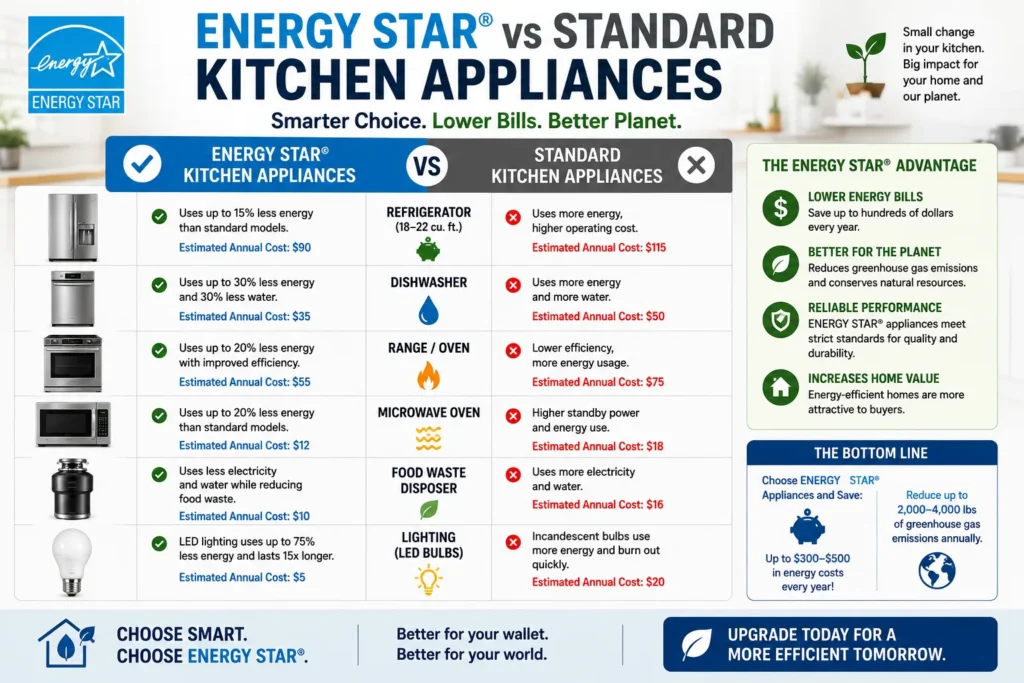
ENERGY STAR is one of the easiest ways for U.S. shoppers to identify products that meet defined energy-efficiency requirements. The program is administered by the U.S. Environmental Protection Agency and, for certain products, the U.S. Department of Energy.
ENERGY STAR explains that certified products use less energy while providing comparable or better performance than standard alternatives.
The actual savings vary by appliance category. For example, ENERGY STAR certified refrigerators are about 9% more efficient than models meeting federal minimum standards, while ENERGY STAR certified dishwashers are described as about 20% more energy efficient and 30% more water efficient than standard models.
| Appliance | Efficiency Opportunity | Useful Buying Feature |
|---|---|---|
| Refrigerator | High because it operates continuously | ENERGY STAR certification, appropriate size |
| Dishwasher | High for frequent users | Soil sensors, efficient cycles, no-heat dry |
| Induction cooktop | High cooking efficiency | Compatible cookware and precise controls |
| Electric oven | Moderate to high | Efficient insulation, convection |
| Freezer | High because it runs continuously | ENERGY STAR certification, suitable size |
| Microwave | Useful for small meals | Appropriate capacity and efficient operation |
| Range hood | Depends on use and airflow | Variable-speed controls |
| Coffee maker | Depends on frequency and standby time | Automatic shutoff |
| Toaster oven | Useful for small portions | Convection and automatic controls |
| Electric kettle | Useful for heating small amounts of water | Auto shutoff and water-level markings |
The table demonstrates why there is no single “best” kitchen appliance for every household. Your biggest opportunity depends on which appliances you use most frequently.
Smart Kitchen Appliances and Energy Savings
Smart technology is making its way into the kitchen, and some connected features can genuinely help with energy management. ENERGY STAR notes that connected certified appliances can offer functionality such as refrigerator-door alerts, dishwasher scheduling, and other controls designed to provide convenience and potential savings.
Imagine getting an alert because someone left the refrigerator door open. Instead of discovering the problem hours later, you can close it quickly. Or imagine scheduling a dishwasher to run during a period when electricity prices are lower, where time-of-use pricing is available. Smart appliances can make those decisions easier.
However, “smart” does not automatically mean “efficient.” A refrigerator covered with screens and internet-connected features is not necessarily better for your electricity bill than a simpler efficient model.
Look at the underlying energy performance first. Smart features should be considered an additional benefit, not a substitute for efficiency certification.
The most useful smart functions are often simple ones: automatic shutoff, scheduling, sensors, remote monitoring, energy-use reporting, and alerts. These features can help you avoid unnecessary operation.
How to Use Kitchen Appliances More Efficiently
Even the best energy efficient kitchen appliances can waste energy if used incorrectly. The simplest strategy is to match the appliance to the task.
Use a microwave or toaster oven for small portions instead of heating a full-size oven when appropriate. Run your dishwasher when it is full. Avoid opening the oven repeatedly. Heat only the amount of water you need in an electric kettle. Turn off coffee makers after brewing instead of keeping the warming plate active for hours.
Maintenance matters too. Keep refrigerator door seals clean and intact. Follow manufacturer instructions for cleaning and ventilation. Keep dishwasher filters clean when applicable. Remove debris that can interfere with airflow or normal appliance operation.
Pay attention to standby energy. If an appliance doesn’t need to remain powered, switch it off when appropriate. Smart plugs can help automate this for certain devices, although they should not be used with appliances unless the plug is rated for the appliance’s electrical load and the manufacturer permits that setup.
The goal isn’t to become obsessed with electricity. It’s simply to make inefficient habits less automatic.
How to Make Your Kitchen More Energy Efficient
If you want to understand how to make your kitchen more energy efficient, start with the appliances that run most often. Your refrigerator and freezer deserve attention because they operate continuously. Your dishwasher, oven, and cooking appliances are next, particularly if your household uses them several times a day.
Lighting is another easy improvement. Replacing frequently used incandescent bulbs with LEDs can reduce electricity consumption dramatically. ENERGY STAR says certified LED bulbs can use up to 90% less energy than traditional incandescent bulbs and can last up to 15 times longer.
Ventilation also matters. Use range hood fans when appropriate, but avoid running them unnecessarily long after cooking is finished. If your kitchen has good natural ventilation, use it when practical while maintaining indoor-air-quality requirements.
You can also improve efficiency through kitchen layout. Keep your refrigerator away from direct sunlight and major heat sources such as ovens. ENERGY STAR specifically recommends placing refrigerators away from heat sources and allowing air circulation around the appliance.
Simple Kitchen Energy-Saving Habits
You don’t have to buy anything to start reducing kitchen energy use. Some of the most useful improvements are simply changes in routine.
- Run the dishwasher with full loads.
- Scrape dishes instead of pre-rinsing them.
- Use no-heat drying when appropriate.
- Heat only the amount of water you need.
- Use smaller appliances for smaller meals.
- Avoid repeatedly opening the oven.
- Turn off appliances when their work is finished.
- Keep refrigerator and freezer doors closed.
- Maintain appliance seals and filters.
- Use efficient LED lighting.
These habits may appear small, but they become powerful when repeated every day. Energy efficiency is rarely about one dramatic action. It is usually about removing dozens of small sources of waste.
Common Mistakes That Waste Kitchen Energy
One common mistake is buying the largest appliance available simply because you have enough space for it. More capacity often means more energy consumption. ENERGY STAR specifically recommends choosing appropriately sized refrigerators rather than automatically choosing the biggest model.
Another mistake is replacing appliances without checking their actual energy consumption. A beautiful new appliance is not automatically efficient. Always compare energy-use information and certification.
Leaving appliances running unnecessarily is another major habit to address. A coffee maker that keeps a warming plate hot for hours, a toaster oven left on after cooking, or an oven preheated long before food is ready can all waste energy.
Pre-rinsing dishes is another surprisingly common mistake. ENERGY STAR specifically recommends scraping rather than rinsing because modern dishwashers and detergents are designed to handle food residue.
Finally, don’t ignore maintenance. A dirty filter, damaged door seal, blocked airflow path, or poorly maintained appliance may perform less efficiently than intended.
Conclusion
Choosing energy efficient kitchen appliances is one of the simplest ways to reduce unnecessary household energy use without sacrificing modern convenience. Refrigerators, dishwashers, induction cooktops, electric ovens, freezers, microwaves, range hoods, coffee makers, toaster ovens, and electric kettles can all play a role in a smarter kitchen. The most important thing is not simply buying the newest appliance but selecting equipment that matches your household’s needs, capacity requirements, frequency of use, and energy priorities.
The data from ENERGY STAR shows that efficiency improvements can be meaningful. Certified refrigerators are about 9% more efficient than models meeting federal minimum standards, while certified dishwashers can be around 20% more energy efficient and 30% more water efficient than standard models. ENERGY STAR also reports that certified electric cooking products are 18% more efficient on average than standard models, while induction cooking can transfer approximately 85% of heating energy into compatible cookware.
But appliances are only part of the equation. How you use your kitchen matters just as much as what you buy. Running full dishwasher loads, avoiding unnecessary pre-rinsing, using smaller appliances for smaller meals, heating only the water you need, maintaining refrigerator seals, and switching appliances off when they’re finished can all reduce wasted energy.
The smartest kitchen isn’t necessarily the one filled with the most expensive technology. It is the kitchen where every appliance is appropriately sized, efficiently designed, properly maintained, and used intentionally. If your goal is to reduce energy consumption and create a more sustainable home, replacing old, heavily used appliances with efficient alternatives can be a practical step toward a lower-energy lifestyle.
Frequently Asked Questions
1. What is the most energy efficient kitchen appliance?
There isn’t one appliance that is universally the most efficient because different appliances perform different tasks. Refrigerators are particularly important because they operate continuously, while induction cooktops are notable for their efficient transfer of cooking energy. ENERGY STAR says certified refrigerators are about 9% more efficient than models meeting federal minimum standards, while induction can transfer about 85% of heating energy to cookware.
2. Do energy efficient appliances really save money?
Yes, although the amount depends on the appliance, how often you use it, electricity prices, and how inefficient the old model was. A heavily used appliance can provide greater long-term savings than a rarely used appliance. When shopping, compare annual energy consumption and estimated operating costs rather than focusing only on the purchase price.
3. Is an induction cooktop more energy efficient than gas?
Induction can be significantly more efficient at transferring heating energy into cookware. ENERGY STAR states that induction transfers about 85% of heating energy to cookware, compared with roughly one-third for gas cooking products. Actual household energy savings will depend on cooking habits and the broader energy system.
4. Does a dishwasher really save energy?
A modern efficient dishwasher can use less energy and water than many people expect. ENERGY STAR says certified dishwashers are about 20% more energy efficient and 30% more water efficient than standard models. Running full loads and avoiding unnecessary pre-rinsing can improve efficiency further.
5. How can I make my kitchen more energy efficient without buying new appliances?
Start with your daily habits. Run full dishwasher loads, scrape dishes instead of pre-rinsing, avoid leaving coffee makers and countertop appliances running unnecessarily, use the smallest appropriate cooking appliance, keep refrigerator doors closed, maintain seals, and replace frequently used inefficient bulbs with LEDs. These simple changes can reduce wasted energy even when your appliances are relatively old.
Fore more informtion click here