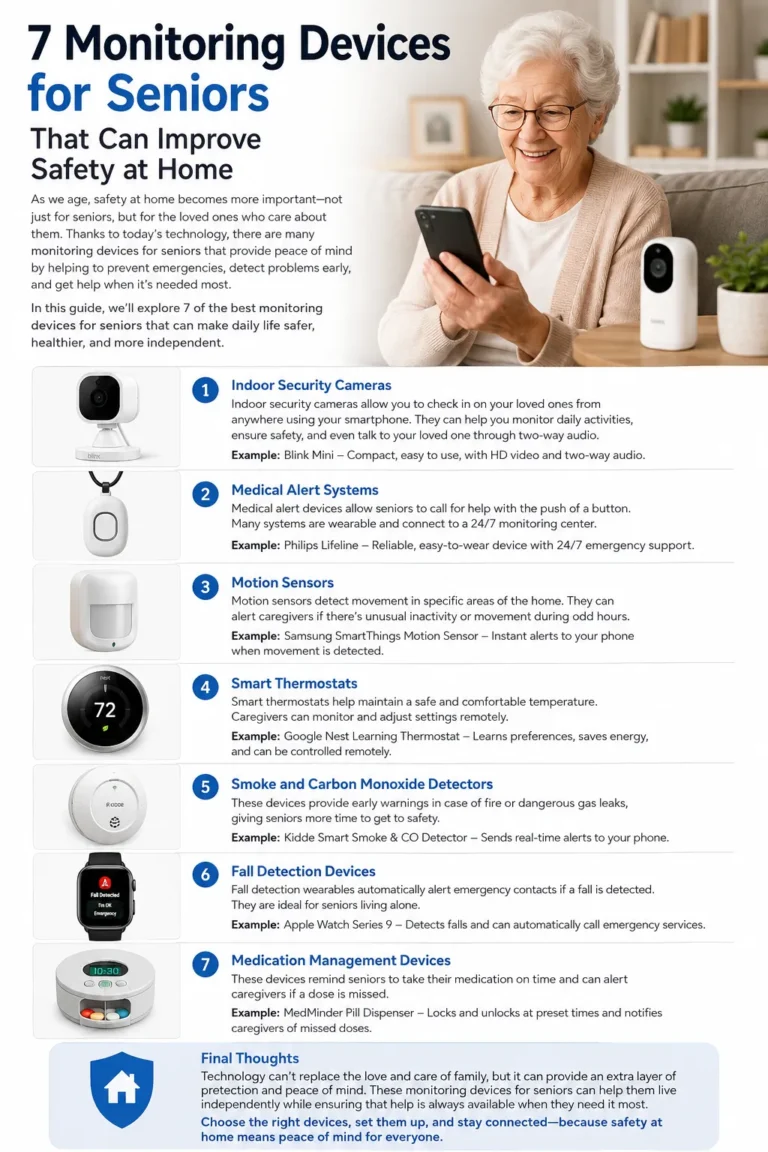
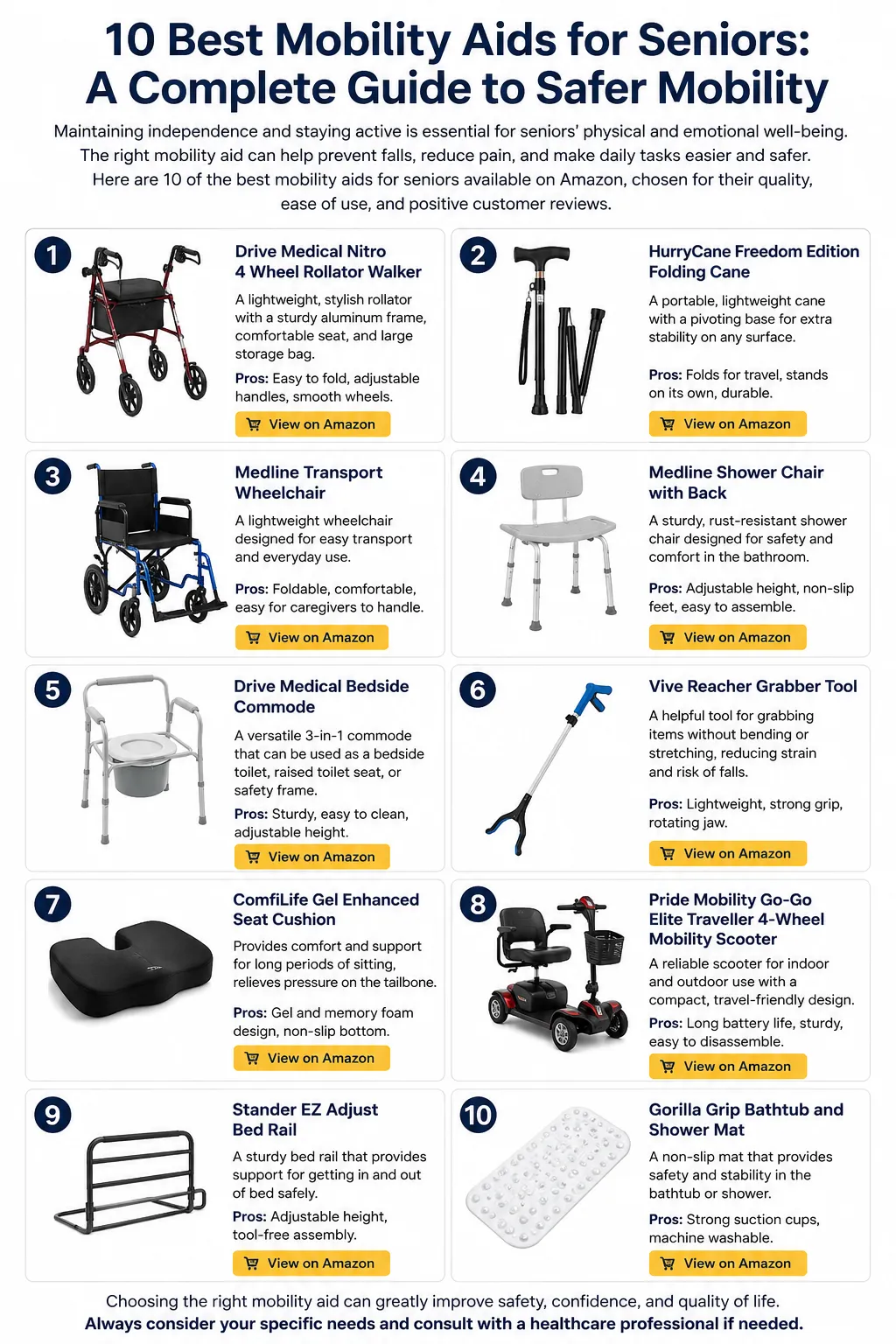
10 Best Mobility Aids for Seniors: A Complete Guide to Safer Mobility
Introduction
Getting older does not have to mean giving up the freedom to walk around the house, visit friends, shop for groceries, enjoy a park, or simply move from one room to another without asking for help. The right mobility aids for seniors can turn an uncertain trip across the living room into a confident walk, make outdoor errands more manageable, and help people remain involved in the activities that make life enjoyable. Think of a mobility aid as an extension of your personal balance system: instead of expecting your body to handle every uneven surface, turn, step, or moment of fatigue by itself, the device provides another point of support. That simple change can make a surprisingly large difference in everyday life. Falls are a major concern among older adults. The CDC reports that more than one in four adults aged 65 and older fall each year, and its fall-prevention compendium notes that falls account for more than 3 million emergency-department visits annually in the United States. The goal, however, should not be to choose the biggest or most expensive device simply because it looks safest. The best mobility aids for seniors are the ones that match the individual’s strength, balance, environment, lifestyle, and ability to operate the equipment correctly. A cane may be perfect for someone who needs a little extra stability, while a standard walker may be much more appropriate for someone who needs substantial support. A rollator may suit an active senior who needs balance assistance and occasional rest, while a wheelchair or scooter may be better when walking endurance is severely limited. This complete guide explains ten major categories of mobility aids, what each one does, who should consider it, what features matter, and how to shop intelligently, including examples of products that have been listed on Amazon.
Why Mobility Aids Matter for Seniors
The phrase mobility aids for seniors covers a surprisingly broad family of equipment, and that is important because no two mobility situations are exactly alike. Some older adults have excellent strength but feel unsteady when walking on unfamiliar surfaces. Others can walk safely for short periods but become exhausted after several minutes. Someone recovering from an operation may temporarily need a walker, whereas another person may require a wheelchair or scooter for longer-term mobility. A device should therefore be viewed as a tool for solving a particular mobility problem rather than as a symbol of declining independence. In fact, using an appropriate aid can sometimes preserve independence precisely because it allows a person to keep doing things that would otherwise become too difficult or risky. Research available through the CDC has found that assistive-device users among adults aged 65 and older were more likely to report mobility limitations and recent falls, which illustrates an important point: needing an aid is often a sign that someone already has meaningful mobility challenges, not evidence that the device itself caused those challenges. The answer is not to avoid assistance out of embarrassment. It is to make sure the assistance is properly selected and fitted. A poorly adjusted walker can be awkward; a cane at the wrong height can encourage poor posture; a rollator with brakes the user cannot comfortably operate may create a hazard rather than solve one. The smartest approach combines the right equipment with proper instruction, sensible home modifications, appropriate footwear, and professional assessment when necessary. Mobility is not an all-or-nothing concept. It is more like a bridge, and the right device helps build that bridge between what the body can currently do and what the person wants to keep doing.
How Mobility Aids Support Independence
Independence is often measured in everyday moments rather than dramatic achievements. Can you get from the bedroom to the kitchen without calling someone? Can you stand long enough to prepare breakfast? Can you walk into a doctor’s office, sit down, and get back outside? Can you move around a supermarket without worrying that your legs will give out? Those ordinary tasks are exactly where mobility aids for seniors can make a meaningful difference. A walker can provide a broad base of support, while a rollator can combine walking assistance with a seat for planned rest breaks. A cane can reduce the amount of balance work required during a short walk, and a wheelchair can conserve energy when walking itself is no longer a practical way to cover longer distances. The CDC’s fall-prevention guidance emphasizes that falls are not an inevitable consequence of aging and that evidence-based interventions can reduce falls. A mobility aid is only one piece of that bigger picture, but it can be an important piece when it is chosen and used correctly. There is also a psychological benefit worth considering. When someone is afraid of falling, they may gradually stop going outside, avoid social activities, or move less because movement feels dangerous. That shrinking circle of activity can lead to even less confidence. A suitable aid can act like a safety net, encouraging useful movement rather than eliminating movement altogether. The key is to use the device to support activity, not to replace every opportunity for appropriate walking, strengthening, and balance practice. If a senior is suddenly having difficulty walking, frequently losing balance, or needing to grab furniture for support, the situation deserves professional attention rather than simply buying equipment online and hoping for the best.
How to Choose the Right Mobility Aid
Choosing among mobility aids for seniors starts with a deceptively simple question: What exactly is the person struggling to do? If the problem is mild instability during short walks, a cane might be sufficient. If balance is significantly impaired, a standard walker could offer a more stable base. If the person walks independently but tires easily and wants somewhere to sit, a rollator may make more sense. If walking is too painful or physically demanding for meaningful distances, a wheelchair or mobility scooter may be more appropriate. The environment matters just as much as the person. A large rollator that feels wonderful on a sidewalk might be frustrating in a narrow apartment. A scooter that works beautifully outdoors may have difficulty navigating small doorways. A wheelchair may be excellent for long trips but unnecessarily cumbersome for someone who mainly needs a little support around the home. Before purchasing, consider the user’s height, weight, upper-body strength, hand grip, balance, vision, cognition, walking speed, endurance, and ability to understand and operate brakes or controls. Weight capacity should never be treated as an approximate suggestion; choose equipment rated appropriately for the user and any belongings that will be carried. Fit matters, too. Handles should allow a comfortable posture rather than forcing the person to hunch or reach downward. For more complex needs, a physical therapist, occupational therapist, physician, or qualified mobility specialist can assess gait and recommend equipment. This is particularly important after a major fall, surgery, stroke, neurological change, or sudden decline in walking ability. The best mobility aids for seniors are not necessarily the most sophisticated ones. They are the ones that provide the right level of support without creating new difficulties.
Matching the Aid to the User
A useful way to approach the decision is to imagine the person’s most difficult typical day rather than their easiest day. Suppose someone can walk comfortably around the house but struggles during a 20-minute shopping trip. A rollator with a seat might be more practical than a basic walker because it allows regular rest. Suppose another person has severe balance problems and needs to place substantial weight through both arms. A standard walker may provide a more appropriate foundation than a lightweight cane. If the person has limited hand strength, brake levers deserve particular attention because a rollator that requires strong squeezing may be difficult or unsafe to operate. If someone has difficulty following instructions or remembering to lock brakes before sitting, a device with more complicated controls may not be suitable without supervision. The same principle applies to mobility aids for seniors used outdoors. Larger wheels can be useful over uneven surfaces, but a larger device can also be harder to maneuver in tight spaces. Wheelchairs and scooters introduce additional considerations such as turning radius, ramps, thresholds, battery management, transport, and accessible entrances. For bathroom mobility, the question changes again because wet surfaces create a different risk profile. A shower chair, transfer bench, grab bar, or raised toilet seat may be more valuable than a walking aid inside the bathroom. This is why a shopping list alone is not enough. The equipment should match the task. Imagine buying hiking boots for someone who only needs comfortable house shoes; the boots might be excellent products, but they would solve the wrong problem. Mobility equipment works the same way. Start with the user’s actual challenge, then select the simplest device capable of addressing it safely and comfortably.
1. Standard Walkers
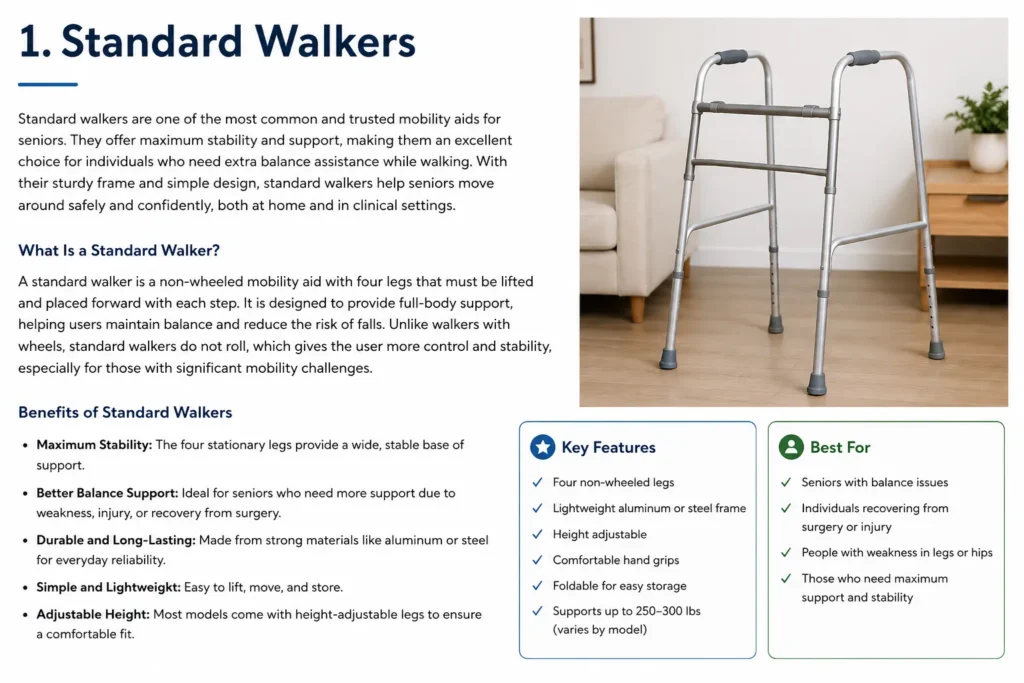
A standard walker is one of the most recognizable mobility aids for seniors, and its appeal comes from simplicity. It usually consists of a lightweight frame with four legs and hand grips, creating a broad base that the user can position ahead of the body before taking a step. Unlike a rollator, a basic walker generally does not have wheels, so the user must lift or reposition it as they move. That can provide a high level of stability, but it also requires enough arm, shoulder, and hand strength to move the frame repeatedly. For someone with significant balance problems who can safely lift and advance the walker, this design can offer reassuring support. It is particularly useful in situations where maximum stability is more important than walking speed. Some models can be fitted with glides or wheels, creating variations that require less lifting. The major mistake is assuming that every walker is interchangeable. Frame width, weight, height adjustment, grip design, folding mechanism, and accessories can affect how easy the device is to use. A walker that feels light to a strong caregiver may still feel heavy to the senior using it. Before buying, check that the frame is appropriately sized and that the user can move it forward without twisting, reaching, or losing balance. A therapist can demonstrate the correct sequence: position the walker securely, advance it an appropriate distance, then step into the supported space rather than pushing it too far ahead. Proper technique matters because the walker is intended to create a stable base, not become something the user has to chase with every step.
Best Uses and Buying Considerations
Standard walkers are especially useful for people who need significant support and who spend much of their time on relatively smooth indoor surfaces. Their four-point base can provide a sense of security that a cane cannot match, but that stability comes with trade-offs. The user has to coordinate the frame and their steps, and lifting the walker repeatedly can become tiring. For that reason, these mobility aids for seniors are not automatically the best choice for people who need to walk long outdoor distances. A wheeled walker or rollator may be more practical in those situations. Look for height adjustment, comfortable hand grips, a sturdy but manageable frame, and a folding mechanism that the user or caregiver can operate reliably. Avoid selecting a model solely because it has numerous accessories. A basket, pouch, or tray can be useful, but accessories should not interfere with safe hand placement or add excessive weight. The user should also understand that a walker is not a substitute for holding onto furniture or countertops. Furniture may move, slide, or be at an inappropriate height, whereas the walker is designed to remain a predictable support. When transitioning from sitting to standing, the safest technique often involves using the chair’s stable armrests or another appropriate fixed surface rather than pulling forcefully on a rolling device. If the senior consistently struggles to coordinate a walker, cannot maintain an upright posture, or becomes exhausted while using it, reassessment is warranted. The goal is controlled, confident movement. If the equipment makes every step feel like a complicated chore, it may be the wrong device or may need professional adjustment.
2. Wheeled Walkers
A two-wheeled walker sits between the traditional standard walker and the more mobile rollator. The front legs have wheels while the rear legs typically have rubber tips, allowing the user to slide or roll the walker forward instead of lifting the entire frame. This can reduce the physical effort required to move the device and can be particularly useful for someone who has enough balance to manage a forward-moving aid but lacks the strength to repeatedly lift a standard walker. These mobility aids for seniors can also make indoor movement smoother because the user can advance the walker without repeatedly picking it up. At the same time, the wheels mean the device requires more control than a fully stationary walker. The user needs to maintain appropriate contact with the frame and avoid pushing it too far ahead. Wheel size and wheel material can influence how the device handles thresholds and different flooring. Small wheels may work well on smooth indoor floors but feel less comfortable over uneven outdoor surfaces. Larger wheels can improve movement over modest obstacles, although they may change the overall size and weight. A two-wheeled walker generally does not offer the same resting features as a rollator, and it is not designed to be sat on. That distinction matters because some seniors may instinctively try to sit on anything that resembles a chair or wheeled walker. Always follow the manufacturer’s instructions and use the device only as designed. When evaluating products, focus on fit, stability, braking requirements if present, frame weight, wheel configuration, and ease of folding. The best device is one the user can control consistently without fatigue or confusion.
3. Four-Wheel Rollators
Four-wheel rollators are among the most versatile mobility aids for seniors because they combine walking support, maneuverability, hand-operated brakes, and—on many models—a built-in seat. Unlike a traditional walker, a rollator is designed to roll continuously as the user walks, which can make it much more practical for outdoor trips, shopping centers, appointments, and longer periods of movement. Many models also include a storage bag or basket, allowing the user to carry small personal items without trying to hold them while walking. The seat is another major advantage, particularly for seniors whose biggest limitation is endurance rather than severe instability. A rollator can provide a convenient place to rest when used correctly on a stable surface with the brakes engaged. Product choices range from compact lightweight models to heavier-duty designs with larger wheels and higher weight capacities. The Medline Steel Rollator Walker with Seat, for example, is an Amazon-listed model with a foldable steel frame, adjustable handles, six-inch wheels, a padded seat, and a stated 350-pound weight capacity; current listings and availability can change. The Drive Medical Nitro Euro-Style Rollator Walker is another real product associated with Amazon listings and is known for larger front wheels and a foldable design. A rollator can be excellent, but it is not automatically safer than a standard walker. Someone with poor control, significant weakness, or difficulty operating the brakes may need a different device. The right rollator should feel predictable, responsive, and appropriately sized.
Features to Look For
When shopping for a four-wheel rollator, pay close attention to the details that determine everyday usability rather than being distracted by color or appearance. Brake handles should be comfortable and easy to operate, particularly for people with arthritis or reduced hand strength. The frame should lock securely when folded, and the seat should be appropriate for the user’s body size and weight. Wheel diameter matters because larger wheels can generally handle uneven outdoor surfaces more comfortably, while compact wheels can make indoor maneuvering easier. Handle height should be adjustable so the user can maintain a natural posture rather than leaning heavily over the frame. Storage is useful, but a heavily loaded bag can change how the device feels, so belongings should remain within the manufacturer’s recommended limits. The Medline rollator available through Amazon listings is a practical example of a conventional steel design with a seat, storage compartment, adjustable arms, and folding capability. The Drive Medical Nitro range illustrates another approach, with larger front casters and a design aimed at smoother maneuvering. Before buying, measure doorways and storage areas. A beautiful rollator that cannot comfortably pass through the bathroom doorway is not a good solution. Also practice locking the brakes before sitting. This sounds obvious, yet it is one of the most important habits associated with safe rollator use. The seat is for controlled rest, not for sitting while the device is moving. If a person has difficulty remembering brake procedures, a caregiver should discuss the safest configuration with a qualified professional.
4. Three-Wheel Rollators
Three-wheel rollators are lighter and often more compact than four-wheel versions, making them attractive mobility aids for seniors who prioritize maneuverability. Their smaller turning radius can make it easier to navigate narrow hallways, crowded shops, and tight indoor spaces. Many designs resemble a triangular arrangement, with one wheel toward the front and two toward the rear. This geometry can make turning feel nimble, but it also means the device does not provide exactly the same stability characteristics as a four-wheel rollator. A three-wheel model is therefore not automatically better simply because it is lighter. It may suit a person who has relatively good balance but wants rolling support and something easier to transport. It may be less suitable for someone who needs maximum stability or who frequently encounters uneven outdoor surfaces. As with any wheeled aid, braking is important. The user needs to be able to slow and stop the rollator reliably and understand how the parking brakes work. Storage capacity is often smaller than on four-wheel models, which can actually be beneficial if the user tends to overload a bag. When choosing between three and four wheels, think about where the device will be used most often. A senior living in a small apartment who mainly walks indoors may appreciate compact maneuverability. Someone who regularly walks outside on sidewalks, paths, and uneven pavement may prefer the stability and larger wheel options available on many four-wheel designs. The best mobility aids for seniors are contextual solutions. A device that performs beautifully in one environment can become frustrating in another, so measure the environment and think through the actual routes the user takes.
5. Canes and Quad Canes
Canes are among the simplest mobility aids for seniors, but simplicity should not be confused with triviality. A properly fitted cane can provide an additional point of contact with the ground and may help a person who needs relatively modest balance or stability assistance. Traditional single-point canes are lightweight and easy to carry, while quad canes have a broader base with multiple contact points. A quad cane can provide more stability than a single-point design, although it may be heavier and less convenient to maneuver. The appropriate cane height is important because a cane that is too tall or too short can encourage awkward posture and inefficient movement. The user also needs instruction on which hand to use and how to coordinate the cane with the affected or weaker leg when appropriate. This is one area where professional assessment can be particularly valuable because the ideal technique depends on the person’s strength, balance, gait, and reason for using the cane. A cane is not intended to support unlimited body weight. If someone regularly needs to lean heavily on it to remain upright, that may be a sign that a walker or another aid would provide a safer base. Rubber tips should be inspected periodically because worn or damaged tips can reduce traction. Handles should also feel comfortable without requiring excessive gripping force. Cane users often benefit from a simple mental rule: the device should improve confidence without becoming something the person has to fight against. If the cane catches on rugs, feels unstable on the ground, or constantly slips away, the problem may involve the device, the technique, or the environment. These small details can have a big effect on safe mobility.
6. Transport Wheelchairs
A transport wheelchair is designed primarily to be pushed by another person, making it one of the most useful mobility aids for seniors when a senior can sit comfortably but cannot safely walk long distances. These chairs are often lighter and more compact than full-size manual wheelchairs, which can make them convenient for appointments, shopping trips, airports, and family outings. The important distinction is that a transport chair generally depends on a caregiver or companion for movement. It is not the same as a self-propelled manual wheelchair with large rear wheels that the user can push independently. This makes transport chairs a good solution for conserving energy while traveling with assistance, but a poor choice if independent wheelchair propulsion is a major goal. Before buying one, examine the chair’s folded dimensions, total weight, seat width, weight capacity, wheel size, footrests, armrests, brakes, and portability. Caregivers should be able to lift and maneuver the chair safely without straining themselves. The route matters too. A transport wheelchair may be easy to use in a shopping center but much harder on gravel, deep grass, or broken pavement. It should never be pushed down stairs unless the manufacturer specifically provides a safe procedure and appropriately trained assistance is available; ramps and accessible routes are preferable. Seating posture is another consideration, especially for longer outings. A chair that is comfortable for a 15-minute trip may not be suitable for several hours. If a senior is spending increasing amounts of time in a transport chair, a more comprehensive wheelchair assessment may be appropriate. Mobility equipment should evolve with changing needs rather than forcing the person to adapt indefinitely to a device that no longer fits.
7. Manual Wheelchairs
Manual wheelchairs can provide a major increase in mobility when walking becomes impractical, painful, or excessively tiring. They are therefore an important category among mobility aids for seniors, especially for people who need to cover longer distances or conserve energy. A manual wheelchair can be self-propelled, pushed by a caregiver, or used in a combination of both ways depending on the model and the user’s physical ability. Compared with a transport chair, a conventional wheelchair usually has larger rear wheels designed to permit self-propulsion. However, independent propulsion requires adequate arm strength, coordination, shoulder function, and technique. A wheelchair should also be correctly sized. Seat width, seat depth, back height, footrest configuration, cushion, and overall frame dimensions can affect comfort and posture. A poor fit can create pressure problems and make propulsion unnecessarily difficult. For seniors who spend substantial time seated, seating and positioning deserve professional attention rather than being treated as optional extras. Wheelchair users also need to understand braking and transfer procedures. The chair should be parked securely before the person attempts to sit down or stand up, and footrests should be managed appropriately during transfers. A manual wheelchair can be an excellent mobility solution, but it is not necessarily the ideal first choice for every person who struggles to walk. Someone who can safely walk short distances may benefit from using a walker and conserving the wheelchair for longer outings, while someone with significant limitations may need the chair much more extensively. The right approach is flexible. Mobility should be preserved wherever safely possible, and wheelchair use should be viewed as a means of access rather than a failure of independence.
8. Mobility Scooters
Mobility scooters are powered mobility aids for seniors designed for people who have difficulty walking long distances but can safely sit, steer, and operate the controls. They can be particularly useful for outdoor mobility, large facilities, shopping areas, community events, and other environments where walking would consume too much energy. Scooters vary considerably in size. Compact travel scooters may be easier to transport and maneuver indoors, while larger models can offer longer-range capabilities and greater stability outdoors. The trade-off is that larger scooters generally require more storage space and may be difficult to transport without a suitable vehicle lift or ramp. Before purchasing, consider turning radius, maximum user weight, seat comfort, battery range, charging requirements, ground clearance, controls, lighting, and the terrain where the scooter will actually be used. A person must also be able to safely mount and dismount, operate the tiller, steer, stop, and understand traffic and pedestrian environments. A scooter is not simply a motorized version of a walker. It changes how the user interacts with doorways, sidewalks, crossings, ramps, other pedestrians, and vehicles. That means training and environmental awareness matter. The CDC has highlighted safety concerns surrounding older pedestrians and motorized mobility scooter users and has emphasized the importance of environments that support safe active mobility. For many seniors, a scooter can restore access to places that would otherwise be unreachable, but the device should be matched to the person’s physical and cognitive abilities. If someone cannot reliably operate the controls or judge distances, a scooter may create more risk than independence. Professional assessment is particularly useful when deciding between a scooter, wheelchair, and walking aid.
Indoor Versus Outdoor Scooters
The environment should drive the scooter decision. An indoor scooter needs to handle tight turns, narrow passages, elevator entrances, and furniture without repeatedly bumping into obstacles. Outdoor use introduces a different set of requirements, including wheel size, suspension, ground clearance, weather exposure, ramps, sidewalk conditions, and battery range. This distinction is often overlooked when people compare specifications online. A scooter with a long advertised range may be unnecessary if most trips are short, while a small travel scooter may be frustrating for someone who routinely travels several miles on uneven sidewalks. Think about the actual journey from the front door to the destination. Where will the scooter be stored? How will it be charged? Can it fit through the doorway? Can the user’s vehicle transport it? Are there accessible entrances? How steep are the ramps? These questions matter more than a flashy feature list. The same principle applies to all mobility aids for seniors: specifications only become meaningful when connected to real life. A powered device also introduces maintenance responsibilities. Batteries need charging, tires and components require inspection, and controls must remain functional. The user should understand what to do if the battery becomes low during an outing. For outdoor travel, visibility and road awareness matter as well. A scooter should be operated in accordance with local rules and manufacturer guidance, and users should favor accessible routes designed for pedestrians and mobility devices. The objective is not maximum speed. It is dependable, controlled access to everyday life.
9. Bathroom Mobility Aids
Bathrooms deserve special attention because they combine several fall hazards in one relatively small space: water, smooth surfaces, transfers, turning, standing, and sometimes poor lighting. That makes bathroom equipment an essential but sometimes overlooked category of mobility aids for seniors. Useful options can include shower chairs, transfer benches, raised toilet seats, toilet safety frames, grab bars, and handheld shower systems. A shower chair allows a person who cannot safely stand for the entire shower to sit while bathing, potentially reducing fatigue and the need to balance on a wet surface. A transfer bench can be helpful when stepping over a bathtub wall is difficult because it allows the person to sit and move across rather than lifting the body over the edge. Raised toilet seats can reduce the amount of knee and hip bending required during toilet transfers. Grab bars can provide a secure handhold when properly installed, but towel bars and decorative fixtures should not be treated as substitutes because they may not be designed to support body weight. Evidence from research on falls among high-risk older adults found that falls occurring in bathrooms were more than twice as likely to result in injury compared with falls in living rooms, reinforcing the importance of bathroom safety. The right equipment should be professionally installed or securely assembled according to instructions. Shower chairs need stable, non-slip feet and should be used on an appropriate surface. A caregiver should also consider whether the user can safely get into and out of the chair. Bathroom mobility is not just about equipment; it is about the complete sequence of movements. If someone struggles to turn, reach, stand, or transfer, those individual steps should be addressed rather than simply adding another product to the room.
10. Transfer and Support Aids
Transfer aids help people move between positions or surfaces, such as from a bed to a wheelchair, from a wheelchair to a toilet, or from a seated position to standing. They are among the most specialized mobility aids for seniors, and they deserve careful consideration because transfers can place substantial demands on balance and strength. Equipment may include transfer boards, bed rails designed for appropriate use, standing-assistance devices, gait belts used by trained caregivers, and specialized lift equipment. The correct solution depends heavily on the person’s physical abilities and the caregiver’s training. A transfer board, for example, may be useful for someone who cannot stand but can participate in a controlled sliding transfer. A standing aid may be appropriate for someone who can bear some weight but needs assistance rising. Mechanical lifts may be necessary when a person cannot safely participate in the transfer. These devices should not be chosen based solely on an online product description because incorrect use can injure both the senior and caregiver. A caregiver who repeatedly lifts an adult manually can also suffer a back or shoulder injury. Proper technique, body mechanics, equipment setup, and training matter enormously. When selecting mobility aids for seniors for transfers, ask whether the device solves the exact movement problem and whether every person involved can operate it correctly. Check weight capacity, dimensions, compatibility with beds or chairs, locking mechanisms, and the amount of caregiver assistance required. If transfers are becoming unpredictable or physically demanding, an occupational or physical therapist can often provide valuable instruction. The purpose of transfer equipment is not merely to move someone from A to B. It is to make that movement repeatable, controlled, and less stressful for everyone involved.
Best Mobility Aids for Different Needs
There is no single winner among mobility aids for seniors because the ideal choice depends on the person’s functional needs. Someone who needs mild balance assistance may find a cane sufficient, while a person who needs substantial bilateral support may require a standard walker. A senior who walks independently but tires quickly may benefit from a rollator with a seat. Someone who cannot safely walk across a large building may need a wheelchair or scooter even if they can still walk short distances. A bathroom-specific problem may be solved more effectively with a shower chair or transfer bench than with a walking aid. The table below provides a practical starting point, but it should not replace individualized assessment when mobility is significantly impaired.
| Mobility need | Often-suitable aid | Main advantage | Main limitation |
|---|---|---|---|
| Mild balance support | Single-point cane | Lightweight and portable | Limited support |
| Greater stability | Quad cane | Wider support base | Heavier and less maneuverable |
| Maximum walking stability | Standard walker | Broad, stable base | Requires lifting/repositioning |
| Easier indoor walking | Two-wheel walker | Less lifting | Less suitable for some uneven terrain |
| Walking plus rest | Four-wheel rollator | Wheels, brakes, seat | Requires brake control |
| Tight spaces | Three-wheel rollator | Compact turning | Less stable than some four-wheel designs |
| Assisted longer-distance travel | Transport wheelchair | Lightweight and caregiver-friendly | Usually requires someone to push |
| Independent wheelchair mobility | Manual wheelchair | Self-propulsion possible | Requires upper-body ability |
| Outdoor distance | Mobility scooter | Conserves walking energy | Requires safe control and charging |
| Bathroom transfers | Shower/transfer equipment | Addresses wet-area risks | Requires correct installation/use |
The table should be treated as a decision framework rather than a prescription. In practice, the most useful mobility aids for seniors often change as circumstances change. Someone recovering from an injury might move from a walker to a cane and eventually stop using an aid. Another person may progress from a cane to a rollator as balance and endurance change. A third person might use a walker indoors and a wheelchair for longer outdoor trips. Using different devices for different environments is not contradictory. It can actually be a sensible strategy. The important thing is that each device is appropriate for the task and that the user knows how to operate it.
Important Features Before Buying
When comparing mobility aids for seniors, start with safety-critical specifications before thinking about style. Weight capacity is fundamental, particularly for walkers, rollators, wheelchairs, shower chairs, and transfer equipment. Adjustability is another major consideration because people vary significantly in height and body proportions. Weight of the device matters if the senior or caregiver needs to lift it into a vehicle. Foldability can be useful for storage and transportation, but only if the folding mechanism is straightforward and secure. Wheels deserve special attention on wheeled devices: diameter, tread, swivel behavior, and construction can influence how the equipment handles thresholds and outdoor surfaces. Brakes should be easy for the user to operate and should function consistently. Seats need adequate width and a suitable weight rating, while cushions and backrests matter when the device will be used for longer periods. Handles should be comfortable and positioned so the user can maintain a natural posture. Storage baskets are convenient, but they should never tempt the user to overload the device. Product quality also matters. Examine the manufacturer’s instructions, warranty information, replacement-part availability, and customer support. For Amazon purchases, check the exact model number because product names can be surprisingly similar. Availability, sellers, colors, prices, and specifications can change over time. Current Amazon-related listings show, for example, multiple Medline rollator configurations and Drive Medical Nitro models. Finally, remember that online reviews can reveal useful practical information, but they cannot determine whether a device is medically appropriate for a specific person. A five-star product can still be the wrong product.
Amazon Products Worth Considering
Amazon carries a broad selection of mobility aids for seniors, making it convenient to compare brands, sizes, and configurations, but convenience should not replace careful evaluation. One real example is the Medline Steel Rollator Walker with Seat, which has appeared in Amazon listings in configurations including a burgundy model with six-inch wheels and a stated 350-pound weight capacity. Current product-tracking information also identifies Medline rollator models among products available through Amazon, although pricing and inventory can change. Another option is the Drive Medical Nitro Euro-Style Rollator Walker, which has been listed for purchase through Amazon and features larger front casters, height adjustment, folding capability, and a seat on applicable configurations. The Drive Medical Nitro family also includes several variants, so buyers should verify the exact model before ordering rather than assuming every Nitro product has identical dimensions or features. A recent Amazon-linked discussion also identified products such as the Drive Medical Trigger Release Folding Walker and Medline Steel Rollator Walker with Seat as examples caregivers were considering for older adults. When using Amazon, search by the exact model name and then verify weight capacity, dimensions, wheel size, seat dimensions, and manufacturer instructions. Prices are especially unreliable as permanent reference points because marketplace pricing can change quickly. It is also smart to confirm whether the listing is sold by Amazon, the manufacturer, or another seller and to check the current return policy. The goal is not to find the product with the most reviews. It is to find a product whose specifications match the user’s needs and whose operation is straightforward enough to become part of everyday life.
How to Use Mobility Aids Safely
Buying the right device is only half the job; learning to use it correctly is the other half. This is particularly important with mobility aids for seniors because a device that is incorrectly adjusted or operated can create a false sense of security. For walkers, the height should permit a comfortable upright posture, and the user should avoid pushing the frame excessively far ahead. For canes, technique and hand placement should be demonstrated rather than guessed. Rollator users should practice controlling speed, turning, navigating thresholds, and locking the brakes before sitting. Wheelchair users and caregivers should practice secure parking, transfers, ramps, and footrest management. Scooter users need instruction on steering, stopping, charging, turning, and navigating pedestrian spaces. Home safety matters just as much as device technique. Loose rugs, cluttered pathways, poor lighting, cords, slippery floors, and poorly positioned furniture can undermine even an excellent mobility aid. The CDC’s fall-prevention resources emphasize assessing risk factors and combining interventions rather than relying on a single solution. Regular maintenance should become a habit. Check rubber tips for wear, wheels for damage, brakes for reliable engagement, fasteners for looseness, and folding mechanisms for proper locking. If something suddenly feels different, stop and investigate rather than continuing to use it. A mobility aid is a piece of equipment, not magic. It cannot compensate for every balance problem, and it cannot eliminate environmental hazards. But when the equipment, technique, and environment are working together, it can become an extremely effective support system.
Common Mistakes to Avoid
One of the most common mistakes is buying mobility aids for seniors based on appearance, price, or popularity instead of function. A fashionable rollator is still a poor choice if its brakes are difficult for the user to operate. A very inexpensive walker is not necessarily a bargain if its dimensions are unsuitable or replacement components are difficult to obtain. Another mistake is choosing a device that provides either too little or too much assistance. A cane may not provide enough support for someone with serious balance impairment, while a bulky powered device may unnecessarily restrict someone who can still walk safely with a simpler aid. People also sometimes forget to measure doorways, vehicle trunks, storage areas, and bathroom spaces before ordering. Another common error is failing to practice with the device. Even an intuitive-looking rollator has brakes, folding mechanisms, turning behavior, and a seat that need to become familiar. Caregivers can make mistakes too, particularly by pulling a senior abruptly or trying to manually lift someone without training. If a person has fallen repeatedly, developed sudden weakness, become noticeably more unsteady, or started avoiding normal activities because of fear of falling, simply ordering equipment may not be enough. The underlying cause needs evaluation. The CDC notes that falls are preventable and recommends multifactorial approaches that identify and address risk factors. Finally, do not treat mobility equipment as permanent just because it was expensive. Needs change. The right aid today may not be the right aid next year, and reassessment can prevent a person from struggling with equipment that no longer matches their abilities.
Conclusion
The best mobility aids for seniors are not defined by price, technology, or popularity. They are defined by fit: the fit between the person’s abilities and the device, between the device and the environment, and between the equipment and the activities the person wants to continue enjoying. A cane can provide a valuable bit of stability, a standard walker can offer a broad foundation, a rollator can combine walking support with convenient rest, and a wheelchair or scooter can open the door to longer-distance mobility when walking is no longer practical. Bathroom and transfer equipment can address specific moments where ordinary walking aids are not enough. The important thing is to identify the actual mobility challenge before choosing the product. Current evidence makes the importance of this approach clear. Falls affect a substantial proportion of older adults, and CDC data continue to identify falls as a major source of injury and healthcare use. Yet aging itself does not mean that independence has to disappear. The right equipment, combined with appropriate exercise, environmental modifications, professional assessment when necessary, and good safety habits, can help seniors stay active and connected. If you’re shopping online, including through Amazon, treat product listings as a starting point rather than the final authority. Verify dimensions, capacity, braking systems, adjustability, intended use, and current availability. Above all, remember that mobility is about participation. The best device is ultimately the one that helps a person move through the world with greater confidence, control, comfort, and dignity.
FAQs
1. What are the best mobility aids for seniors?
The best mobility aids for seniors depend on the individual’s balance, strength, endurance, environment, and goals. A cane may work for mild balance support, while a walker is generally more appropriate when greater stability is required. Rollators can be useful for people who want wheeled support and a place to rest, whereas wheelchairs and scooters can conserve energy when walking longer distances is difficult. There is no universal best device. A professional assessment is especially valuable when the person has recently fallen, undergone surgery, developed sudden weakness, or has a significant neurological or balance problem. The right device should feel stable and predictable without requiring excessive effort or complicated operation. If a senior has to lean heavily on a cane, constantly fight a walker, or cannot reliably use rollator brakes, those are signs that the equipment may need adjustment or replacement. The objective is safe, useful mobility rather than choosing the most advanced device available. A simpler aid that the person can use correctly is often preferable to a sophisticated product that creates confusion or physical strain.
2. Is a rollator better than a walker for seniors?
Neither is automatically better because they serve somewhat different needs. A standard walker generally offers a broader, more stationary support base and can be appropriate for someone who needs substantial stability. A rollator is designed to move continuously on wheels and often includes brakes, a seat, and storage, making it particularly attractive for seniors who can walk but need balance assistance or frequent rest breaks. The important question is whether the person can safely control the rolling device. If someone has difficulty squeezing or operating the brakes, a rollator may not be the right choice without professional guidance. If the person is very unstable and needs to place substantial weight through the frame, a standard walker may provide a more appropriate foundation. On the other hand, if someone is walking outdoors, becoming tired, and needs occasional seating, a rollator may be considerably more practical. Fit, environment, and training matter just as much as the category name. A physical therapist or occupational therapist can help determine which style matches the person’s gait and functional abilities.
3. What should I look for when buying mobility aids on Amazon?
When purchasing mobility aids for seniors on Amazon, start with the exact model number and verify the manufacturer’s specifications. Check weight capacity, product weight, dimensions, handle-height range, seat dimensions if applicable, wheel size, brake type, folding dimensions, and warranty information. Also check whether replacement tips, wheels, batteries, or other important components are available. Do not rely exclusively on star ratings because a product can receive excellent reviews from users whose needs are completely different from yours. Current Amazon-linked listings include models such as the Medline Steel Rollator Walker with Seat and Drive Medical Nitro rollators, but prices and availability can change. Before ordering, measure the user’s doorways, bathroom spaces, storage area, and vehicle if the equipment will be transported. Read the manufacturer’s instructions and confirm that the device can actually be operated by the intended user. If the person has significant mobility impairment, asking a healthcare professional for a recommendation before purchasing can prevent an expensive mismatch. Online shopping is convenient, but correct fit and safe use should remain the priorities.
4. Can mobility aids prevent falls?
Appropriately selected and correctly used mobility aids for seniors can contribute to safer mobility, but they should not be viewed as a guarantee against falls. Fall prevention works best as a broader strategy that can include strength and balance exercises, medication review, vision care, appropriate footwear, environmental modifications, and assessment of gait and balance. The CDC’s fall-prevention compendium identifies evidence-based interventions that can reduce falls among community-dwelling older adults. An improperly adjusted aid can actually make movement more difficult, which is why professional fitting and instruction can be valuable. The environment matters as well. A walker cannot remove a loose rug, a slippery bathroom floor, or clutter from a hallway. Seniors should practice using their equipment before relying on it for unfamiliar outdoor trips. Caregivers should also learn appropriate transfer and assistance techniques rather than assuming they can safely catch or lift someone during a loss of balance. If falls continue despite using a mobility aid, that is a reason to reassess the situation rather than simply buying a larger device. Repeated falls can indicate an underlying issue that deserves medical or rehabilitation evaluation.
5. When should a senior see a professional before buying a mobility aid?
Professional input is particularly valuable when mobility has changed suddenly, when falls are recurring, when balance is significantly impaired, or when the person has difficulty understanding or operating equipment. A physical therapist can evaluate walking, strength, balance, and gait mechanics, while an occupational therapist can consider how mobility interacts with everyday activities and the home environment. Someone recovering from surgery may also receive specific instructions about how much weight can be placed through a particular leg or arm, which directly affects the appropriate equipment. A professional can also help determine whether a cane, walker, rollator, wheelchair, scooter, or combination of devices makes the most sense. This is especially important for people who appear to need substantial support. The CDC’s fall-prevention guidance encourages identification of fall risk factors and multifactorial assessment rather than relying on one intervention. If a senior is grabbing furniture, repeatedly stumbling, suddenly walking differently, or avoiding activities because of fear of falling, those changes deserve attention. Buying equipment can be part of the solution, but understanding why mobility has changed is often even more important.
For more information click here