

Disclosure: Some links in this article are affiliate links. If you buy through them, KHAMOVA may earn a commission at no extra cost to you. As an Amazon Associate, KHAMOVA earns from qualifying purchases. Read our affiliate disclosure.
Introduction
When the electricity goes out in the evening, your family may want to keep a few important things running: the refrigerator, Wi-Fi router, lights, phone chargers, and perhaps a television. But how much power do these appliances actually need? If you are considering solar energy or a backup battery, knowing the answer can help you avoid choosing a system that is either too small or unnecessarily expensive.
One of the most common questions homeowners ask is how many watts does a refrigerator use, especially because it needs electricity throughout the day. The good news is that you do not need to be an electrician to understand appliance wattage. With a simple chart, a few practical examples, and your appliance labels, you can estimate your family’s essential electricity needs before spending money on anything.
Check the current price on Amazon
1. How Many Watts Does a Refrigerator Use?
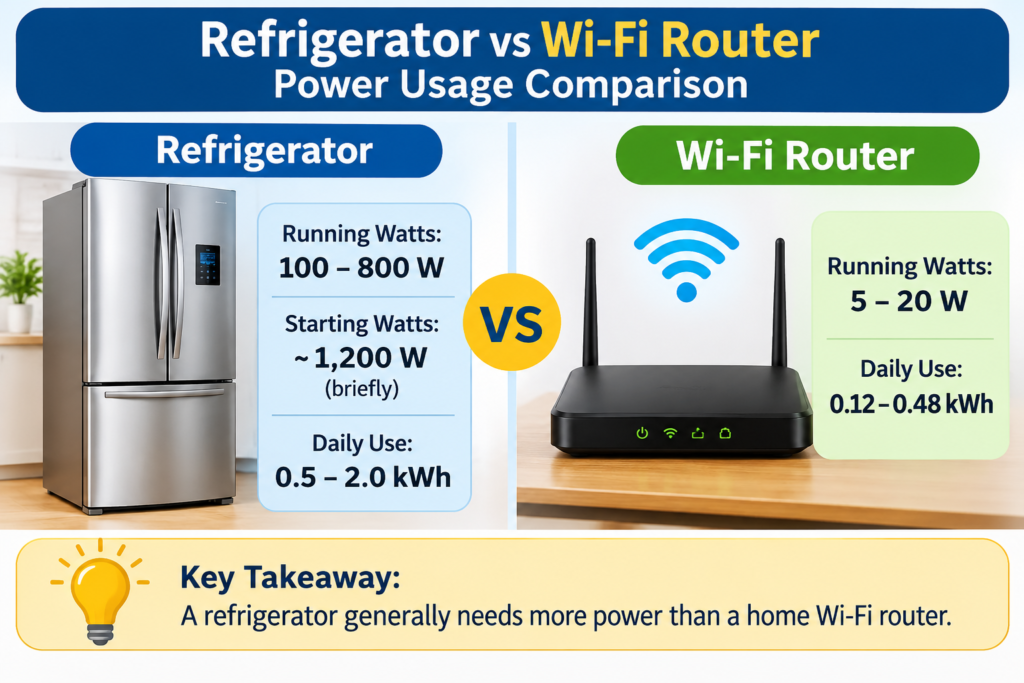
A typical household refrigerator may use approximately 100–800 watts while its compressor is operating, depending on its size, age, design, and operating conditions. However, this does not mean it consumes that amount continuously.
A refrigerator switches its compressor on and off to maintain a cool temperature. This process is called cycling. When the compressor stops, electricity consumption drops, although internal lights, controls, and other components may still use a small amount of power.
For example, a refrigerator rated at 200 watts does not necessarily consume 200 watts every minute of the day. Its actual daily energy consumption depends on how long the compressor operates.
When planning backup electricity, you should also understand starting watts. This is the extra power a motor may need briefly when it starts. A refrigerator can therefore require more power at startup than during normal operation.
Here is a useful distinction:
- Running watts: Electricity needed while the refrigerator operates.
- Starting watts: Additional short-term power needed when its compressor starts.
- Daily energy: The total electricity consumed over 24 hours, measured in watt-hours or kilowatt-hours.
For a reliable estimate, check the refrigerator’s specification label or manual rather than relying entirely on an online average.
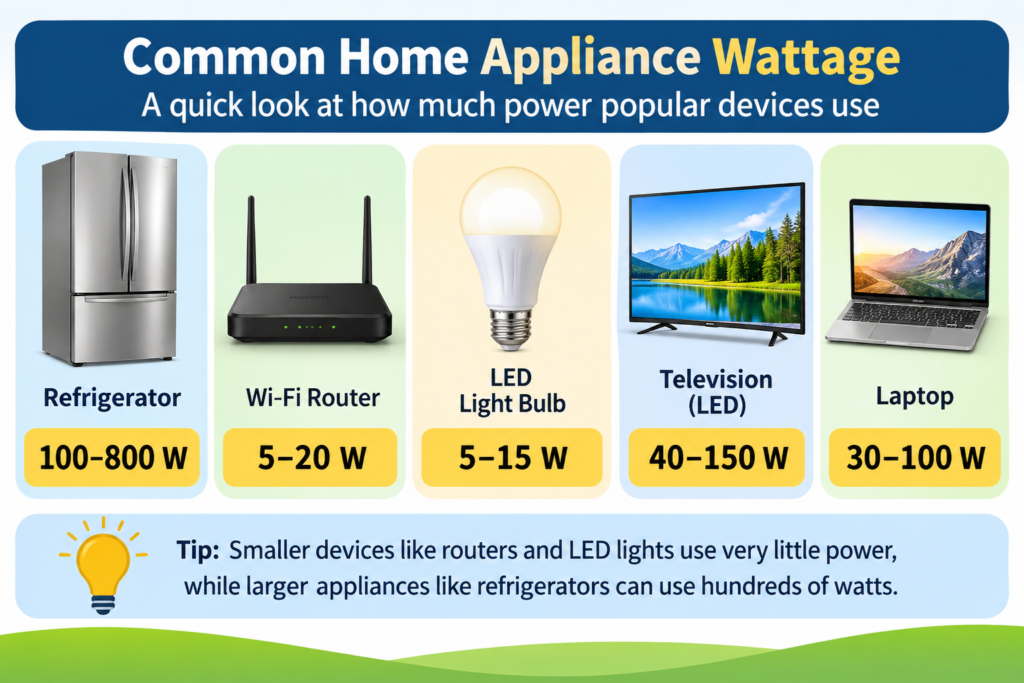
2. Family Appliance Wattage Chart: How Much Power Does Each Appliance Need?
A family appliance wattage chart gives you a quick starting point for understanding which devices use the most electricity. The following figures are approximate examples, not guaranteed ratings for every model.
Table caption: Estimated running wattage of common household appliances
| Household appliance | Approximate running watts |
|---|---|
| Refrigerator | 100–800 W |
| Wi-Fi router | 5–20 W |
| LED light bulb | 5–15 W |
| LED television | 40–150 W |
| Laptop | 30–100 W |
| Smartphone charger | 5–25 W |
| Ceiling fan | 40–100 W |
| Microwave | 750–1,500 W |
| Washing machine | 300–1,000 W |
| Electric kettle | 1,500–2,500 W |
| Hair dryer | 1,000–2,000 W |
| Electric space heater | 750–1,500 W |
These ranges help explain why running a refrigerator, router, and several LED lights is usually easier than operating an electric kettle, heater, or microwave at the same time.
Notice that appliances with heating elements often require considerably more power. A 2,000-watt kettle, for example, can demand more instantaneous power than several small electronic devices combined.
Your actual numbers may differ because manufacturers use different components and designs. Always check the rating printed on the appliance or its power adapter.
3. How Many Watts Does a Wi-Fi Router Use?
A typical home Wi-Fi router uses approximately 5–20 watts, making it one of the smaller electricity loads in most households. This is useful information if you want to maintain internet access during a power outage without using too much backup energy.
For example, a router consuming 10 watts continuously for 24 hours uses:
10 W × 24 hours = 240 Wh, or 0.24 kWh per day.
That is relatively little compared with an electric heater or microwave. However, remember that your internet connection may also depend on a modem, fiber equipment, or other network devices.
If you want to keep your internet working during an outage, check whether those additional devices need separate power. A router alone cannot provide internet access if the service provider’s network is unavailable.
Suggested source: Electrical Safety First — Ratings of electrical appliances (reason: provides indicative wattage figures for common appliances, including Wi-Fi routers).
4. Running Watts vs Starting Watts: What Is the Difference?
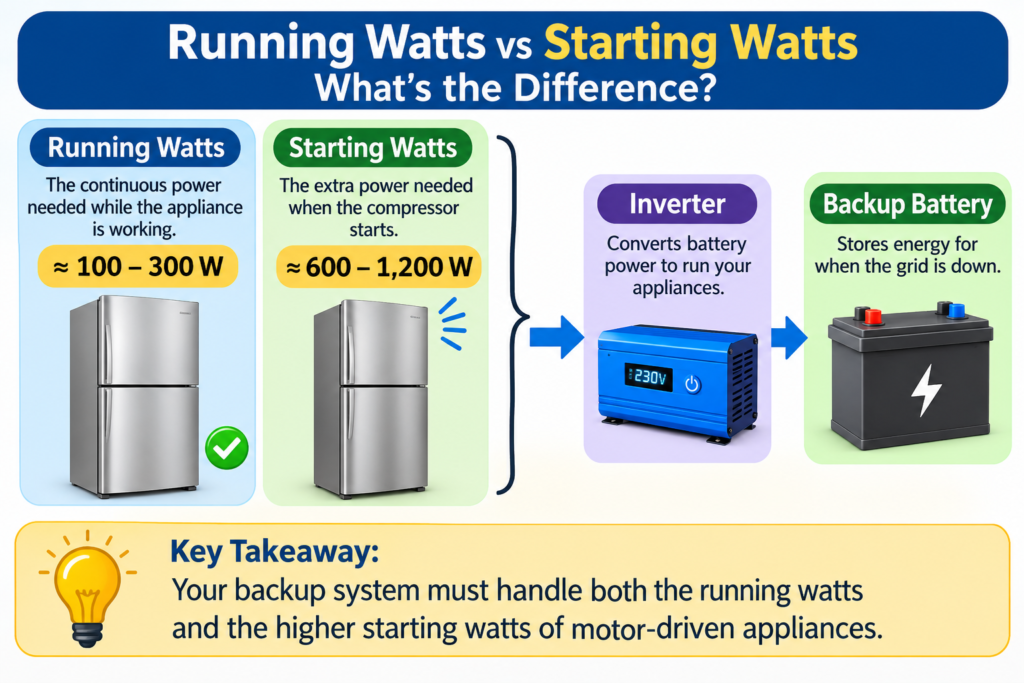
Running watts measure the continuous power an appliance needs to operate, while starting watts describe the additional short burst of power some motor-driven appliances need when switching on.
This difference matters when calculating the capacity of a backup power station, inverter, or generator. A refrigerator might operate normally at 200 watts but briefly require substantially more power when its compressor starts.
Imagine you want to operate a refrigerator, a 10-watt router, and four 10-watt LED lights.
Your approximate running load would be:
- Refrigerator: 200 W
- Wi-Fi router: 10 W
- Four LED lights: 40 W
- Total: 250 W
However, your backup system must also handle the refrigerator’s starting demand. That is why checking both running and starting specifications is important.
Diagram: Refrigerator + Wi-Fi router + LED lights → inverter → backup battery.
Planning Tip
Before selecting a backup system, write down the running watts of every appliance you want to operate together. Then identify which appliances have motors and may need additional starting power.
5. Realistic Limits: What This Solution Cannot Do
An appliance wattage chart is a planning guide, not a guarantee that your home will have electricity during every outage. Actual consumption changes with temperature, appliance condition, usage habits, and operating settings.
For example, a refrigerator may work harder in a hot room or when family members open its door frequently. Similarly, a battery that can supply 500 watts cannot automatically power every appliance with a combined demand above that level.
There is another important limitation: a grid-connected solar system without battery backup may shut down during a grid outage. This is a safety feature that prevents electricity from flowing into power lines while utility workers may be repairing them.
You should also remember that battery capacity and inverter power are different measurements. Battery capacity, usually expressed in kilowatt-hours (kWh), describes how much energy is stored. Inverter power, measured in watts, describes how much electricity can be delivered at one time.
6. How to Calculate Your Family’s Essential Appliance Power
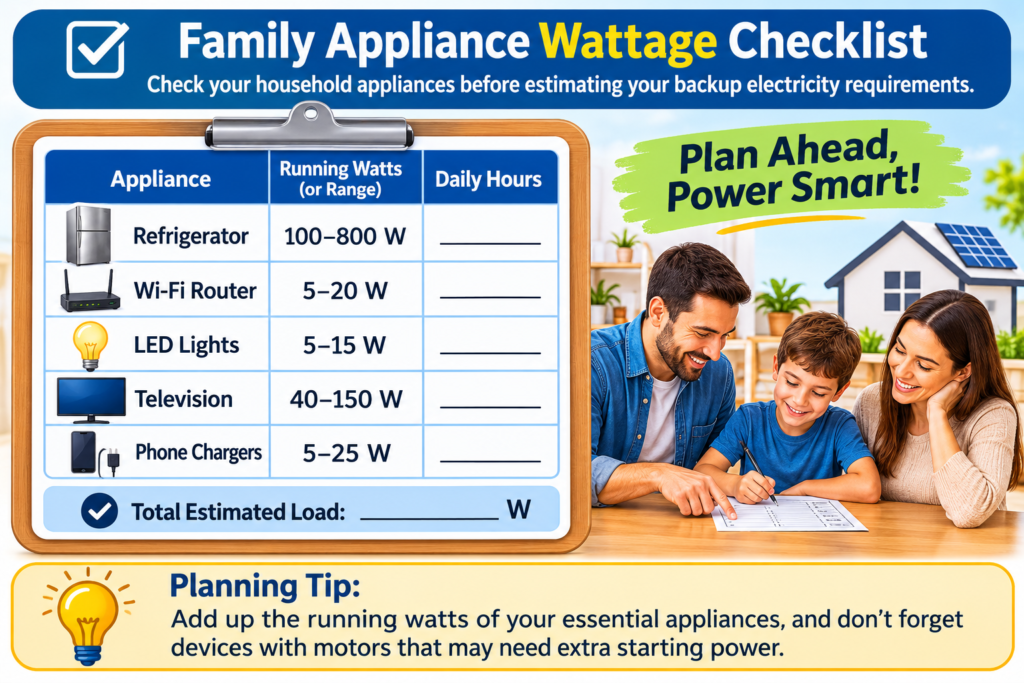
You can estimate your family’s essential electricity requirements in four simple steps without purchasing special equipment.
- Identify essential appliances: Start with your refrigerator, router, lights, and phone chargers.
- Record running watts: Check each appliance’s label or instruction manual.
- Calculate total running power: Add the watts of appliances you expect to operate simultaneously.
- Estimate daily energy: Multiply each appliance’s watts by its daily operating hours, then add the results.
For example, a 10-watt router operating for 24 hours uses 240 Wh daily. Four 10-watt LED bulbs operating for 5 hours use another 200 Wh. Together, these devices consume 440 Wh, or 0.44 kWh per day.
Use this simple checklist when collecting your household figures:
- Refrigerator wattage recorded.
- Wi-Fi router and modem wattage recorded.
- Number and wattage of LED lights counted.
- Phone chargers and television included.
- Running watts and starting watts checked where applicable.
- Daily operating hours estimated.
Related article: [How to Calculate Your Family’s Daily Electricity Use (Step by Step)] (use this guide to understand daily energy consumption).
Related article: [Which Appliances Matter Most? How to Build a Family Backup Power Plan] (use this next guide to prioritize essential appliances).
Suggested source: U.S. Department of Energy — Energy Saver (reason: provides neutral educational information about household energy use and efficiency).
Conclusion
Understanding how many watts does a refrigerator use and how much electricity other household appliances need makes family energy planning much easier. Start with your essential devices, compare their running and starting watts, and calculate their daily energy consumption.
If you have already read [How to Calculate Your Family’s Daily Electricity Use (Step by Step)], you can use those calculations alongside this appliance chart. Next, explore [Which Appliances Matter Most? How to Build a Family Backup Power Plan] to understand how to prioritize your household electricity needs. Good planning starts with information, not rushed purchases.
Frequently Asked Questions
1. How many watts does a refrigerator use per day?
A refrigerator’s daily energy consumption depends on its efficiency, size, and operating conditions. Check its energy label for kWh consumption. Multiply daily kWh by 1,000 to convert the result into watt-hours.
2. How many watts does a Wi-Fi router use?
Most home Wi-Fi routers use approximately 5–20 watts, depending on their model and features. A 10-watt router operating continuously for 24 hours consumes 240 watt-hours daily.
3. Do LED lights use less electricity than traditional bulbs?
Yes. A typical 8–10-watt LED bulb can provide brightness similar to a traditional 60-watt incandescent bulb, while using considerably less electricity.
4. What is the difference between running watts and starting watts?
Running watts describe the power an appliance needs during normal operation. Starting watts describe the additional short-term power some motor-driven appliances require when switching on.
5. Can a 1,000-watt backup power station run a refrigerator?
It depends on the refrigerator’s running demand, startup requirement, and the power station’s continuous and surge ratings. Its battery capacity also determines how long it can operate the refrigerator.
Want to learn more about solar energy, electricity savings, and home backup power? Visit Khamova for more practical guides, helpful tips, and easy explanations to help your family make smarter energy decisions.