9 Vertical Farming Technologies Every Modern Grower Should Know
Introduction
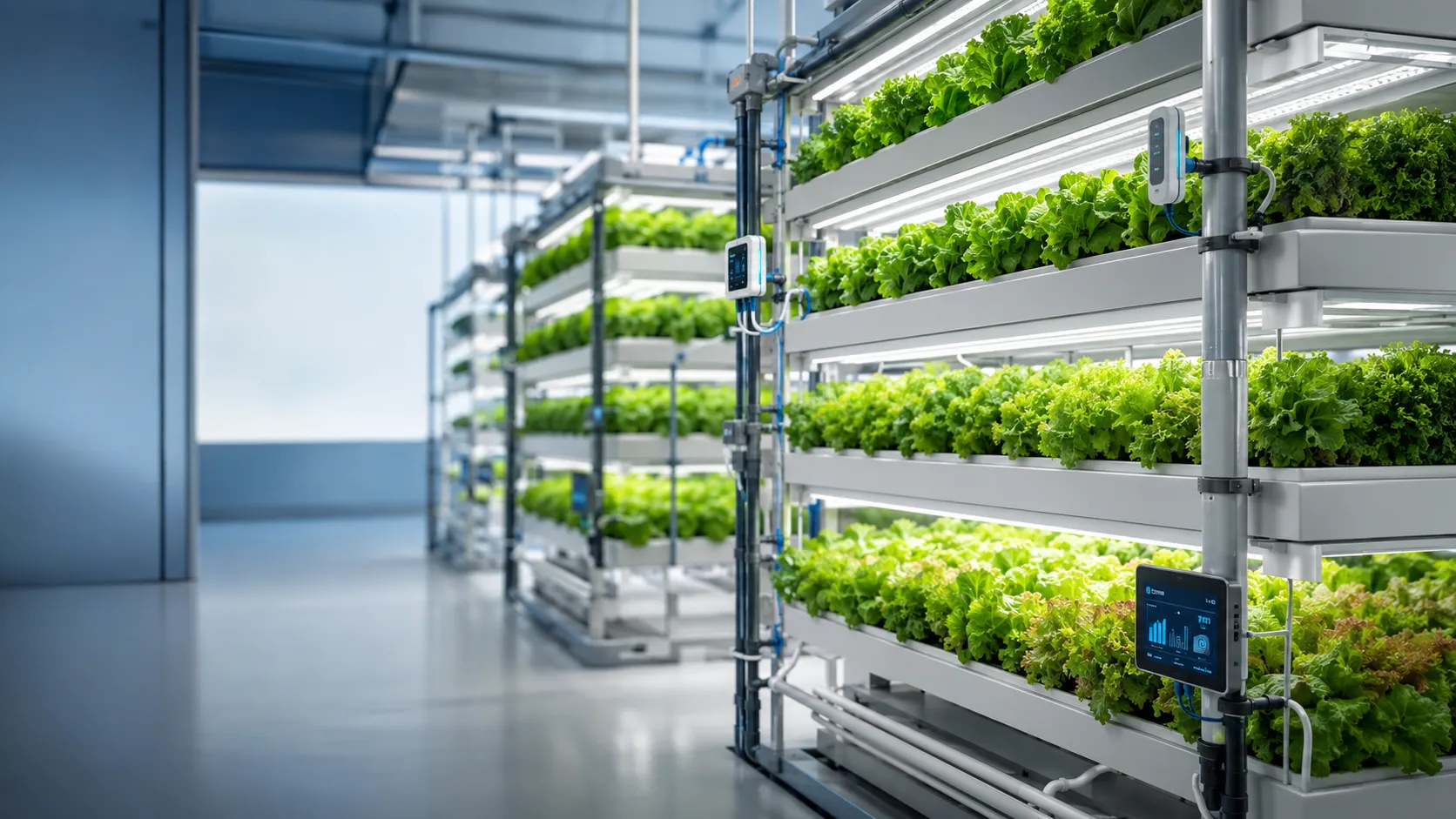
Modern agriculture is changing quickly. As growers face challenges such as limited land, unpredictable weather, water constraints, and growing demand for fresh produce, new approaches are helping farmers produce more from smaller spaces. Vertical farming technology is at the center of this shift, combining controlled environments, hydroponics, sensors, automation, efficient lighting, and data-driven crop management.
Unlike traditional farming, vertical farming grows crops in stacked layers rather than spreading plants across large areas of land. This approach can make productive use of warehouses, greenhouses, shipping containers, and other indoor spaces. It also gives growers greater control over important factors such as light, temperature, humidity, irrigation, and nutrients.
For beginners, however, the technology behind a vertical farm can seem complicated. There are different growing systems, lighting options, sensors, automation platforms, and energy-management strategies to consider. Understanding the major vertical farming technologies makes it easier to decide which solutions actually fit your crops, budget, and production goals.
This guide explores 9 vertical farming technology solutions every modern grower should know, explaining how each one works, where it provides value, and what challenges growers should consider before investing.
1. Hydroponic Vertical Farming Systems
Hydroponics is one of the most widely recognized approaches to vertical farming. Instead of growing plants directly in traditional soil, hydroponic vertical farming supplies roots with water containing carefully managed nutrients. Plants can be arranged in stacked towers, channels, shelves, or other vertical structures, allowing growers to produce crops in a relatively small footprint.
Several hydroponic methods can be used in vertical systems. Nutrient Film Technique, for example, moves a thin stream of nutrient solution along plant roots, while deep-water culture keeps roots in oxygenated nutrient-rich water. Other systems periodically flood and drain growing containers.
The main advantage is control. Growers can manage the nutrient solution, irrigation schedule, pH, and other growing conditions according to the needs of a particular crop. Because plants are grown in a controlled environment, growers can also reduce some of the variability associated with outdoor soil conditions.
Hydroponics can be particularly useful for leafy greens, herbs, and other crops that adapt well to controlled growing environments. A small indoor farm, for example, could use stacked hydroponic channels to grow lettuce throughout the year.
There are challenges, however. Hydroponic systems require pumps, reservoirs, plumbing, monitoring, and regular maintenance. A pump failure or nutrient imbalance can affect many plants quickly because multiple growing levels may depend on the same infrastructure.
Best suited for: growers producing leafy greens, herbs, microgreens, and other crops that perform well in soilless systems.
2. Aeroponic Farming Systems
Aeroponics takes soilless cultivation a step further. Instead of keeping plant roots in a nutrient solution, an aeroponic system suspends the roots and periodically sprays them with a fine nutrient-rich mist.
This creates an environment where roots have access to both moisture and oxygen. The principle sounds simple, but designing and maintaining an effective aeroponic system requires careful engineering.
One of the biggest attractions of aeroponics is its potential for highly precise root-zone management. Growers can control the timing and frequency of nutrient misting, while the exposed roots can receive substantial oxygen.
Aeroponic systems can also fit naturally into vertical structures because plants can be arranged in towers or enclosed growing chambers. This makes them interesting for growers who want to maximize production in limited floor space.
The downside is complexity. Spray nozzles can clog, pumps can fail, and the system needs reliable monitoring. Because roots depend heavily on the misting system, interruptions can become serious if they are not detected quickly.
For a beginner, aeroponics may require more technical knowledge than a straightforward hydroponic system. However, growers who are comfortable with automation and monitoring can find it an attractive option.
Best suited for: technologically advanced growers, research operations, and commercial farms seeking precise root-zone control.
3. LED Grow Light Technology
Lighting is fundamental to indoor agriculture because plants need light for photosynthesis. When natural sunlight is limited or unavailable, LED grow lights provide the artificial light necessary for crop growth.
Modern LED systems can be designed around different light intensities and spectral characteristics. Instead of simply illuminating a growing area, growers can configure lighting schedules and intensity according to crop requirements and growth stages.
One important benefit of LEDs is that they can provide efficient artificial lighting while producing less unwanted heat than some older lighting technologies. That matters in vertical farms because excessive heat can increase the cooling burden.
LED lighting can also be installed close to plants, which is useful when crops are grown on multiple stacked levels. Properly designed lighting therefore becomes an essential component of many indoor farming technology systems.
However, lighting remains one of the major energy considerations for indoor farms. Running hundreds or thousands of lights for long periods can create substantial electricity demand. Growers must therefore consider electricity costs, lighting efficiency, heat management, crop requirements, and operating schedules before choosing a system.
A small indoor herb farm might use adjustable LED fixtures above each growing shelf, allowing the operator to provide consistent lighting even when the building receives little natural sunlight.
Best suited for: indoor growers, vertical farms, greenhouse operators supplementing sunlight, and growers producing crops indoors year-round.
4. Automated Irrigation and Nutrient Delivery
Watering plants manually becomes increasingly difficult as a vertical farm grows. Automated irrigation and nutrient-delivery systems solve this problem by delivering water and nutrients according to predefined schedules or sensor-based conditions.
A typical system may include pumps, reservoirs, filters, pipes, valves, injectors, and controllers. The system can distribute nutrient solution to multiple growing levels while reducing the need for workers to manually water individual plants.
More advanced systems can connect irrigation with sensors. For example, a controller might adjust irrigation based on environmental measurements, crop requirements, or a predetermined growing schedule.
Automation provides consistency, which is especially valuable when hundreds or thousands of plants are being cultivated. It can also reduce repetitive labor and make it easier to maintain standardized growing conditions.
But automation does not eliminate maintenance. Pumps need inspection, filters can become blocked, pipes can leak, and sensors may require calibration. A good automated system should therefore include alerts and backup procedures.
Imagine a grower managing several vertical shelves of basil. Instead of manually watering each shelf, an automated system can distribute nutrient solution at scheduled intervals and notify the grower if a pump stops operating.
Best suited for: commercial growers, larger indoor farms, and growers who want to reduce repetitive irrigation tasks.
5. Climate and Environmental Control Systems
Plants respond strongly to their surrounding environment. Temperature, humidity, airflow, carbon dioxide concentration, and other environmental factors can influence plant development and crop quality.
Climate-control systems allow growers to manage these variables inside a controlled growing environment. Depending on the facility, equipment may include heating and cooling systems, ventilation, dehumidifiers, humidifiers, fans, and environmental controllers.
This technology is an important part of controlled environment agriculture, because the goal is to create conditions that remain within a suitable range for the crop rather than leaving growth entirely to outdoor weather.
The benefit is predictability. A grower can reduce the impact of heat waves, cold nights, heavy rain, or other outdoor conditions. This is especially valuable for indoor farms operating in regions where seasonal weather makes consistent production difficult.
The challenge is energy consumption and system complexity. Heating, cooling, and dehumidification can require significant electricity, particularly in large indoor facilities. Poorly designed environmental systems can therefore increase operating costs.
Growers should avoid thinking about climate control as simply making a room warmer or cooler. The best systems coordinate temperature, humidity, airflow, lighting, and irrigation as interconnected parts of the growing environment.
Best suited for: indoor farms, commercial vertical farms, greenhouse operations, and growers producing crops with specific environmental requirements.
6. IoT Sensors and Real-Time Crop Monitoring
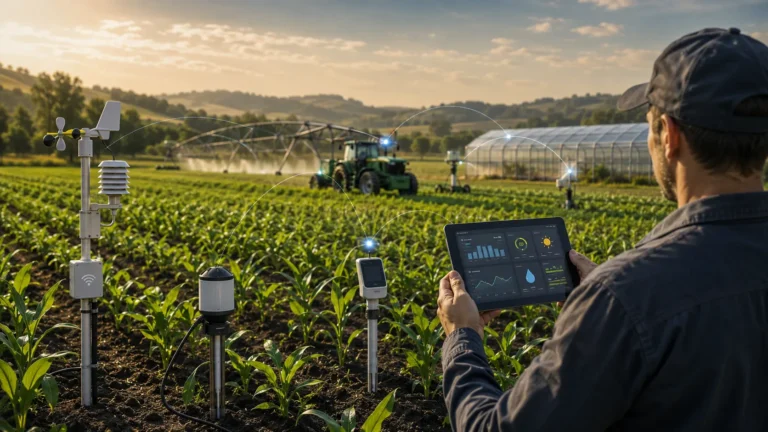
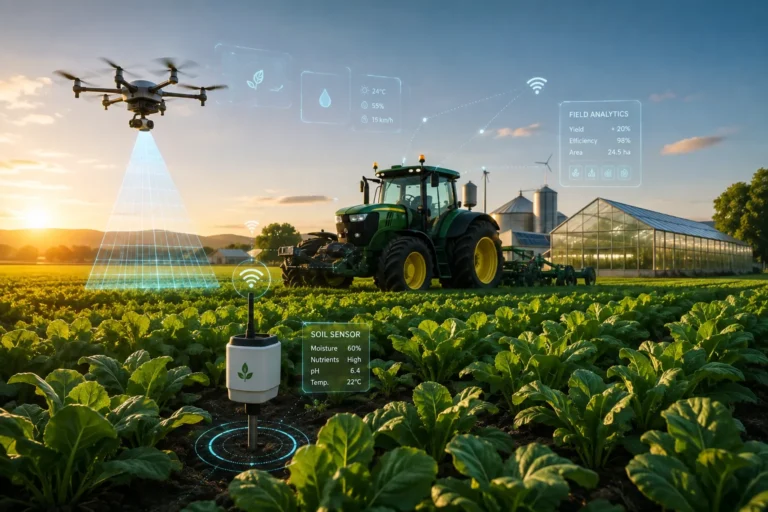
Sensors are the eyes and ears of a modern vertical farm. IoT sensors can collect information about environmental and growing conditions and send that information to a central platform for monitoring.
Depending on the system, sensors can measure variables such as temperature, humidity, light intensity, water conditions, electrical conductivity, pH, and other useful parameters.
Instead of walking through every growing area to manually check conditions, a grower can view measurements through a dashboard. If humidity rises unexpectedly or a nutrient solution moves outside a desired range, the system can potentially alert the operator.
This is where smart farming technology becomes especially useful. Data collected from different parts of the farm can help growers identify problems earlier and make decisions based on measurements rather than guesswork.
Sensors also become more valuable as the farm grows. Checking five plants manually is easy. Checking thousands of plants across multiple growing levels is a completely different task.
The main limitations are cost, sensor quality, calibration, connectivity, and data management. A sensor that provides inaccurate readings can lead to poor decisions. Growers therefore need reliable equipment and a clear understanding of what each measurement actually means.
For example, temperature and humidity sensors placed at different levels of a vertical rack could reveal that the top shelf is warmer than the bottom shelf, allowing the grower to adjust airflow.
Best suited for: growers who want real-time visibility, commercial operations, and farms using connected automation systems.
7. AI and Data Analytics for Crop Management
Once a vertical farm starts collecting large amounts of data, another question appears: what should the grower do with all of it?
Artificial intelligence and data analytics can help transform raw measurements into useful information. Instead of simply showing temperature, humidity, lighting, and irrigation data, an analytics platform can help identify patterns and unusual conditions.
For example, historical crop data might reveal that a particular combination of temperature, humidity, and lighting is associated with better growth. Analytics can also help identify trends in energy consumption or detect unusual changes that deserve investigation.
AI-powered computer vision is another developing area. Cameras can potentially be used to monitor plant appearance, identify visible stress indicators, estimate growth, or detect differences between plants.
However, AI is not a magic replacement for agricultural knowledge. The quality of the output depends heavily on the quality and relevance of the underlying data. A system trained on inappropriate data or poorly configured measurements can produce misleading recommendations.
For beginners, the best approach is often to start with simple analytics. Track crop cycles, environmental conditions, water use, energy consumption, and yields before investing heavily in sophisticated AI systems.
Best suited for: commercial growers, data-focused farms, research operations, and operators managing large amounts of crop information.
8. Robotics and Farm Automation
As vertical farms become larger and more sophisticated, labor can become a major operational consideration. Robotics and vertical farm automation can help handle repetitive activities such as transporting trays, seeding, transplanting, harvesting, or moving crops between production areas.
Automation does not necessarily mean replacing every human task. In many cases, the most useful approach is to automate repetitive physical work while keeping people responsible for crop decisions, quality control, maintenance, and problem-solving.
Robotic systems can also improve consistency. A machine can perform a repetitive movement at the same speed and follow the same programmed process across many production cycles.
The challenge is cost. Robotics can require significant investment in equipment, software, infrastructure, maintenance, and staff training. Automation also makes more sense for some crops and farm layouts than others.
A small startup growing several hundred plants may find manual handling perfectly practical. A large commercial facility handling thousands of trays every day may have a stronger reason to investigate automated transportation or harvesting systems.
Best suited for: medium-to-large commercial farms, high-volume production facilities, and operations with repetitive labor-intensive workflows.
9. Smart Energy and Water Management
Energy and water management are critical parts of any modern vertical farm. Technology can make crop production more controlled, but pumps, lighting, cooling, ventilation, and climate equipment all require resources.
Smart energy-management systems can monitor electricity consumption across different parts of a facility. Growers can use this information to identify which systems consume the most energy and where operational improvements may be possible.
Water management is equally important. Recirculating hydroponic systems can reuse nutrient solutions rather than continuously supplying fresh water, although water still needs to be monitored and managed appropriately.
Smart controllers can also coordinate equipment. For example, lighting schedules can be integrated with environmental controls, while irrigation can be linked to crop schedules or sensor readings.
Renewable energy can be another part of the strategy where practical. Solar power, energy storage, efficient HVAC systems, and optimized lighting can potentially help reduce reliance on conventional electricity, depending on the farm’s location and economics.
The key limitation is that energy efficiency does not automatically happen because a farm uses advanced technology. Growers need to measure consumption, understand their biggest energy loads, and optimize the system continuously.
Best suited for: commercial vertical farms, energy-conscious growers, facilities with high electricity demand, and farms seeking long-term operating efficiency.
Benefits of Using Vertical Farming Technology
The real value of vertical farming technology comes from how different systems work together. A hydroponic system alone can grow plants without soil, but combining it with automated irrigation, LED lighting, environmental controls, sensors, and data analytics can create a much more sophisticated production environment.
1. Better Use of Limited Space
Vertical growing allows plants to be arranged in stacked layers. Instead of expanding production horizontally across more farmland, growers can potentially increase production capacity within an existing building or growing area.
This can be especially useful in urban environments where land is expensive or limited.
2. More Controlled Growing Conditions
Controlled environment agriculture allows growers to manage variables that would normally be influenced by outdoor weather. Temperature, humidity, irrigation, lighting, and other conditions can be adjusted to suit the crop.
Greater control can make production more predictable, although it also means growers must manage the technology carefully.
3. Reduced Dependence on Weather
Outdoor agriculture is exposed to heat, cold, storms, drought, and other weather events. Indoor vertical farming can reduce direct exposure to these conditions.
This does not make indoor farms completely independent of the outside world, since they still depend on electricity, water, equipment, and other infrastructure.
4. More Efficient Water Management
Many vertical farming systems use recirculating growing methods. Water can move through the growing system and be collected, monitored, and reused rather than being continuously lost to soil or runoff.
Actual water performance depends on the system design, crop, climate, operating practices, and water-management strategy.
5. Potential for Year-Round Production
Because vertical farms can operate inside controlled environments, growers are less dependent on traditional outdoor growing seasons.
With suitable lighting, temperature control, irrigation, and crop planning, production can potentially continue throughout the year.
This can be particularly useful for crops with relatively short growth cycles and consistent demand.
How to Choose the Right Vertical Farming Technology
There is no universal technology package that works for every grower. A small beginner operation has very different requirements from a commercial vertical farm supplying supermarkets.
Before investing, consider the following factors.
Farm Size and Available Space
Start by measuring the space you actually have. A compact growing room may work well with simple racks and hydroponics, while a larger facility could justify sophisticated environmental controls and automation.
Think vertically, but do not ignore access. Every growing level needs to be accessible for planting, inspection, maintenance, and harvesting.
Budget
Technology costs extend beyond the initial purchase price.
Consider:
- Equipment and installation
- Electricity
- Water
- Nutrients
- Maintenance
- Replacement parts
- Software subscriptions
- Labor
- Training
A basic system that you understand and maintain well can be more valuable than an expensive system packed with features you rarely use.
Crop Type
Your crop should influence your technology choices.
Leafy greens and herbs can work well with many hydroponic systems, while crops with different growth structures may require different spacing, lighting, support, or irrigation arrangements.
Start with the crop rather than starting with the technology.
Energy Requirements
Lighting, cooling, heating, pumps, fans, and dehumidification can all contribute to energy demand.
Before purchasing equipment, estimate how much electricity the system may require and investigate the local electricity rate. Energy can be one of the most important operating costs in indoor agriculture.
Desired Level of Automation
Decide how much work you want technology to handle.
A beginner might automate irrigation while manually handling planting and harvesting. A commercial facility may eventually automate transportation, environmental control, crop monitoring, and other processes.
Automation should solve a real operational problem rather than exist simply because it looks impressive.
Maintenance and Technical Skills
Every additional component creates another potential maintenance requirement.
Ask yourself:
- Can you troubleshoot the system?
- Are replacement parts readily available?
- Can you calibrate the sensors?
- What happens if a pump fails?
- Is there a backup plan for power interruptions?
A technology is only useful when you can keep it operating reliably.
Final Thoughts
Vertical farming technology is transforming how growers think about space, resources, and crop production. Hydroponics and aeroponics provide alternative growing methods, LED grow lights supply controlled illumination, automated irrigation delivers water and nutrients, and environmental systems help maintain suitable growing conditions.
Sensors, AI, robotics, and smart resource management take the concept even further by connecting physical growing systems with data and automation.
But modern technology should not be adopted simply because it is new. The best vertical farming system is the one that matches your crops, available space, budget, energy resources, technical skills, and production goals.
For beginners, starting small can be a smart strategy. Learn how one system works, monitor your results, identify the biggest operational challenges, and add automation or advanced analytics when they provide a clear benefit.
As agriculture continues moving toward more controlled, connected, and resource-conscious production, understanding these vertical farming technologies can help modern growers make better decisions and build farms that are both practical and adaptable.
SEO Details
SEO Title:
9 Vertical Farming Technology Solutions for Growers
Meta Description:
Discover 9 vertical farming technology solutions, from hydroponics and LED lights to IoT sensors and automation, for smarter and sustainable growing.
URL Slug:/vertical-farming-technology/
Focus Keyword:vertical farming technology
Secondary Keywords:
vertical farming systemsvertical farming technologiesindoor farming technologyhydroponic vertical farmingsmart farming technologyautomated farmingcontrolled environment agriculturevertical farm automation
FAQs
What is vertical farming technology?
Vertical farming technology refers to the equipment, systems, software, and methods used to grow crops in stacked or vertically arranged growing environments. It can include hydroponics, aeroponics, LED lighting, sensors, automation, climate control, and data analytics.
Is vertical farming suitable for beginners?
Yes. Beginners can start with relatively simple hydroponic or vertical growing systems before moving toward advanced automation. Starting small makes it easier to understand irrigation, lighting, nutrients, and environmental management.
What is the most important technology in a vertical farm?
There is no single technology that is best for every farm. Hydroponics, lighting, irrigation, environmental controls, and monitoring systems all play important roles, but the right combination depends on the crop and production environment.
Does vertical farming use less water?
Many vertical farming systems can use water efficiently, particularly recirculating hydroponic and aeroponic systems. Actual water savings depend on system design, crop type, climate, maintenance, and how effectively water is recovered and reused.
Can vertical farming operate year-round?
Introduction
As agriculture faces rising land costs, water shortages, unpredictable weather, and growing demand for fresh food, growers are looking for smarter ways to produce crops. Vertical farming technology offers one promising answer by allowing plants to grow in stacked layers inside highly controlled environments. Instead of relying entirely on large outdoor fields, modern growers can combine hydroponic farming, LED lighting, sensors, automation, and data-driven crop management to make better use of limited space.
The appeal goes beyond simply growing plants upward. Modern vertical farming systems can carefully control light, temperature, humidity, water, nutrients, and airflow. This makes indoor farming more predictable and gives growers greater control over the conditions their crops experience throughout the growing cycle.
For beginners and experienced growers alike, understanding the technology behind these systems is essential. Here are nine important technologies shaping the future of vertical farming.
1. Hydroponic Vertical Farming Technology
Hydroponics is one of the most widely used technologies in modern vertical farms. Instead of growing plants directly in soil, hydroponic systems deliver water and dissolved nutrients directly to plant roots. Crops can grow in channels, trays, towers, or other structures designed to maximize the available growing area.
There are several hydroponic approaches, including nutrient film technique, deep-water culture, and drip irrigation. Each method has different requirements for water circulation, oxygenation, nutrient delivery, and crop support.
The biggest advantage is resource efficiency. Water can be collected, filtered, and recirculated rather than continuously flowing through the growing area. Because nutrients are delivered directly to the roots, growers can also control plant nutrition more precisely.
For modern growers, hydroponics provides a practical foundation for vertical farming technology. When selecting a system, consider crop type, available space, pump reliability, maintenance requirements, and the cost of replacing components.
2. Aeroponics for High-Efficiency Growing
Aeroponics takes soilless cultivation a step further. In an aeroponic system, plant roots are suspended in the air while fine nutrient-rich mist is delivered directly to them. The roots receive water and nutrients without being submerged in a growing medium.
This approach can provide excellent oxygen exposure to the root zone, which may support rapid growth when the system is correctly managed. However, aeroponics also requires precise control. If pumps, nozzles, or power systems fail, plants can become stressed quickly because their exposed roots have limited access to moisture.
For this reason, aeroponics is particularly interesting for advanced indoor agriculture operations where reliability and environmental control are priorities. Growers considering the technology should budget for backup power, filtration, nozzle maintenance, and monitoring equipment.
The key lesson is simple: aeroponics can be highly efficient, but it rewards careful management.
3. LED Grow Lights and Intelligent Lighting
Light is one of the most important inputs in any indoor farm. Since plants cannot depend on natural sunlight inside a building, growers use artificial lighting to provide the energy needed for photosynthesis.
Modern LED grow lights have transformed indoor cultivation because they can deliver consistent illumination while using less energy than many older lighting technologies. Growers can adjust lighting intensity and, depending on the system, use different light spectra to support specific stages of plant development.
Intelligent lighting systems can also automate schedules. Instead of manually switching lights on and off, a controller can manage photoperiods according to crop requirements.
When investing in lighting, growers should look beyond the purchase price. Energy consumption, heat generation, coverage, durability, dimming capability, and controllability all affect long-term operating costs.
For commercial growers, lighting can become one of the largest energy expenses, making efficient lighting a central part of sustainable vertical farming technology.
4. Smart Sensors and Crop Monitoring
A successful indoor farm depends on knowing what is happening inside the growing environment. Agricultural sensors make this possible by continuously measuring important conditions such as temperature, humidity, pH, electrical conductivity, light levels, carbon dioxide, and moisture.
Instead of checking every growing area manually, growers can use sensors to collect real-time information. A central dashboard can then display the data and highlight unusual changes.
This is where crop monitoring becomes especially valuable. Imagine a growing room where humidity suddenly increases. A smart system can detect the change before the grower notices visible problems and potentially trigger ventilation or send an alert.
Useful sensor categories include:
- Temperature and humidity sensors
- pH and nutrient sensors
- Water-level sensors
- Light sensors
- CO₂ sensors
- Environmental monitoring devices
For modern growers, sensors turn an indoor farm from a collection of equipment into a measurable production environment. When implementing vertical farming technology, sensor accuracy and calibration should be treated as essential rather than optional.
5. Automated Irrigation and Nutrient Delivery
Automation helps growers manage repetitive tasks with greater consistency. In vertical farms, automated irrigation systems can deliver water and nutrients according to predefined schedules or sensor readings.
A basic system might use pumps, timers, reservoirs, valves, pipes, and drip emitters. More advanced systems can adjust irrigation based on environmental data and crop requirements.
Automation offers several practical benefits. It can reduce manual labor, improve consistency, prevent unnecessary watering, and help growers manage larger farms without increasing labor at the same rate.
However, automation should not mean ignoring the farm. Pumps can fail, pipes can clog, and sensors can provide inaccurate readings. A good automated farming setup should therefore include alarms, backup systems, and routine inspections.
This combination of automation and human oversight is a major component of modern smart farming.
6. Climate Control and Controlled Environment Agriculture
One of the defining characteristics of vertical farming is the ability to control the growing environment. Controlled environment agriculture (CEA) uses equipment and software to regulate conditions such as temperature, humidity, airflow, light, and carbon dioxide.
Heating, ventilation, air conditioning, dehumidifiers, fans, and air circulation systems can work together to create a stable environment. This matters because plants respond strongly to environmental conditions.
For example, excessive humidity can increase the risk of certain plant diseases, while insufficient airflow can create uneven growing conditions. Temperature fluctuations can also affect plant development and crop quality.
Effective climate control makes vertical farming technology much more than stacked shelves with lights. It creates a carefully managed ecosystem in which growers can establish repeatable growing conditions.
Before installing a system, calculate the building’s insulation, ventilation requirements, cooling load, electricity availability, and expected operating costs. Energy-efficient climate equipment can make a significant difference to profitability.
7. AI and Data-Driven Farm Management
Modern farms generate enormous amounts of information. Sensors record environmental conditions, cameras capture plant images, and automated systems track irrigation, lighting, and climate data. Artificial intelligence and data analytics can help growers turn this information into useful decisions.
For example, image-based crop monitoring can potentially identify changes in leaf color, plant size, or growth patterns. Data analysis can also reveal relationships between environmental conditions and crop performance.
Instead of relying entirely on intuition, growers can compare historical data and identify trends. Over time, this can help optimize lighting schedules, irrigation strategies, nutrient levels, and environmental settings.
AI does not eliminate the need for agricultural knowledge. Rather, it can act as another tool in the grower’s toolbox.
As smart agriculture technology continues to develop, data-driven management will likely become increasingly important for commercial indoor farms seeking consistent yields and efficient resource use.
8. Robotic and Automated Farming Systems
Labor is an important consideration in commercial agriculture. Robotic technology can help automate repetitive activities such as seeding, transplanting, crop movement, inspection, harvesting, and packaging.
Automated farming systems can use conveyors, robotic arms, machine vision, and software to move products through different stages of production. In a large indoor facility, automation can reduce the amount of manual movement required between growing areas.
The technology is especially useful where farms operate at high density. Workers may otherwise spend significant time moving trays or inspecting large numbers of plants.
However, robotics can involve substantial upfront investment. Growers should first identify tasks that consume the most labor and determine whether automation will provide a realistic return on investment.
The best approach is not necessarily to automate everything. Strategic automation can make a farm more efficient while keeping skilled human workers focused on crop health, planning, maintenance, and quality control.
9. IoT Connectivity and Integrated Vertical Farming Technology
The final piece of the modern indoor farming puzzle is connectivity. Internet of Things (IoT) technology allows sensors, controllers, lighting systems, irrigation equipment, climate systems, and software platforms to communicate with one another.
Instead of operating independently, connected devices can form an integrated growing system. A sensor might detect changing humidity, for example, while the control system responds by adjusting ventilation.
Remote monitoring can also give growers access to farm information from a smartphone, tablet, or computer. This can be particularly useful for commercial operations where staff need to oversee multiple growing rooms.
The real value of connected vertical farming technology comes from integration. A farm becomes more responsive when its different systems can exchange information and act based on real-time conditions.
When choosing IoT equipment, look at compatibility, cybersecurity, data ownership, connectivity reliability, software support, and the ability to expand the system as the farm grows.
How to Choose the Right Vertical Farming Technology
Not every grower needs the most advanced system available. A small indoor farm growing leafy greens may need reliable LED lights, hydroponics, environmental sensors, and basic automation, while a commercial operation may benefit from robotics, AI, advanced climate control, and integrated IoT platforms.
Start with the crop rather than the equipment. Different plants have different requirements for light, temperature, humidity, nutrients, root space, and growth cycles.
It is also important to calculate operating costs before investing. Equipment may look affordable initially, but electricity, water treatment, replacement parts, maintenance, software subscriptions, and labor can significantly affect the total cost.
A practical evaluation should consider:
- Crop requirements: Does the system suit the plants you want to grow?
- Energy use: How much electricity will lighting, pumps, HVAC, and automation require?
- Water efficiency: Can water and nutrients be recirculated effectively?
- Scalability: Can you expand the system later?
- Maintenance: Are components easy to clean, repair, and replace?
- Automation: Which repetitive tasks are worth automating?
- Data: Can you monitor important growing conditions accurately?
The best vertical farming technology is not necessarily the newest or most expensive. It is the technology that solves a specific production problem while fitting your budget, crop strategy, labor resources, and long-term goals.
Benefits of Modern Vertical Farming Systems
When these technologies work together, vertical farming systems can offer several advantages over conventional growing approaches. Crops can be produced in locations where farmland is limited, while controlled environments can reduce exposure to extreme outdoor weather.
Indoor agriculture can also bring production closer to consumers, potentially reducing transportation distances for certain crops. Water recirculation, precise nutrient delivery, and targeted lighting can help growers use resources more strategically.
Another major benefit is consistency. A controlled environment gives growers more opportunities to establish repeatable conditions from one crop cycle to the next.
Still, vertical farming is not automatically sustainable. Electricity demand, equipment manufacturing, building requirements, and climate-control needs all matter. The sustainability of an operation depends on how efficiently its systems are designed and where its energy comes from.
That is why sustainable agriculture should focus on the complete production system rather than one technology in isolation.
Conclusion
The future of indoor agriculture is being shaped by a combination of technologies rather than a single breakthrough. Hydroponics and aeroponics provide efficient growing methods, while LED grow lights, sensors, climate controls, automation, AI, robotics, and IoT connectivity create increasingly sophisticated production environments.
For modern growers, understanding vertical farming technology makes it easier to choose equipment based on real production needs rather than hype. Start small where appropriate, measure results carefully, and prioritize systems that improve resource efficiency, crop consistency, and operational control.
As smart farming continues to evolve, vertical farms will become increasingly data-driven and automated. The growers who understand how these technologies work—and how they fit together—will be better positioned to build productive, efficient, and resilient growing operations.
Frequently Asked Questions
1. What is vertical farming technology?
Vertical farming technology refers to the equipment, systems, and digital tools used to grow crops in stacked indoor or controlled environments. It can include hydroponics, aeroponics, LED lighting, sensors, climate control, automation, robotics, and IoT platforms.
2. Is vertical farming suitable for beginners?
Yes. Beginners can start with relatively simple systems such as small hydroponic setups, LED grow lights, and basic environmental sensors. Starting with a manageable crop and learning how to control water, nutrients, lighting, and climate can provide a strong foundation before investing in advanced automation.
3. What crops work best in vertical farms?
Leafy greens, herbs, microgreens, and some small fruiting crops are commonly considered suitable for indoor growing. The best crop depends on the available lighting, growing system, climate controls, market demand, and operating costs.
4. Does vertical farming use less water?
Many vertical farms use recirculating systems that capture and reuse water. Hydroponic and aeroponic systems can therefore be highly water-efficient, although actual water savings depend on system design, crop choice, climate control, and farm management.
5. What is the most important technology for a vertical farm?
There is no single technology that is best for every operation. A successful farm typically needs several systems working together. Reliable growing infrastructure, efficient lighting, accurate environmental monitoring, water and nutrient management, and appropriate automation are all important foundations.
For more information click here